
Trump, Xi Speak On Call Over Agreement To Keep TikTok Online In US
- Date & Time:
- |
- Views: 74
- |
- From: India News Bull
Trump and Xi Jinping spoke on Friday as they seek an agreement to help keep TikTok online in US
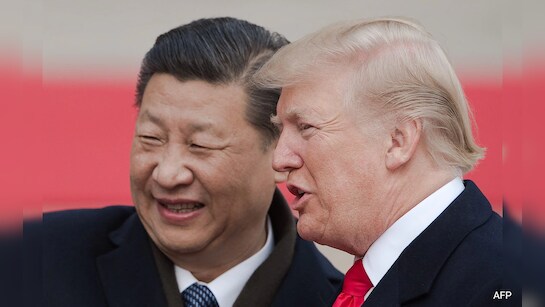
Chinese state media confirmed Presidents Donald Trump and Xi Jinping engaged in a telephone conversation on Friday, as the two leaders work toward an agreement to maintain TikTok's operations in the United States and ease escalating tensions between the two global superpowers currently at odds over trade issues.
The conversation marks their first known communication in three months, with TikTok's future and trade relations topping the agenda. The report from China's state broadcaster CCTV provided no specific details about their discussion, and the White House did not immediately offer comment when requested.
This effort to stabilize relations comes amid discussions about a potential face-to-face summit between the two leaders during the upcoming Asia-Pacific Economic Cooperation (APEC) summit scheduled for October 30-November 1 in South Korea, according to Reuters reports.
Beijing's final endorsement of a framework agreement reached earlier this week represents a crucial step toward keeping TikTok operational in the US. Congress had mandated the application's shutdown for American users by January 2025 unless Chinese owner ByteDance divested its US assets.
While Trump has delayed enforcing the legislation as his administration seeks a new ownership structure, he has also expressed concern that banning the popular platform could alienate its massive user base and disrupt political communications channels.
"I like TikTok; it helped get me elected," Trump stated during Thursday's press conference. "TikTok has tremendous value. The United States has that value in its hand because we're the ones that have to approve it."
Several critical aspects of the proposed arrangement remain unresolved, including the precise ownership structure, China's level of control, and whether Congress will ultimately approve the deal.
According to Reuters reporting, the agreement would transfer TikTok's US assets from ByteDance to American owners. Sources familiar with the negotiations indicated that the US TikTok operation would continue utilizing ByteDance's algorithm.
This arrangement has raised concerns among lawmakers who fear Beijing could potentially conduct surveillance on Americans or implement influence operations through the platform. Chinese officials have consistently maintained there is no evidence supporting claims that the app poses national security threats.
Trump has framed his foreign policy approach as focused on peace-seeking and deal-making, though relations between the world's two largest economies remain strained.
"We're pretty close to a deal," Trump remarked on Thursday, apparently referring to broader trade negotiations. "We may do an extension with China, but it's an extension based on the same terms that we have right now, which are pretty good terms."
Additional key issues include competition in semiconductors and advanced technologies. The United States is seeking increased Chinese purchases of American soybeans and Boeing aircraft.
Washington is also pressing Beijing to restrict exports of fentanyl-related chemicals, which contribute significantly to US overdose deaths. Chinese officials have accused the US of misrepresenting this issue.
Recent economic data indicates slowing growth in both China and the United States.
Since returning to office in January, Trump has implemented substantial tariff increases across various sectors, with particularly punitive rates targeting China's export-driven economy. China responded with reciprocal measures, resulting in tariff rates on both sides reaching triple-digit percentages by April.
A series of limited agreements since May has temporarily halted the escalating tariff war between the two nations.
These agreements also set aside disputes that had led China to restrict rare-earth magnets essential for American high-tech manufacturing. Previously, Trump had blocked Chinese access to semiconductor design software, jet engines, and certain chemicals.
"China's effective use of sticks (rare earths) and carrots (TikTok) has turned things heavily in their favor," observed Scott Kennedy, who heads the Chinese Business and Economics program at the Center for Strategic and International Studies.
Tariffs, which function as taxes on US importers, have been central to Trump's economic strategy. He has elevated them to their highest levels in nearly a century.
The Republican president has characterized tariffs as a remedy that can recover lost manufacturing jobs, reduce chronic federal deficits, address perceived trade imbalances, and influence foreign nations to align with Washington's interests.
Despite these tariff policies, China remains America's third-largest trading partner and the source of its largest bilateral goods trade deficit.
While Trump has threatened punitive tariffs against Chinese exports related to the country's purchases of Russian oil, he has not yet implemented them.
Meanwhile, regional concerns continue to mount regarding Taiwan and the South China Sea—potential flashpoints that struggle to receive the same level of attention in Washington as the conflicts in Ukraine and Gaza.
"Heads-of-state diplomacy plays an irreplaceable role in providing strategic guidance for China-US relations," stated Liu Pengyu, spokesperson for the Chinese embassy in Washington.
In what appears to be a goodwill gesture prior to the call, China permitted Wells Fargo banker Chenyue Mao to depart the country after preventing her return to the United States for several months.