
Senate Advances Bill to End 40-Day Government Shutdown: Healthcare Subsidies Remain Uncertain
- Date & Time:
- |
- Views: 73
- |
- From: India News Bull
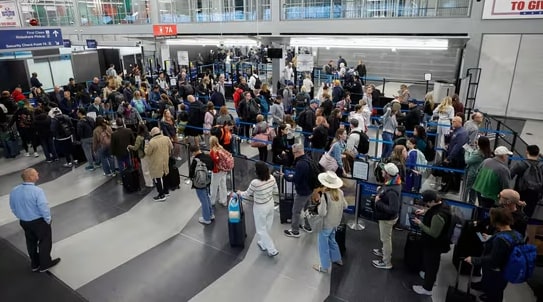
US government shutdown has now reached its 40th day.
Washington:
The Senate initiated the first step towards ending the government shutdown on Sunday as a group of moderate Democrats agreed to proceed without securing guaranteed extensions of healthcare subsidies, causing frustration among many in their party who believe Americans want them to continue advocating for these benefits.
In an initial test vote, the first of several required procedural steps, the Senate voted 60-40 to advance compromise legislation that would fund the government and schedule a later vote on extending Affordable Care Act tax credits set to expire January 1. Final passage could take several days if Democrats choose to object and delay the process.
This agreement does not guarantee the extension of healthcare subsidies that Democrats have been demanding for nearly six weeks. Senate Democratic leader Chuck Schumer of New York voted against advancing the package, joined by all but eight of his Democratic colleagues.
A trio of former governors—Senators Jeanne Shaheen and Maggie Hassan of New Hampshire, along with Independent Senator Angus King of Maine—broke the six-week impasse on Sunday when they agreed to advance three bipartisan annual spending bills and extend remaining government funding until late January in exchange for a mid-December vote on extending healthcare tax credits.
The agreement also includes reversing mass firings of federal workers that occurred under the Trump administration since the shutdown began October 1, and ensures federal workers will receive back pay.
Senate Majority Leader John Thune promptly endorsed the deal and called for an immediate vote to begin the approval process as the shutdown continued disrupting flights nationwide, threatening food assistance for millions of Americans, and leaving federal workers unpaid.
"The time to act is now," Thune stated.
Returning to the White House Sunday evening after attending a football game, President Donald Trump did not explicitly endorse the deal but remarked, "It looks like we're getting close to the shutdown ending."
Besides Shaheen, King, and Hassan, Democratic Senator Tim Kaine of Virginia, home to tens of thousands of federal workers, also voted to advance the agreement. Other supporting Democrats included Illinois Senator Dick Durbin, the No. 2 Democrat, Pennsylvania Senator John Fetterman, and Nevada Senators Catherine Cortez Masto and Jacky Rosen.
The moderate Democrats had expected greater support, as 10-12 Democratic senators had participated in negotiations. However, only five Democrats ultimately switched their votes—exactly the number Republicans needed to reach 60. King, Cortez Masto, and Fetterman had consistently voted to reopen the government since October 1.
Sunday evening's vote faced a temporary delay when three conservative senators often critical of spending bills—Republicans Mike Lee of Utah, Rick Scott of Florida, and Ron Johnson of Wisconsin—withheld their votes while conferring with Thune at the chamber's rear. They eventually voted yes after speaking with Trump, according to Lee.
Another Republican, Senator John Cornyn of Texas, had to fly back from Texas to deliver the crucial 60th vote.
After Democrats met for over two hours to discuss the proposal, Schumer stated he could not "in good faith" support it.
Schumer, who faced party criticism in March when he voted to keep the government open, said Democrats have now "sounded the alarm" on healthcare.
"We will not give up the fight," he declared.
Independent Senator Bernie Sanders of Vermont, who caucuses with Democrats, called abandoning the fight a "horrific mistake."
Senator Chris Murphy, D-Conn., agreed, noting that in last week's elections, people voted overwhelmingly Democratic "to urge Democrats to hold firm."
Democrats had voted 14 times against reopening the government while demanding extension of tax credits that make Affordable Care Act coverage more affordable. Republicans refused to negotiate on healthcare, but GOP leaders had been quietly working with moderate Democrats as an agreement framework began to emerge.
The agreement includes bipartisan bills developed by the Senate Appropriations Committee to fund certain government functions—including food aid, veterans programs, and the legislative branch. All other funding would extend until late January, giving lawmakers over two months to complete additional spending bills.
The deal would reinstate federal workers who received reduction-in-force notices, reimburse states that used their own funds to maintain federal programs during the shutdown, protect against future layoffs through January, and guarantee back pay for federal workers once the shutdown ends.
House Democrats quickly criticized the Senate agreement.
Texas Representative Greg Casar, chairman of the Congressional Progressive Caucus, stated that a deal failing to reduce healthcare costs represents a "betrayal" of millions of Americans counting on Democrats to fight.
"Accepting nothing but a pinky promise from Republicans isn't a compromise—it's capitulation," Casar posted on X. "Millions of families would pay the price."
Representative Angie Craig of Minnesota remarked that "if people believe this is a 'deal,' I have a bridge to sell you."
House Democratic leader Hakeem Jeffries blamed Republicans, saying, "Donald Trump and the Republican Party own the toxic mess they have created in our country and the American people know it." He affirmed Democrats would continue fighting.
It remains unclear whether the parties could find common ground on healthcare subsidies before the promised December Senate vote. House Speaker Mike Johnson, R-La., has not committed to bringing such legislation up in the House.
Some Republicans have expressed openness to extending the COVID-19-era tax credits as insurance premiums could dramatically increase for millions of people, but they also want new limitations on subsidy eligibility and prefer routing tax dollars through individuals rather than plans.
Other Republicans, including Trump, have used this debate to renew longstanding criticisms of the healthcare law, calling for its repeal or major revision.
Meanwhile, shutdown consequences continue mounting. U.S. airlines canceled over 2,000 flights on Sunday—the first such occurrence since the shutdown began—with more than 7,000 flight delays reported by FlightAware, a website tracking air travel disruptions.
Treasury Secretary Sean Duffy warned on CNN's "State of the Union" that pre-Thanksgiving air travel will be "reduced to a trickle" if the government doesn't reopen.
Simultaneously, food assistance for tens of millions of Americans faces delays as Supplemental Nutrition Assistance Program benefits are entangled in shutdown-related legal challenges.
In Washington, D.C., home to tens of thousands of unpaid federal workers, the Capital Area Food Bank reported it is providing 8 million additional meals ahead of the holidays beyond what was budgeted—nearly a 20% increase.
Source: https://www.ndtv.com/world-news/senate-nears-potential-shutdown-deal-but-theres-no-guarantee-of-success-9605777