
China's Revolutionary 'Ghost Jellyfish' Drone: The Future of Covert Underwater Surveillance Technology
- Date & Time:
- |
- Views: 53
- |
- From: India News Bull
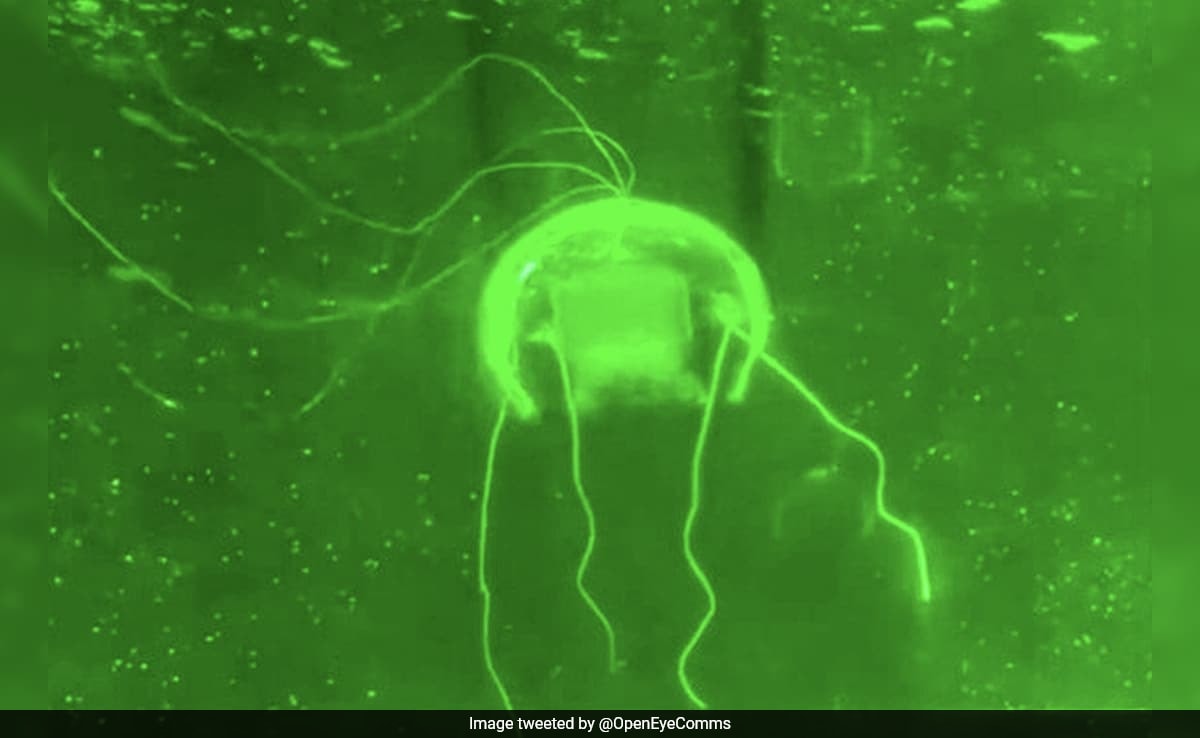
Chinese engineers have created an innovative jellyfish-inspired robot designed specifically for covert underwater operations. Developed by scientist Tao Kai at Northwestern Polytechnical University, this "underwater phantom" effectively mimics actual jellyfish, enabling environmental monitoring without disturbing marine ecosystems.
The robot features a transparent body with tentacles crafted from specialized hydrogel electrode material. This design allows it to move in a manner virtually identical to real jellyfish, making detection extremely difficult in underwater environments, according to South China Morning Post reports.
Tao explained to Science and Technology Daily that "the robot's minimal power requirements, silent operation, and naturalistic appearance make it exceptionally suitable for covert deep-sea monitoring, observing delicate ecosystems, and conducting precise underwater structure inspections."
With dimensions of 120mm in diameter and weighing just 56 grams, this compact device utilizes an electrostatic hydraulic actuator that replicates jellyfish neural signals. Operating at only 28.5 milliwatts, it creates minimal disturbance while moving through water. The robot incorporates an onboard camera and AI processing chip, enabling machine learning-based identification of underwater targets during extended covert missions.
State broadcaster CCTV featured this bionic jellyfish in August during a science program that also highlighted other nature-inspired robots, including mechanical birds, locusts, geckos, and fish.
During this broadcast, Tao demonstrated the jellyfish robot's impressive capabilities, showing how it maintains stable hovering positions despite changing water conditions and accurately identifies specific objects such as the university's emblem and marine life like clownfish. The demonstration emphasized how these biomimetic robots can autonomously sense their environment and precisely identify targets.
The program positioned the bionic jellyfish as a significant innovation that addresses major challenges in deep-sea exploration, particularly regarding energy efficiency, stealth capabilities, and environmental adaptability.
Northwestern Polytechnical University has established itself internationally for pioneering work in robotics and aerospace engineering, particularly in developing robots inspired by birds and insects, as well as hybrid systems capable of operating in both air and water environments.
Tao's research group operates within the Ministry of Education's Key Laboratory of Micro and Nano Systems for Aerospace, which stands among China's leading research centers for micro-electromechanical systems and plays a significant role in advancing the nation's robotic technology capabilities.
Source: https://www.ndtv.com/world-news/china-unveils-ghost-drone-for-stealth-underwater-surveillance-9519046