
Trump's Second Putin Summit Plan Raises Concerns Over Ukraine Support Strategy
- Date & Time:
- |
- Views: 59
- |
- From: India News Bull
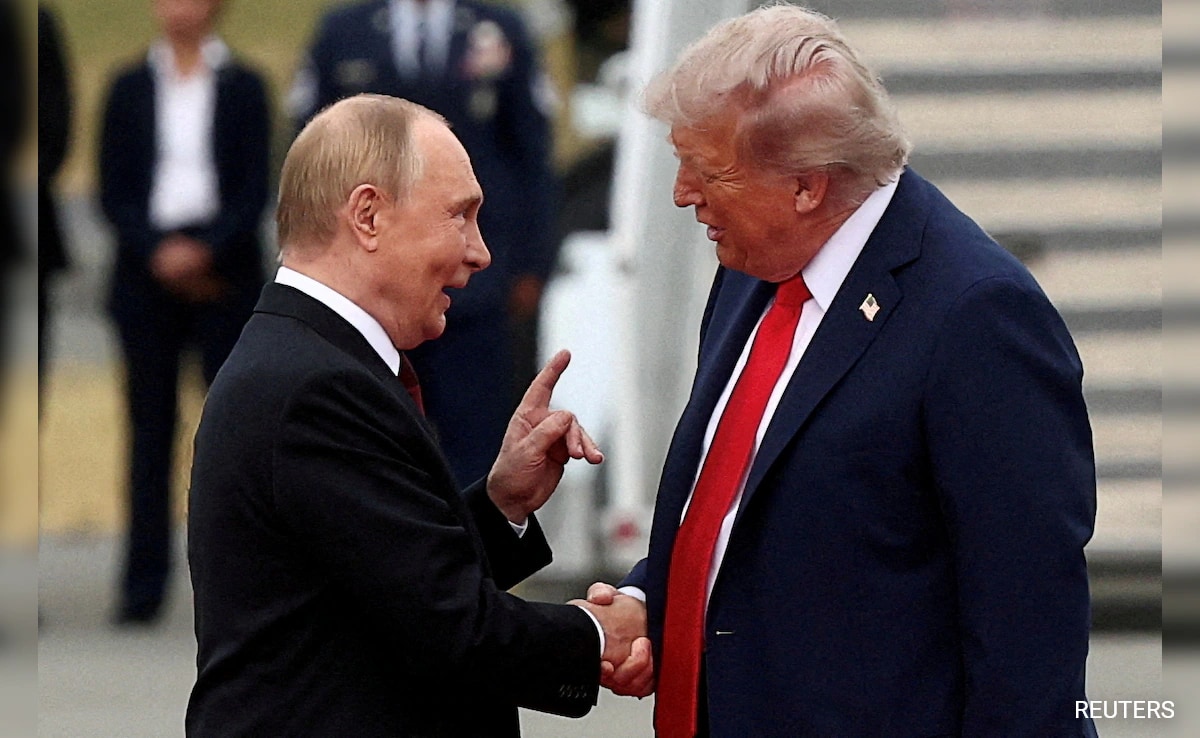
Donald Trump engaged in a conversation with Putin that lasted over two hours on Thursday.
President Donald Trump is once again focusing on resolving the Ukraine conflict, announcing a subsequent meeting with Russian President Vladimir Putin after their initial summit in Alaska failed to produce meaningful results.
The president presented this decision, revealed after his extensive two-hour conversation with Putin on Thursday, as a strategy to finally bring peace to a conflict that he previously claimed he could resolve within a single day. However, this move also diminishes any mounting pressure on Putin that had been building in recent weeks as Trump expressed frustration with the Russian leader's reluctance to end the war.
Trump's conversation with Putin preceded his scheduled meeting with Ukrainian President Volodymyr Zelensky on Friday. Trump had been adopting an increasingly positive tone toward Zelensky recently while cooling his relationship with Putin—a notable shift from his previously cooler stance toward the Ukrainian leader earlier in his administration, which included a public rebuke in the Oval Office earlier this year.
More concerning for Zelensky, Trump expressed uncertainty on Thursday regarding both the possibility of providing long-range Tomahawk missiles and supporting the Senate's push for punitive sanctions against Russia.
"We need Tomahawks for the United States of America, too," Trump stated to reporters in the Oval Office. "So I don't know what we can do about that." Regarding sanctions, he mentioned that the Republican push for strong new measures "may not be perfect timing, but it could happen in a week or two."
Both Ukraine and Russia have attempted to capitalize on Trump's momentum following the Gaza summit that halted the conflict between Hamas and Israel—though with opposing objectives. Zelensky believes Trump's growing impatience with Putin might lead him to apply pressure that the White House has thus far resisted. He plans to renew requests for air defense systems and assistance in securing new energy supplies, along with the desired Tomahawk missiles.
However, Trump has yet to approve providing those weapons to Ukraine, and during their call, Putin warned the US president that doing so "would cause significant damage to relations between our countries, not to mention the prospects for a peaceful settlement," according to a statement from the Kremlin.
Sergey Radchenko, a Cold War historian and professor at the Johns Hopkins School of Advanced International Studies, described it as "almost foolhardy" for Trump to agree to another meeting considering that the Alaska summit in August yielded no agreement despite considerable fanfare. What's necessary, he suggested, was combining pressure with communication.
"I'm seeing a lot of efforts at dialogue," Radchenko observed. "I'm not yet seeing maximum pressure."
Instead, the US president appears to be relying on incentives to bring Putin to negotiations. Trump noted that the two leaders discussed extensively about trade prospects after the war concludes. According to the Kremlin, Trump emphasized that the economic opportunities would be "colossal."
With plans for lower-level discussions and an eventual leaders' summit, "Putin is essentially buying time, delaying the delivery of much-needed United States weapons to Ukraine and the implementation of the energy sanctions that Trump has promised," according to Maria Snegovaya, senior fellow for Russia and Eurasia with the Europe, Russia, and Eurasia Program at the Center for Strategic and International Studies.
The choice of Budapest as the venue for Trump's planned summit with Putin is likely to be viewed skeptically by European allies as a potential attempt by the Russian leader to create division between the US and Europe. Hungarian Prime Minister Viktor Orban has faced strong criticism from European Union and NATO allies for maintaining close relations with Russia even after Putin invaded Ukraine. This includes opposing EU sanctions on Moscow, preventing weapons deliveries to Ukraine, and committing Hungary to a long-term gas contract with Russia.
Trump has placed responsibility on Europe to cease all energy imports from Russia as a prerequisite for the US to implement tough measures against Russia. Although the European Union has dramatically reduced purchases of Russian oil and gas since the beginning of the Ukraine war, Hungary remains one of the few countries in the bloc that continues to depend on Russian imports.
Despite European tensions, Trump has long regarded Orban as a close ally on the international stage, part of a small group of MAGA-aligned foreign leaders. As such, the American president may view Budapest as favorable territory for a summit with his Russian counterpart.
The Hungarian leader stated in a social media post on platform X that preparations for the "USA-Russia peace summit" were underway, adding that "Hungary is the island of PEACE!"
For Trump, holding a second Putin summit carries substantial risk if the White House has no plan to simultaneously impose costs on Russia, according to Celeste Wallander, an adjunct senior fellow at the Center for a New American Security and a former top Pentagon official responsible for Russia and Europe during the Biden administration.
If the summit concludes without an acceptable agreement, it would again "allow Putin to use the opportunity to send a message to the world that he's kind of in control of the narrative," she said.
(This story has not been edited by NDTV staff and is auto-generated from a syndicated feed.)
Source: https://www.ndtv.com/world-news/trumps-plan-for-a-second-meeting-with-putin-undercuts-ukraine-push-9471785