
UK Expected To Recognise Palestinian State Despite US Opposition
- Date & Time:
- |
- Views: 74
- |
- From: India News Bull
UK Expected To Recognise Palestinian State Despite US Opposition
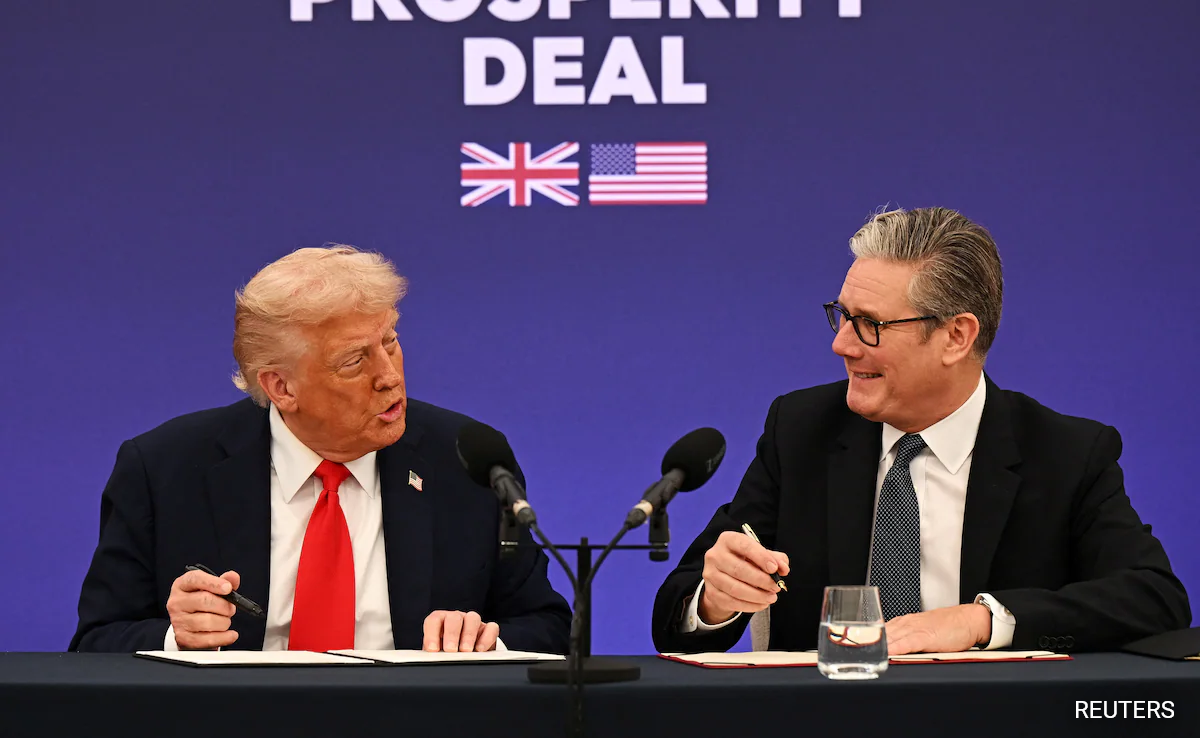
US President Donald Trump and UK Prime Minister Keir Starmer
The United Kingdom is poised to officially recognise a Palestinian state on Sunday, despite opposition from the United States, after determining that Israel has not fulfilled conditions established regarding the Gaza conflict.
While largely symbolic, the UK's anticipated recognition aims to escalate diplomatic pressure for ending the Gaza conflict and potentially establish groundwork for a lasting peace based on a two-state coexistence model.
Deputy Prime Minister David Lammy, who previously served as foreign secretary until earlier this month, confirmed that Prime Minister Keir Starmer will make an announcement regarding Palestinian state recognition later Sunday.
"Recognising a Palestinian state, if that happens later today, doesn't create a Palestinian state overnight," he explained during his Sky News interview.
Lammy indicated that such recognition would help preserve the viability of a two-state solution, emphasizing that associating all Palestinian people with Hamas represents a false narrative.
In July, following significant pressure from within his Labour Party, Prime Minister Starmer stated the UK would recognise a Palestinian state unless Israel agreed to a Gaza ceasefire, permitted UN aid deliveries, and took additional steps toward sustainable peace.
This expected announcement comes before the UN General Assembly this week, where several other nations including Australia, Canada and France are also preparing to recognise a Palestinian state. Portugal is anticipated to make a similar announcement later Sunday.
Over 140 countries have already recognised a Palestinian state, but France and Britain's decisions carry particular weight as members of both the G7 and the UN Security Council.
The UK's expected recognition comes just days after US President Donald Trump's state visit, during which he expressed disapproval of the plan.
"I have a disagreement with the prime minister on that score," Trump stated.
Critics, including the US and Israeli government, which has shown little interest in pursuing a two-state solution, have condemned these plans, arguing they reward Hamas and terrorism. Critics further contend that recognition represents an empty gesture considering Palestinian territories remain divided between the West Bank and Gaza, without an internationally recognised capital.
Starmer has maintained that Hamas will have no role in future Palestinian governance and must release the remaining Israeli hostages taken during the October 7, 2023 attacks.
France and the UK have played historic roles in Middle Eastern politics over the past century, having partitioned the region following the Ottoman Empire's defeat in World War I.
Through this partition, the UK became the governing authority over what was then Palestine. It also authored the 1917 Balfour Declaration, which supported establishing a "national home for the Jewish people."
However, the declaration's second part has been largely overlooked through decades. It specified "that nothing shall be done, nothing which may prejudice the civil and religious rights" of the Palestinian people.
Lammy, who will represent the UK at the UN this week, stated in July that this commitment had not been upheld and represented "a historical injustice which continues to unfold."
Husam Zomlot, Palestinian head of mission in the UK, told the BBC that recognition would correct a colonial-era wrong.
"The issue today is ending the denial of our existence that started 108 years ago, in 1917," he said. "And I think today, the British people should celebrate a day when history is being corrected, when wrongs are being righted, when recognition of the wrongs of the past are beginning to be corrected."
For decades, the UK has supported an independent Palestinian state alongside Israel, but insisted recognition should come as part of a comprehensive peace plan achieving a two-state solution.
However, the government has grown increasingly concerned that such a solution is becoming virtually impossible—not only due to Gaza's destruction and displacement of most of its population during nearly two years of conflict, but because Israel's government continues aggressively expanding settlements in the West Bank, territory Palestinians claim for their future state. Much of the international community considers Israel's occupation of the West Bank, nominally administered by the Palestinian Authority, illegal.
"We are working to reform the Palestinian Authority, and we have to keep two states alive for the children of both Gaza and the West Bank and East Jerusalem," said Lammy.