
GPS-Tagged Amur Falcons Embark on Epic 3,000 km Migration Journey from India to Africa
- Date & Time:
- |
- Views: 44
- |
- From: India News Bull
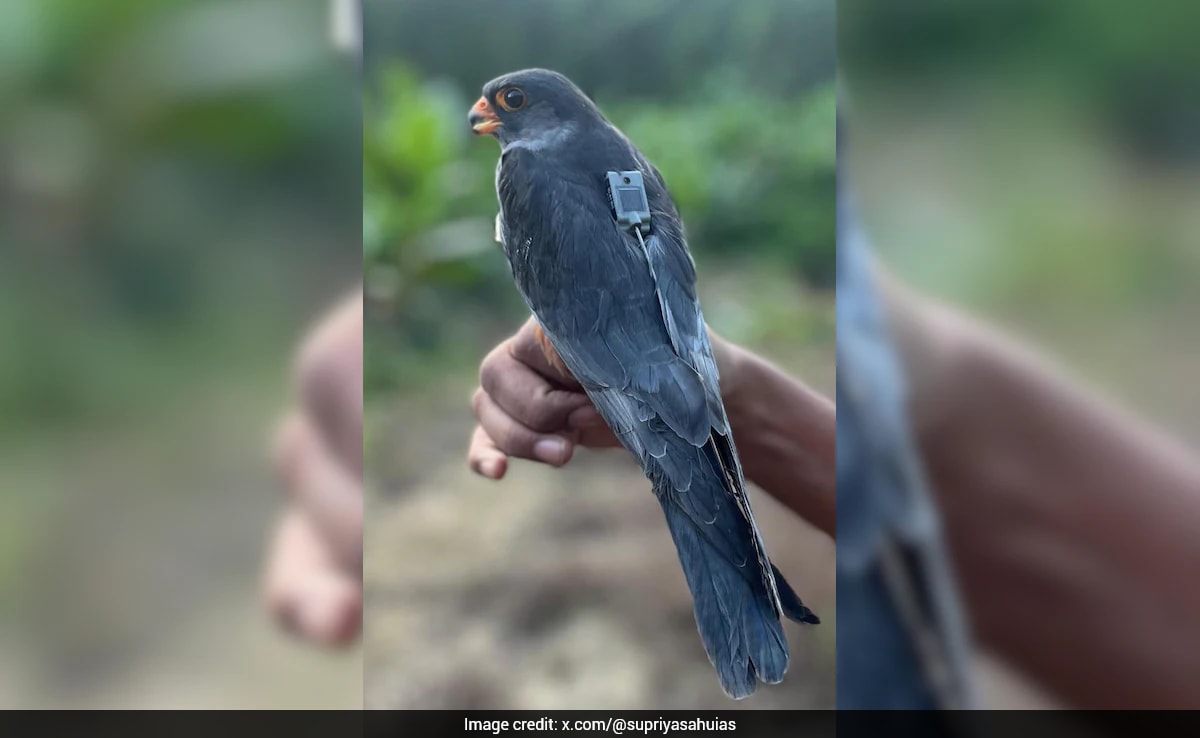
Tamil Nadu IAS officer Supriya Sahu has documented the remarkable migration of three GPS-tagged Amur falcons as they begin their annual journey from India to Africa.
The three birds—Apapang (adult male), Alang (young female), and Ahu (adult female)—were satellite-tagged on November 11 as part of the Manipur Amur Falcon Tracking Project conducted by the Wildlife Institute Of India. Their tracking data reveals the extraordinary capabilities of these small raptors.
Sahu shared the progress of these remarkable birds on social media platform X, stating, "And the epic journey begins again in all its glory." She highlighted how Apapang has already made an extraordinary non-stop flight across central India and is now approaching the Arabian Sea, preparing for a 3,000 km oceanic crossing to Somalia.
"These tiny birds barely 150 grams continue to remind us of the sheer wonder of migration, and why India's protection of stopover sites has become a global conservation story. What a wonder!" Sahu remarked in her post, which included photographs of the tracker fitted to one of the birds and video footage showing thousands of Amur falcons taking flight together.
By Sunday, Sahu provided an update on their progress: "All three satellite-tagged Amur Falcons are now undertaking their daring Arabian Sea crossing. Apapang has already flown nonstop for 76 hours, covering 3100 km at an average of 1000 km per day, aided by strong easterly tailwinds."
The Arabian Sea crossing represents one of the most challenging continuous flights attempted by any raptor species, requiring substantial energy reserves and favorable wind conditions to complete successfully.
Every November, Amur falcons depart from their breeding grounds in Russia, China, parts of Korea and Japan to begin a trans-equatorial journey toward South Africa. Their most crucial stopover occurs in northeastern India, particularly in Manipur and Nagaland, where conservation efforts over the past decade have transformed these once-hunted birds into protected migrants.
Just ten years ago, Amur falcons were extensively hunted across parts of Manipur, Nagaland, and Assam during their winter stopovers. This situation changed after the Wildlife Institute of India launched its first tracking project in Nagaland in 2013.
Villages like Chiuluan in Manipur, formerly hunting sites, now protect these birds and participate in tagging efforts. The village gained global recognition last year when a tagged falcon named Chiuluan 2 flew from Maharashtra across the Arabian Sea to Somalia, continuing through Kenya, Tanzania, and Mozambique on its way to Johannesburg.
Despite their vast breeding range across Siberia and East Asia with a population exceeding one million, these falcons specifically choose northeast India for a vital reason: termites. Research conducted by the Wildlife Institute of India, including a 2024 study analyzing over 1,400 food pellet samples from Assam, Manipur, and Nagaland, revealed that termites constitute 85 percent of the Amur falcon's diet.
Northeast India, emerging from its monsoon season in October, provides an abundant supply of these insects, allowing the birds to build the protein reserves necessary for their grueling 3,000 km non-stop flight across the Arabian Sea.
Source: https://www.ndtv.com/india-news/amur-falcons-begin-journey-from-manipur-to-africa-ias-officer-posts-video-9648299