
ISRO Successfully Tests Main Parachutes for Gaganyaan Crew Module: A Critical Milestone in India's Human Spaceflight Program
- Date & Time:
- |
- Views: 48
- |
- From: India News Bull
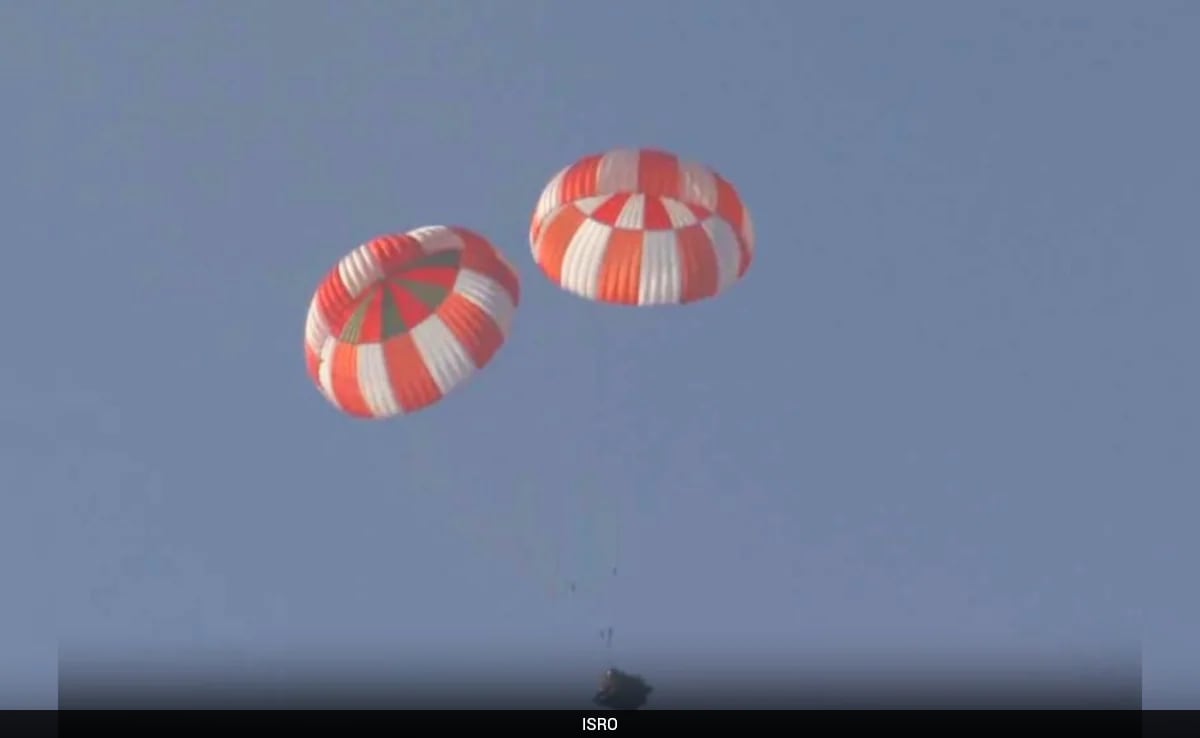
ISRO created a spectacular orange-and-white pattern across the skies of Babina in Uttar Pradesh as India's groundbreaking Gaganyaan human spaceflight program achieved another significant milestone.
The space agency successfully executed an Integrated Main Parachute Airdrop Test (IMAT) at the Babina Field Firing Range in Jhansi, Uttar Pradesh. This test represents a crucial qualification step for the parachute system designed to bring Indian astronauts safely back to Earth.
During the test, a 2.5-tonne simulated crew module was released from an Indian Air Force IL-76 aircraft at an altitude of 2.5 kilometers.
The parachute system deployed perfectly as the module descended, confirming its capability to manage one of the most challenging scenarios anticipated during an actual mission: a delay in the dis-reefing process between two main parachutes.
This asymmetric load condition is regarded as one of the most demanding structural challenges for the system.
The Significance of This Test
The Gaganyaan parachute system is an intricate engineering achievement comprising 10 parachutes of four distinct types:
Two Apex Cover Separation Parachutes that remove the protective cover of the parachute compartment.
Two Drogue Parachutes that stabilize and slow down the module.
Three Pilot Parachutes that extract the main parachutes.
Three Main Parachutes that decelerate the crew module for a safe landing. The design incorporates redundancy - just two of the three main parachutes are sufficient to ensure a secure touchdown.
Deployment follows a meticulous process called reefed inflation, where each parachute initially opens partially (reefing) before fully expanding (dis-reefing) after a predetermined time, utilizing small rocket or pyro devices.
This controlled inflation prevents sudden impacts and maintains structural integrity during descent while protecting the Gaganyatris from experiencing extreme G forces.
ISRO has previously conducted air drop tests of the crew module using Chinook helicopters over the Bay of Bengal.
A Nationwide Collaboration
The successful test highlights the collaborative approach behind Gaganyaan - a Rs 10,000 crore national endeavor aiming to send one or two Indian astronauts into Low Earth Orbit for a mission lasting less than a week.
Various institutions across India are contributing to this mission, including ISRO's Vikram Sarabhai Space Centre (VSSC), the Aerial Delivery Research and Development Establishment (ADRDE) of the Defence Research and Development Organisation (DRDO), the Indian Air Force, and the Indian Army.
Looking Forward
If everything proceeds according to schedule, the first unmanned test flight of Gaganyaan could happen in the coming months, establishing the foundation for India's first human spaceflight, tentatively planned for 2027.
This achievement will place India among an exclusive group of just four nations capable of independent human space missions - an accomplishment that combines advanced science, engineering excellence, and national pride.
The successful parachute test represents more than just a technical breakthrough; it symbolizes India's advancing capabilities in space technology and its commitment to ensuring astronaut safety throughout every phase of the mission. As the skies over Babina transformed into a display of orange and white, India took another determined step toward making history in space exploration.
Source: https://www.ndtv.com/india-news/isro-conducts-key-test-on-main-parachutes-for-gaganyaan-crew-module-9618169