
Chandrayaan-3 Discovers Highly Active Electrical Environment at Moon's South Pole: Revolutionary Plasma Findings
- Date & Time:
- |
- Views: 33
- |
- From: India News Bull
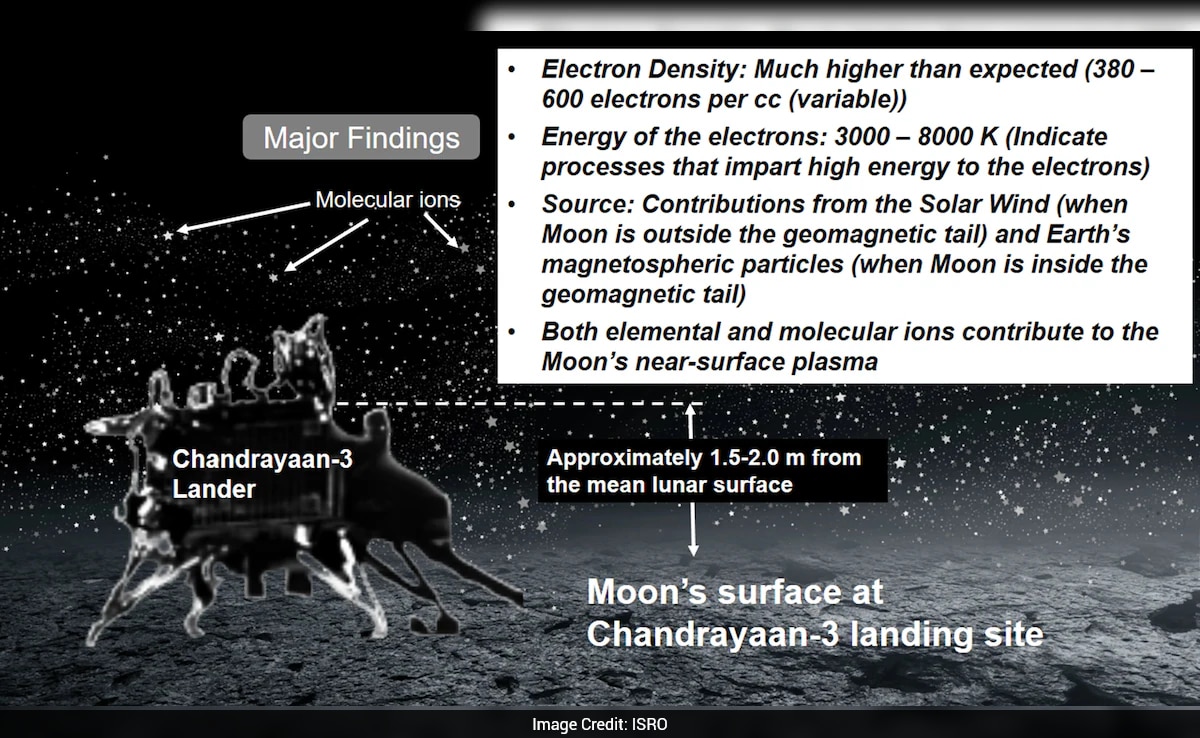
The RAMBHA-LP experiment, developed by the Space Physics Laboratory, has yielded groundbreaking results in lunar exploration.
Chandrayaan-3's latest data analysis reveals a significantly more dynamic and active electrical environment near the lunar south pole than scientists previously believed. This discovery comes from the Radio Anatomy of the Moon Bound Hypersensitive ionosphere and Atmosphere - Langmuir Probe (RAMBHA-LP) instrument mounted on the Vikram lander.
According to the Indian Space Research Organisation (ISRO), these findings represent the first direct measurements of lunar plasma so close to the surface in the southern high latitudes region. The probe detected electron densities between 380 and 600 particles per cubic centimeter at the Shiv Shakti point landing site, substantially exceeding earlier satellite-based estimates.
ISRO explains that in physics, plasma is commonly referred to as the fourth state of matter, consisting of charged particles including ions and free electrons. Despite overall electrical neutrality, plasma exhibits high conductivity and strong responses to electromagnetic fields. The Moon's thin plasma environment, or lunar ionosphere, is influenced by several major processes.
Solar wind—a continuous stream of charged particles primarily comprising electrons, hydrogen, and helium ions from the Sun's upper atmosphere—constantly impacts the lunar surface. This interaction, along with the photoelectric effect, constitutes the primary mechanism for plasma creation in this environment.
The lunar plasma undergoes further modification through the deposition of charged particles from Earth's magnetosphere, specifically the magnetotail, during the Moon's passage through this region (typically 3-5 days within a 28-day period). This results in a continuously changing electrical environment near the surface.
Researchers also discovered that the electrons are highly energetic, with temperatures ranging between 3,000 and 8,000 Kelvin. The plasma environment experiences constant shifts due to solar wind during lunar daytime and charged particles from Earth's magnetotail during the Moon's orbital transit.
ISRO researchers noted that the study "uncovered that the lunar plasma is not static but is constantly modulated by two distinct factors, depending on the Moon's orbital position around the Earth."
When the Moon faces the Sun during lunar daytime and remains outside Earth's magnetic field, changes in near-surface plasma are driven by solar wind particles interacting with the Moon's sparse neutral gas (exosphere). Conversely, when the Moon traverses the geomagnetic tail, plasma changes result from charged particles streaming from the tapered region of Earth's extended magnetic tail, positioned opposite to the Sun.
These discoveries provide essential "ground truth" data for future lunar missions and enhance our understanding of the complex plasma environment on the Moon.
The innovative RAMBHA-LP experiment was developed at the Space Physics Laboratory of the Vikram Sarabhai Space Centre in Thiruvananthapuram, highlighting India's growing capabilities in space research and exploration.
Source: https://www.ndtv.com/india-news/chandrayaan-3-finds-active-electrical-environment-near-moons-south-pole-9794072