
Putin's India Visit: Navigating US-Russia Relations Amid Defense and Energy Ties
- Date & Time:
- |
- Views: 38
- |
- From: India News Bull
President Vladimir Putin is set to visit India this week for the first time since Russia's invasion of Ukraine, a rare trip that underscores the countries' defense and energy ties as New Delhi seeks to finalize a trade deal with Washington.
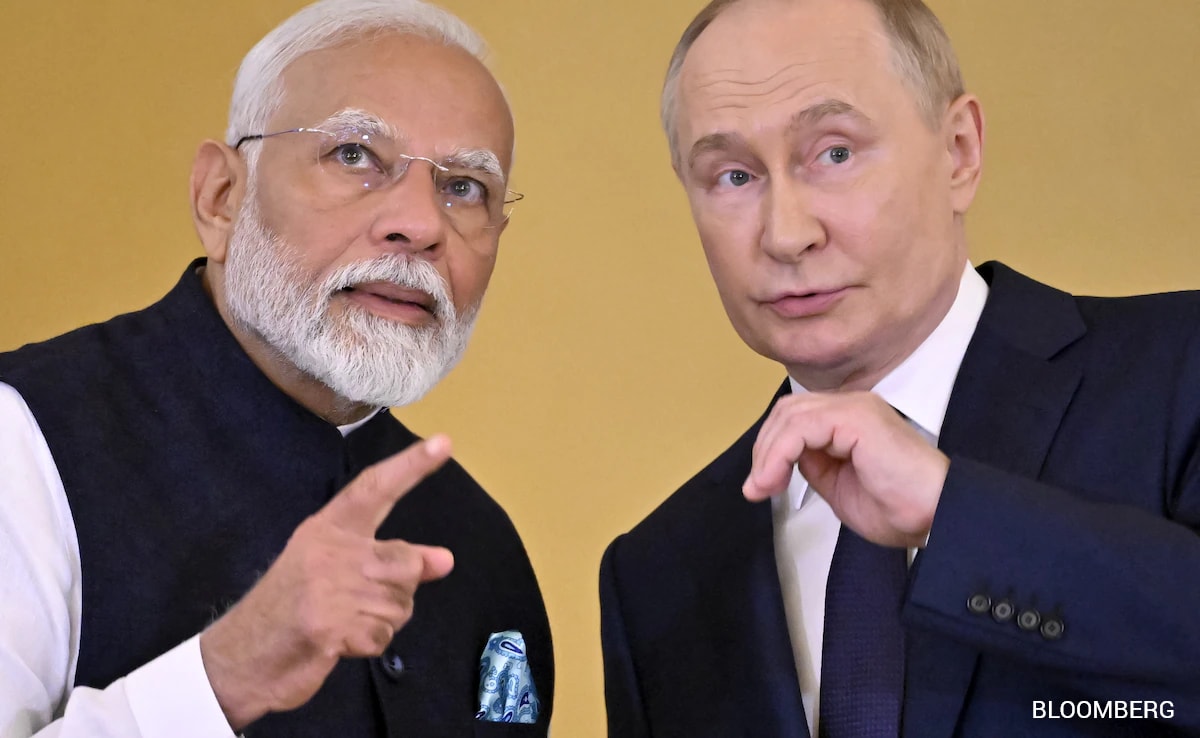
India is keen to discuss with Russia the purchase of Su-57 fighter jets.
The Russian leader is eager to demonstrate that Moscow maintains strong relationships beyond the West - and has access to significant trading markets. For India, whose deep economic and political connections with Russia extend back to the Soviet era, the visit comes as sanctions and American pressure restrict an energy trade that has been beneficial for its economy and essential for Russia. It also provides an opportunity for Prime Minister Narendra Modi to showcase his continued ability to pursue an independent geopolitical strategy.
"As the US under Trump has become more isolationist and transactional, and relations with China remain poor, India is ensuring that its ties with middle powers like Russia - or Japan, UAE and the EU - are deepened," said Pramit Pal Chaudhuri, head of Eurasia Group's South Asia practice. "It helps India that President Trump has already ended Putin's pariah status by holding his Alaska Summit."
Both countries have officially framed the visit around trade, though deeper questions persist regarding energy and defense - two areas that have put India under Trump's scrutiny. The US president has increased India's tariffs to 50 percent as punishment for purchasing Russian oil, and has pressured New Delhi to buy more American weapons. Modi's government is in discussions with the Trump administration about trade and close to reaching an agreement - a goal that could become more challenging after a demonstration of strengthened India-Russia relations.
Putin's visit coincides with his Tuesday talks with US envoy Steve Witkoff and Jared Kushner, Trump's son-in-law, regarding a new peace plan that Washington is strongly encouraging Russia and Ukraine to accept. India has maintained a careful position regarding the Ukraine war, calling for an end to hostilities while refusing to compromise its relationship with Moscow. Modi embraced Putin and called him "my friend" during his first visit to Moscow in five years in 2024, just a day after a deadly Russian missile strike on Kyiv's main children's hospital sparked international condemnation.
The European ambassadors from Germany, France and Britain in New Delhi reportedly criticized Russia's war against Ukraine, indirectly signaling India's long-standing position that the conflict should be resolved through negotiations.
On the eve of his visit, Putin praised his country's ties with India and China, and committed to elevating relations to a "qualitatively new level." He told a business forum in Moscow on Tuesday he'll discuss trade with Modi, including "increasing the import of Indian goods into our market."
India is interested in discussing with Russia the acquisition of Su-57 fighter jets and the advanced S-500 missile defense shield. Russia remains its largest provider of military hardware, despite a significant reduction in purchases in recent years, as New Delhi increasingly turns to the US and European countries. Modi's government has indicated it will continue to acquire equipment from both the US and Russia.
India already possesses over 200 Russian fighter jets and several batteries of earlier generation air-defense systems, which were utilized during a four-day clash with Pakistan in May - a confrontation that has only increased New Delhi's sense of urgency.
Any sale would need to overcome complications created by sanctions and Russia's own wartime requirements.
Another major topic for the two leaders will be the oil trade, a crucial revenue source for the Kremlin. India will aim to balance its need for affordable crude, given the size of its import bill, with its desire to avoid punitive US tariffs and sanctions.
Historically, India has not been a major importer of Russian oil, relying more heavily on the Middle East. This changed in 2022, following the Ukraine invasion and a price cap imposed by G7 nations intended to limit the Kremlin's oil revenues. The increase in purchases - to the point where India became the largest buyer of seaborne Russian crude - was tacitly supported by the Biden administration, which was eager to maintain oil flow and keep prices down.
Trump transformed this into a pressure campaign this year, criticizing India and its refiners and eventually sanctioning Russia's two largest oil producers, Rosneft PJSC and Lukoil PJSC, in an effort to push Putin toward negotiations. This has dramatically reduced Russian shipments, despite steep discounts - exporters are already offering Russia's flagship Urals crude to India with a discount of up to $7 per barrel compared to the Brent benchmark for deliveries in December and January, bringing the price for India to its lowest level in at least two years.
This is a loss Putin will almost certainly try to reverse. The delegation arriving Thursday is expected to include senior oil industry executives, along with defense and other officials.
Both leaders will also use the visit to attempt to diversify their trade beyond Russian oil and weapons, addressing a business forum on Friday to attract private companies.
India is seeking greater access to the Russian market for its exporters affected by US tariffs, with a likely agreement to be announced regarding the shipment of marine products and agricultural goods, according to an official from India's Ministry of External Affairs who briefed reporters on Tuesday. The two sides are also expected to agree on a pact to facilitate Indian workers traveling to Russia for employment.
Russia, meanwhile, excluded from markets like Europe, is also seeking alternatives.
"The idea is simple - to get more goods from India and pay for them with the rupees that Russia earns by selling India its oil," said Tatiana Shaumyan, the head of the Center for Indian Studies at the Institute of Oriental Studies in Moscow.
Putin and Modi are expected to discuss increasing bilateral trade from the current $68 billion to $100 billion by 2030, and also improving systems for settling transactions in their own currencies, Kremlin spokesman Dmitry Peskov told local media Tuesday.
For India, breaking into the Russian market presents challenges. Local and Chinese goods are widely available and competitively priced, leaving Indian exporters with a "quite small" list of viable products, according to Alexey Kupriyanov, head of the Center of the Indo-Pacific Region at the state-run IMEMO institute in Moscow.
Source: https://www.ndtv.com/world-news/putins-india-visit-to-test-new-delhis-us-russia-balancing-act-9741905