
Pope Leo XIV Makes Historic First Foreign Visit to Turkey: Bridging Religious Divides and Promoting Peace
- Date & Time:
- |
- Views: 49
- |
- From: India News Bull
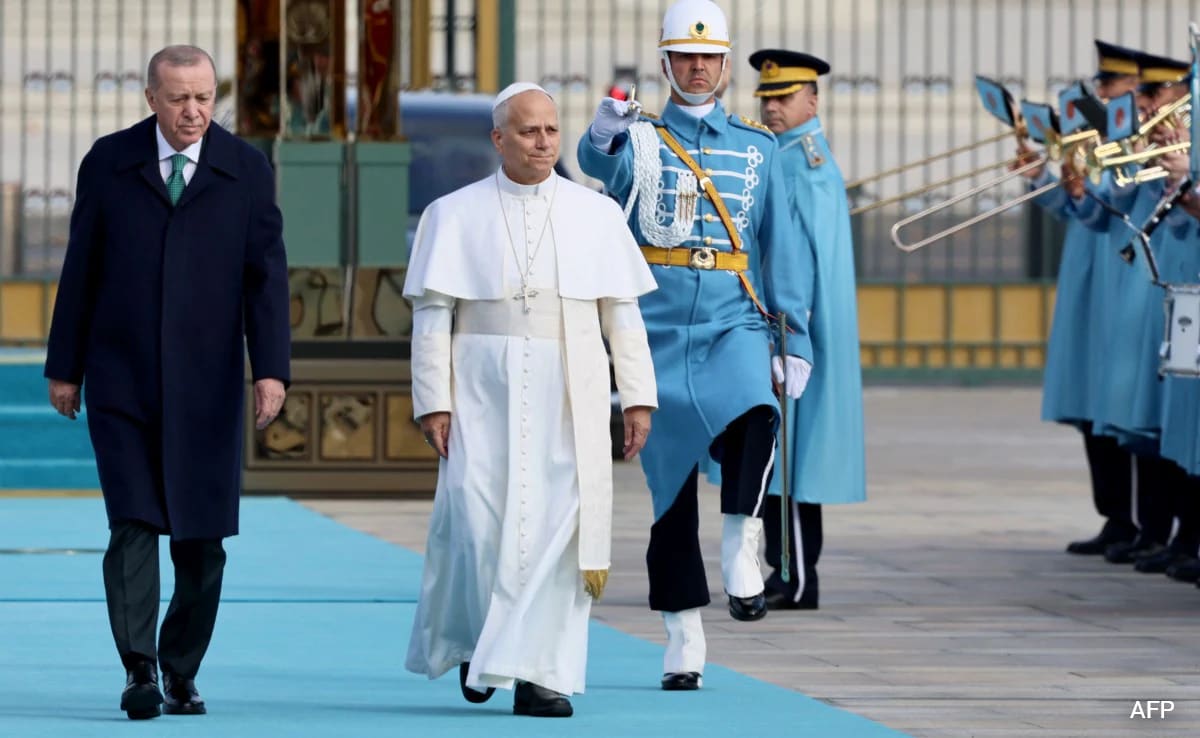
Pope Leo XIV embarked on his inaugural foreign journey to Turkey on Thursday, fulfilling the vision set forth by Pope Francis to commemorate a significant Christian milestone and deliver a message of peace to the region at a critical juncture in efforts to resolve the Ukrainian conflict and ease tensions in the Middle East.
Upon arrival at Ankara's Esenboga Airport, Leo was greeted with a military guard of honor. He proceeded along a turquoise carpet, exchanging handshakes with Culture and Tourism Minister Mehmet Nuri Ersoy, various officials, and senior church representatives from Turkey.
His schedule included a planned meeting with President Recep Tayyip Erdogan and an address to the diplomatic corps. Later Thursday, he was set to travel to Istanbul for three days of ecumenical and interfaith engagements before continuing to Lebanon.
Speaking to journalists aboard his flight, Leo acknowledged the historic significance of his first international trip, expressing his anticipation due to its importance for Christians and global peace efforts.
Leo emphasized that while commemorating a key ecumenical anniversary held significance for Christians, he hoped his broader message of peace would resonate worldwide. "We aspire to announce, transmit, and proclaim the importance of peace throughout the world, inviting all people to unite in seeking greater harmony and discovering ways for all men and women to truly become brothers and sisters despite differences in religions and beliefs."
Leo's visit comes as Turkey, a nation of over 85 million predominantly Sunni Muslims, positions itself as a crucial mediator in peace negotiations for the Ukrainian and Gaza conflicts.
Ankara has facilitated rounds of discussions between Russia and Ukraine and offered to participate in the Gaza stabilization force to support the fragile ceasefire—initiatives Leo may commend in his arrival address.
Turkey's expanding military influence, commanding NATO's largest army after the United States, has drawn Western leaders closer to Erdogan despite criticisms regarding his crackdown on the country's main opposition party.
While support for Palestinians and ending the Ukrainian conflict is widespread in Turkey, international politics remains a secondary concern for many Turks facing ongoing economic challenges due to market instability caused by domestic political upheavals.
This may explain why Leo's visit has received limited attention from many in Turkey, particularly outside the country's small Christian community.
Local resident Sukran Celebi remarked, "I wasn't aware of his visit. He is welcome. It would be beneficial if he advocated for global peace, though I doubt it will effect significant change."
Some speculated that the visit by history's first American pope aimed to advance U.S. interests or perhaps advocate for reopening a Greek Orthodox religious seminary that has become central to religious freedom discussions in Turkey.
Metin Erdem, who owns a musical instruments shop in Istanbul's tourist district of Galata, suggested, "A papal visit typically indicates America seeks something from Turkey."
The primary motivation for Leo's Turkey journey is to mark the 1,700th anniversary of the Council of Nicaea, Christianity's first ecumenical council.
Leo will pray alongside Ecumenical Patriarch Bartholomew, spiritual leader of the world's Orthodox Christians, at the site of the A.D. 325 gathering in modern-day Iznik in northwestern Turkey, signing a joint declaration as a visible demonstration of Christian unity.
Eastern and Western churches remained united until the Great Schism of 1054, a division largely precipitated by disagreements regarding papal primacy.
While the visit coincides with this significant Catholic-Orthodox anniversary, it also provides Leo an opportunity to strengthen the church's relations with Muslims. His itinerary includes visiting the Blue Mosque and presiding over an interfaith gathering in Istanbul.
Asgın Tunca, a Blue Mosque imam who will receive the pope, stated that the visit would enhance Christian-Muslim relations and dispel misconceptions about Islam. "We aim to reflect this image by demonstrating our religion's beauty through our hospitality—following God's command."
Since assuming power in 2002, Erdogan's government has implemented reforms improving religious groups' rights, including opening places of worship and returning confiscated property.
Nevertheless, some Christian groups encounter legal and bureaucratic challenges when registering churches, according to a U.S. State Department report on religious freedoms.
The Catholic Church, with approximately 33,000 members in Turkey, lacks formal legal recognition in the country, which Rev. Paolo Pugliese, superior of the Capuchin Catholic friars in Turkey, describes as "the source of many problems."
"However, the Catholic Church enjoys considerable importance due to our international profile and the pope's backing," he added.
One particularly delicate moment during Leo's visit will occur Sunday when he visits the Armenian Apostolic Cathedral in Istanbul. The cathedral has hosted all popes visiting Turkey since Paul VI, except Francis, who visited Turkey in 2014 when its patriarch was ill.
Francis visited the patriarch in the hospital, but months later severely strained Turkey-Vatican relations in 2015 by declaring the slaughter of Armenians by Ottoman Turks "the first genocide of the 20th century." Turkey, which has consistently denied genocide occurred, recalled its ambassador to the Holy See in protest.
Leo has generally displayed greater prudence than Francis in public statements, and using such terminology on Turkish soil would create a diplomatic incident. Simultaneously, the Vatican navigates complicated relations with Armenia, as its interfaith overtures to Azerbaijan have faced criticism.
Source: https://www.ndtv.com/world-news/pope-leo-xiv-visits-turkey-on-first-foreign-trip-of-his-papacy-9710539