
'Shocked, Devastated': Gaza City Assault Leaves Palestinians Traumatised
- Date & Time:
- |
- Views: 84
- |
- From: India News Bull
'Shocked, Devastated': Gaza City Assault Leaves Palestinians Traumatised
Palestine:
Al Shifa hospital's director was coordinating emergency responses to Israel's Gaza City offensive on Saturday when he faced a devastating personal tragedy: his brother and sister-in-law arrived as casualties from a strike.
"I was shocked and devastated to see the bodies of my brother and his wife," Mohammed Abu Salmiya told AFP while working in Gaza's main hospital. "Anything is possible now, as you receive your dearest ones as martyrs or wounded. The occupation's crimes continue, and the number of martyrs keeps rising."
As Israel intensifies its campaign to capture Gaza's largest urban center—despite widespread concerns for civilian safety and hostages held by militants—Salmiya's grief reflects a common experience among Palestinians.
An AFP journalist witnessed ambulances arriving at the hospital early Saturday with sirens blaring, delivering more casualties from Israel's bombardment. Medical staff unloaded four bodies wrapped in white shrouds, placing them beneath a tree, as another ambulance brought injured people including a young boy.
'Death Is More Merciful'
According to Gaza's civil defence agency operating under Hamas authority, Gaza City has been the focal point of Israel's fierce offensive in recent weeks.
Though hundreds of thousands have evacuated, many Palestinians remain trapped, lacking resources or energy to flee.
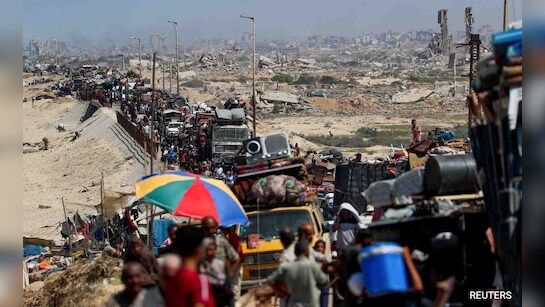
"Death is more merciful," said Mohammed Nassar, 38, from Gaza City's Tal al-Hawa district, as he watched his neighbors departing en masse. Families evacuated with possessions loaded on trucks, cars, donkey carts, or carried on their backs.
Nassar explained that he lacked both strength and money to evacuate with his wife and three daughters. "We will wait until the last moment," he said.
The civil defence agency reported at least 20 fatalities from Saturday's strikes on Gaza City. When contacted by AFP, the Israeli military did not immediately comment on these casualties or the deaths of Al Shifa director Salmiya's relatives.
"The occupation wants to forcibly displace everyone so it can destroy Gaza City and turn it into another Beit Hanoun or Rafah—unlivable for the next 100 years," Nassar stated, referencing other Gaza areas devastated during nearly two years of conflict.
Israel has launched intensive air strikes and tank operations against Gaza City in efforts to capture what it describes as one of Hamas's final strongholds.
Meanwhile, the United Nations and international powers have urged Israel to reconsider its offensive due to concerns about worsening humanitarian conditions in the city, where the UN has already declared famine.
'We'll Stay'
Israel began its ground assault on Tuesday, instructing residents to move southward, but many Palestinians describe prohibitive evacuation costs and uncertainty about where to seek refuge.
Evacuees report journeys exceeding 12 hours to reach military-designated southern areas. Transportation costs have skyrocketed, with truck owners charging $1,500 to $2,000 for the approximately 30-kilometer (19-mile) journey.
According to Friday's report from the civil defence agency, 450,000 Palestinians have fled Gaza City. The Israeli military estimates approximately 480,000 evacuees.
United Nations assessments from late August indicated about one million people were living in Gaza City and surrounding areas.
The military has directed Palestinians to relocate to a "humanitarian area" in coastal Al-Mawasi, promising aid, medical care, and humanitarian infrastructure there. Though Israel designated this area a safe zone early in the conflict, it has conducted multiple strikes there, claiming Hamas targets were present.
Raeda al-Amareen described being awakened before dawn by explosions. "We want to evacuate but we have no money," she told AFP. "We don't even have 10 shekels to buy bread. What are we supposed to do? We'll stay—either we die or someone finds a solution for us."