
Trump's Defense Deal with Saudi Arabia: F-35 Jets Promised as Crown Prince Gets Warm Washington Welcome
- Date & Time:
- |
- Views: 57
- |
- From: India News Bull
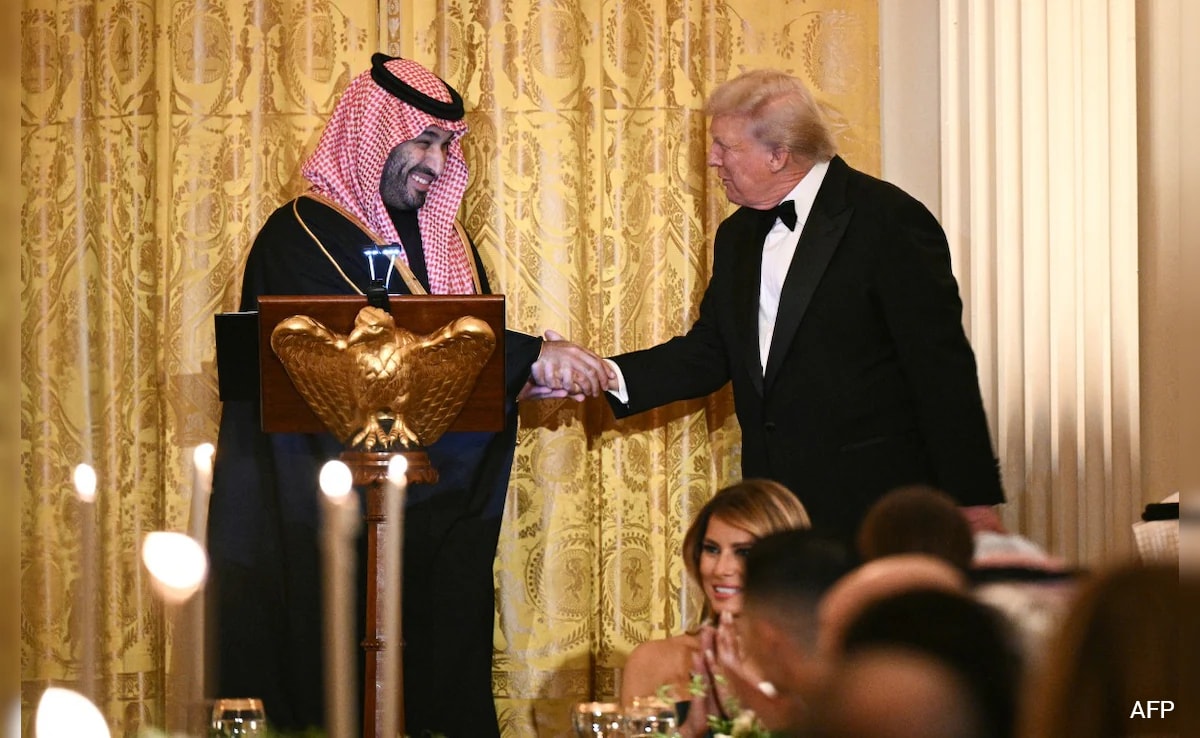
President Trump announced Saudi Arabia would purchase "nearly $142 billion worth of American military equipment" during Crown Prince Mohammed bin Salman's Washington visit.
President Donald Trump provided Saudi Crown Prince Mohammed bin Salman an extravagant welcome in Washington, offering a defense agreement including advanced F-35 fighter jets and dismissing allegations regarding the murder of an American journalist. However, the reciprocal benefits for the United States remain questionable.
The American president welcomed the Crown Prince with impressive ceremonial displays, including mounted soldiers bearing flags, a Marine Corps band performing from the White House balcony, and a flyover featuring the F-35 fighter jets long desired by Saudi Arabia. Following these ceremonies, the White House announced the signing of a broadly-worded defense cooperation agreement, and Trump designated Saudi Arabia as a "major non-NATO ally" during a dinner honoring his 40-year-old counterpart.
This ceremonial reception matched the grandeur with which the Crown Prince had welcomed Trump during his earlier visit to Saudi Arabia. In exchange, Trump received a vague commitment from Saudi Arabia to invest potentially $1 trillion in the United States—an increase from a previous $600 billion pledge. This adds to similar trillion-dollar commitments Trump has secured from other trading partners, which experts suggest may never fully materialize.
The visit represented a significant victory for MBS, as the Saudi de facto leader is commonly known, who has worked to strengthen and repair relations with the United States while leveraging closer ties with China. Trump repeatedly praised the Crown Prince, describing him as "a very good friend of mine" and commending his purported achievements "in terms of human rights and everything else."
"I do think it's lopsided," remarked Frederic Wehrey, a former Air Force officer and senior fellow at the Carnegie Endowment for International Peace's Middle East program. "The US is surrendering enormous leverage here by giving up so much, so quickly."
Beyond the F-35 fighter jet sales, the United States agreed to authorize initial deliveries of sophisticated artificial intelligence chips to a Saudi Arabian company, according to informed sources. This approval came despite American national security concerns regarding Saudi Arabia's economic connections with China.
Later Tuesday, Trump announced Saudi Arabia would purchase "nearly $142 billion worth of American military equipment and services." He provided no specifics, leaving questions about how Saudi Arabia would finance such extensive hardware acquisitions, given that the amount represents nearly 15% of the country's annual gross domestic product.
Equally significant, Trump offered Prince Mohammed substantial image rehabilitation seven years after journalist Jamal Khashoggi's killing. A U.S. intelligence assessment had concluded that MBS authorized the killing of Khashoggi, a former Saudi insider turned Washington Post columnist, who was dismembered inside the Saudi consulate in Istanbul by operatives including members of the prince's security detail.
"He knew nothing about it, and we can leave it at that," Trump stated, criticizing a journalist who questioned the matter as "insubordinate."
The Khashoggi assassination—along with civilian casualties from Saudi Arabia's Yemen military campaign—has overshadowed U.S.-Saudi relations for years, including during the latter part of Trump's first term. Former President Joe Biden had labeled MBS a "pariah," though he later moderated his position and initiated negotiations for a comprehensive defense agreement.
Notably, the elaborate Oval Office ceremonial displays obscured the lack of concrete details and timelines for several agreements. While officials released a fact sheet outlining the general framework of deals, no formal signing ceremony occurred, and preceding negotiations had been challenging.
Even the enhanced security partnership remains ambiguous. Although Saudi Arabia and other nations highly value the "major non-NATO ally" designation as a prestigious status symbol, the approximately 20 countries holding this designation often struggle to fully realize its benefits.
While potential sales of premier warplanes and petroleum-backed investment pledges reinforced the impression of strengthened U.S.-Saudi relations, Trump failed to secure Saudi Arabia's agreement to normalize relations with Israel by joining the Abraham Accords he has championed since his first term. Additionally, Saudi Arabia did not—at least not yet—obtain a mutual defense agreement comparable to that established with fellow Gulf state Qatar.
"The fact he was able to come to Washington and to be received at the White House was a win for him," said Abdullah Alaoudh, a Washington-based Saudi human rights advocate. "But the trip so far has failed on a strategic level."
As with many preliminary deal announcements made by Trump with international partners, the timeline for Saudi Arabia to realize the benefits of U.S. commitments remains unclear. The pledge to sell F-35s initiates a prolonged negotiation process unlikely to result in aircraft deliveries for several years—if ever. Washington's national security officials remain cautious about sharing such technology, particularly given concerns about potential transfer to Beijing.
While Tuesday's announcements allowed both leaders to claim victories, the most significant potential agreement between the two nations—a complex security and diplomatic arrangement requiring cooperation between the U.S., Saudi Arabia, and Israel—may require years to finalize.
Saudi Arabia envisions an agreement wherein the U.S. would provide Senate-ratified security guarantees to the kingdom in exchange for Riyadh normalizing diplomatic relations with Israel.
Given the extensive destruction caused by Israel's Gaza conflict, Saudi Arabia maintains that normalization also depends on concrete progress toward Palestinian statehood.
"The big thing the Saudis want is a mutual defense treaty and that's only going to be available if there's a whole packaged deal involving normalisation," explained Michael Ratney, who served as U.S. ambassador to Saudi Arabia during the Biden administration and now works at the Center for Strategic and International Studies.
Khashoggi's murder was "a horrific incident," he acknowledged. "But even the Biden administration sort of figured that as horrible as it was, it can't be a reason not to pursue things where we have fundamental national security interests."
Source: https://www.ndtv.com/world-news/trumps-warm-welcome-gives-saudi-crown-prince-lopsided-rewards-9661937