
Mysterious Interstellar Comet 3I/ATLAS Shows Unusual Acceleration and Color Change Puzzling Scientists
- Date & Time:
- |
- Views: 53
- |
- From: India News Bull
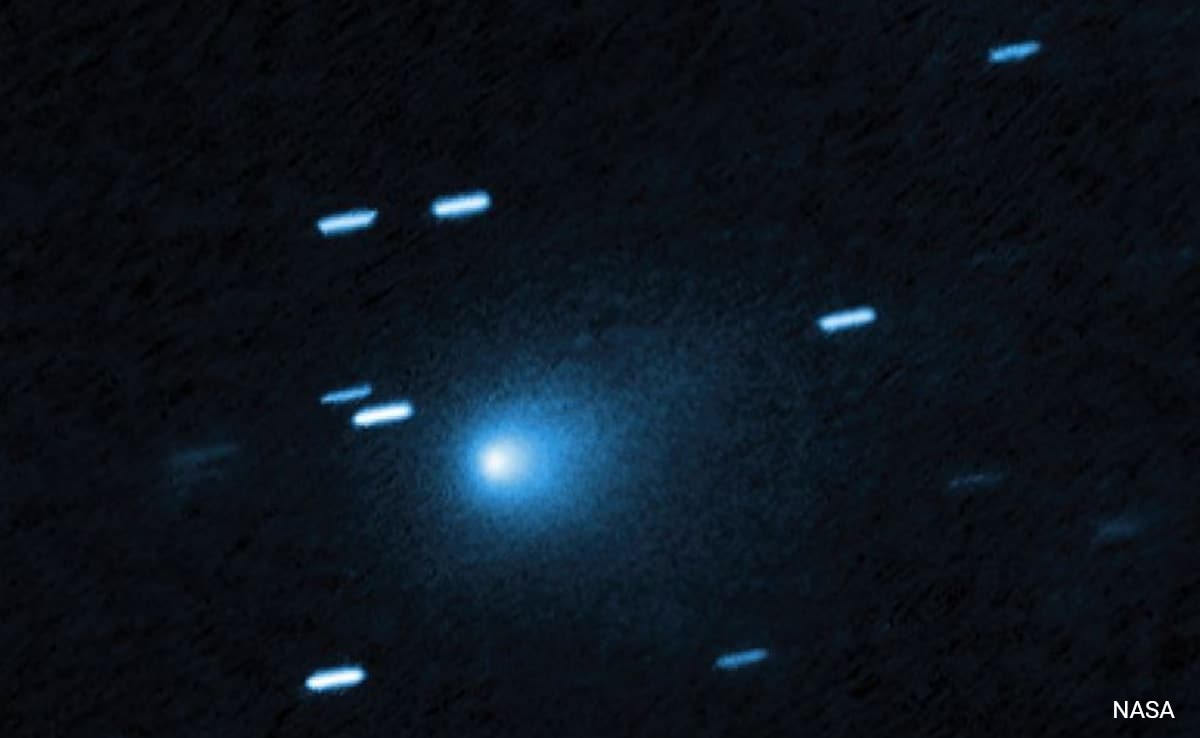
Astronomers around the world are intently studying 3I/ATLAS, an enigmatic interstellar visitor that has exhibited unexpected acceleration and a striking color transformation.
First detected by a Chilean telescope in July, 3I/ATLAS represents only the third confirmed object from beyond our solar system, following Oumuamua and Borisov. NASA has reassured that it presents "no threat" to Earth and will make its closest approach in December, maintaining a safe distance of 269 million kilometers.
By October 29, the object displayed comet-like characteristics before suddenly brightening and shifting to a "distinctly bluer" hue as it approached the Sun.
NASA scientists have documented its velocity at 244,600 kilometers per hour, noting an unusual "kick" in acceleration that cannot be attributed solely to solar gravitational forces.
According to JPL navigation engineer Davide Farnocchia, 3I/ATLAS demonstrates "non-gravitational acceleration" – an additional force beyond solar gravity affecting its trajectory.
Harvard astrophysicist Avi Loeb suggests this acceleration likely results from mass ejection as the comet releases gas and dust into space.
"As it expels this material at a greater rate, it's being kicked in the opposite direction," Loeb explained in his blog. He estimates the comet could shed "about a tenth of its mass" within just one month.
In conversation with NBC News, Loeb noted that Chile's Atacama Large Millimeter/submillimeter Array (ALMA) observed a "deviation by four arcseconds in right ascension from the expected path."
"That's very significant statistically," he remarked, attributing it to "the evaporation of about a sixth of the mass of the object," which he characterized as "a significant fraction."
Loeb anticipates that "such a massive mass loss" should produce a detectable large gas plume surrounding 3I/ATLAS during November and December.
The interstellar visitor has also undergone a color change, appearing bluer as it neared the Sun.
While some reports claimed multiple color changes, Qicheng Zhang from Lowell Observatory clarified: "We don't have any evidence for the gas coma changing colours. Our result just showed that the gas coma is likely still around and contributing substantially to the overall brightness."
Zhang explained that the perceived "color change" occurred once, when its gas coma initially became visible due to solar heating.
"As far as we know, the comet just 'changed colour' once when its gas coma first became visible/bright, and it's still like that now (only brighter)," he stated.
"However, this was already beginning to happen by early September... numerous photos from amateur astronomers from around then already showing that the comet has a blue/green gas coma," Zhang added.
Loeb, who has previously proposed that some interstellar objects might be artificial in origin, considered technological explanations: "Alternatively, the non-gravitational acceleration might be the technological signature of an internal engine. This might also explain the report on 3I/ATLAS getting bluer than the Sun."
He observed that cometary dust typically makes objects appear redder rather than bluer, speculating that the blue color "could potentially be explained by a hot engine or a source of artificial light."
Nevertheless, Loeb acknowledged that natural explanations remain most probable. The blue coloration could "be a signature of ionised carbon monoxide for a natural comet," he noted.
Astronomers were further puzzled when recent images revealed the interstellar comet had lost its tail after its solar approach.
Typically, solar heat causes comets to release gas and dust, forming a distinctive tail, yet 3I/ATLAS's tail mysteriously vanished. Loeb calculated that approximately 13 percent of its mass should appear as a tail, but "no such tail is visible."
NASA and ESA will continue monitoring 3I/ATLAS as it proceeds toward Jupiter in March 2026.
The comet's name follows astronomical naming conventions: comets typically bear their discoverers' names, in this case the ATLAS (Asteroid Terrestrial-impact Last Alert System) survey team in Rio Hurtado, Chile, which first reported the object on July 1.
The "I" in its designation stands for "interstellar," indicating its extrasolar origin, while "3" denotes it as the third known interstellar object identified.
Source: https://www.ndtv.com/world-news/3i-atlas-interstellar-comet-speeds-up-turns-blue-loses-tail-leaves-experts-stumped-9606969