
Hidden Voids Discovered Inside Egypt's Pyramid of Menkaure Reveal Potential Secret Entrance
- Date & Time:
- |
- Views: 66
- |
- From: India News Bull
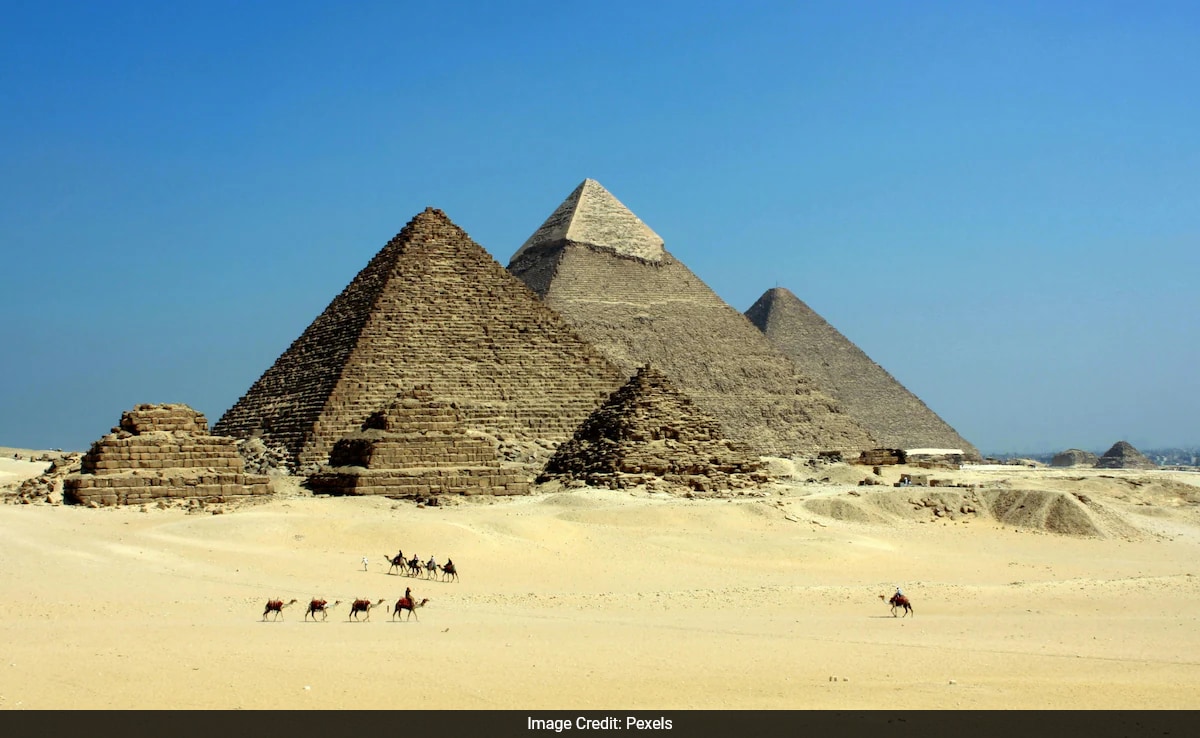
Researchers from the ScanPyramids project have employed non-invasive imaging technologies to investigate the ancient Egyptian structure.
Archaeological teams have identified two concealed cavities within Egypt's Pyramid of Menkaure at Giza, potentially revealing insights about a mysterious lost entrance to this historic monument. The Pyramid of Menkaure, rising nearly 200 feet in height, stands as the smallest of the three principal pyramids in the Giza necropolis complex. Historians believe its construction was completed around 2510 BC during the Fourth Dynasty of Egypt, serving as the final resting place for King Menkaure, according to Newsweek reports.
The discovery emerged from collaborative research between Cairo University in Egypt and the Technical University of Munich (TUM) in Germany, who utilized sophisticated scanning technology. Archaeologists have long been fascinated by an unusual section of polished granite blocks located on the pyramid's eastern facade, measuring approximately 13 feet in height and 20 feet in width. Such polished stonework is otherwise found exclusively on the northern side where the known entrance is situated. Lead investigator Stijn van den Hoven proposed in 2019 that this eastern feature might indicate a second, undiscovered entrance.
The ScanPyramids research team implemented several non-destructive examination methods, including georadar, ultrasound, and electrical resistance tomography to examine the internal structure. Their investigation revealed two air-filled spaces behind the exterior facade, with depths of 4.6 feet and 3.7 feet respectively. The larger void measures approximately 3.2 feet in height and 4.9 feet in width, while the smaller cavity is about 3 feet high and 2.3 feet wide.
Professor Christian Grosse, who specializes in non-destructive testing at TUM, noted that following the identification of an unknown chamber within the Khufu Pyramid in 2023, the ScanPyramids initiative has achieved another significant breakthrough at the Giza complex.
He further emphasized that the examination techniques developed by their team enable researchers to form accurate assessments about the pyramid's interior structure while preserving the integrity of this invaluable historical monument.
Source: https://www.ndtv.com/world-news/archaeologists-discover-hidden-voids-in-egypts-pyramid-of-menkaure-9599041