
James Watson: Pioneer of DNA Double Helix Structure Dies at 97, Leaving Complex Scientific Legacy
- Date & Time:
- |
- Views: 58
- |
- From: India News Bull
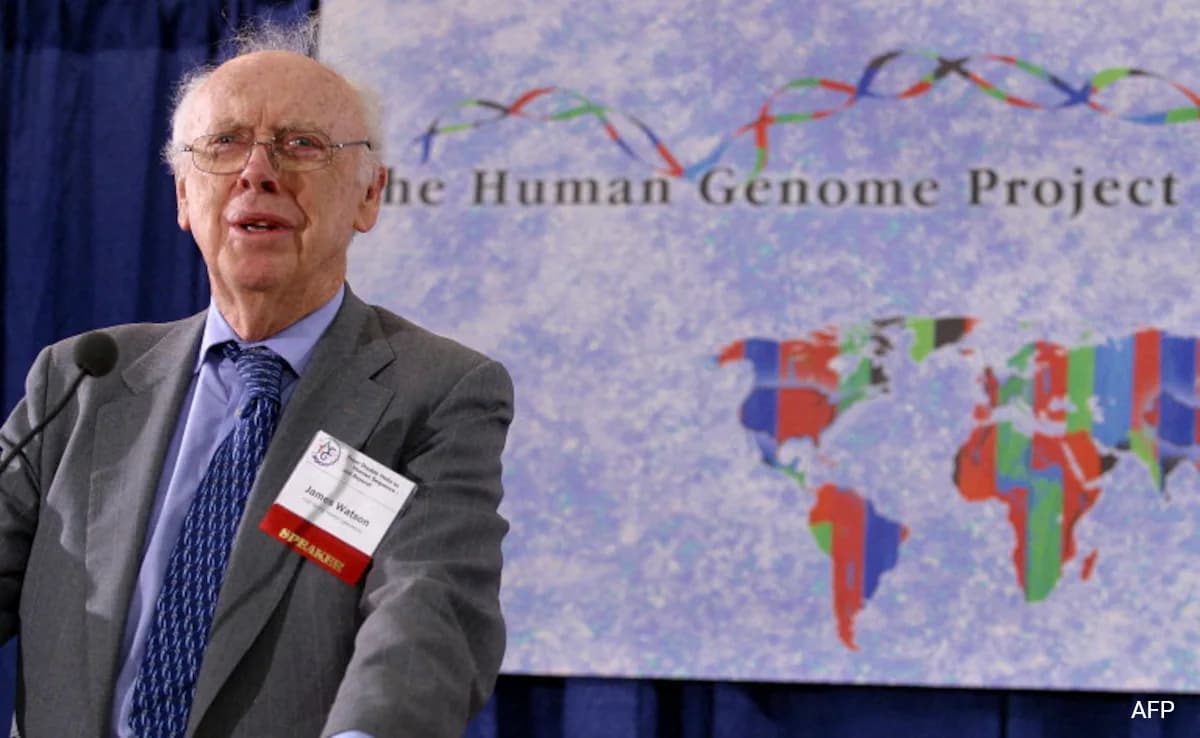
James D. Watson, the renowned scientist whose collaborative discovery of DNA's double-helix structure in 1953 revolutionized medicine, forensics, genealogy, and bioethics, has passed away at age 97, as confirmed by his former research laboratory.
Watson's groundbreaking achievement came remarkably early in his career, when the Chicago-born scientist was just 24 years old. This discovery established him as a revered figure in scientific circles for decades, though his later years were marred by controversy stemming from offensive racial statements, including claims about intelligence differences between racial groups.
In 1962, Watson shared the Nobel Prize with Francis Crick and Maurice Wilkins for identifying that deoxyribonucleic acid (DNA) forms a double helix—two strands coiled around each other resembling a gently twisting ladder. This revelation was transformative, immediately suggesting how hereditary information is stored and how cells replicate their DNA during division, a process beginning with the two strands separating like a zipper.
The double helix transcended scientific circles to become a universally recognized symbol, appearing in Salvador Dali's artwork and even on British postage stamps. This discovery catalyzed numerous scientific advances, including genetic modification, gene therapy, forensic DNA identification, and genealogical tracing. However, it also raised profound ethical questions about altering genetic blueprints for cosmetic purposes or in ways affecting future generations.
"Francis Crick and I made the discovery of the century, that was pretty clear," Watson once stated. He later reflected, "There was no way we could have foreseen the explosive impact of the double helix on science and society."
Though Watson never replicated the magnitude of this discovery, his subsequent contributions to science remained significant. He authored influential textbooks and a bestselling memoir, helped guide the Human Genome Project, mentored promising young scientists, and leveraged his prestige to shape science policy.
Watson's reputation suffered severely in 2007 when the Sunday Times Magazine in London quoted his controversial statements suggesting intelligence disparities between racial groups. Despite apologizing, the international backlash led to his suspension and subsequent retirement as chancellor of Cold Spring Harbor Laboratory in New York, where he had held leadership positions for nearly four decades.
In a 2019 television documentary, when asked if his views had changed, Watson responded, "No, not at all." This prompted Cold Spring Harbor Laboratory to revoke his honorary titles, describing his statements as "reprehensible" and "unsupported by science."
The juxtaposition of Watson's scientific brilliance and controversial statements created a complex legacy. Dr. Francis Collins, former National Institutes of Health director, noted in 2019 that Watson had demonstrated "a regrettable tendency toward inflammatory and offensive remarks," adding, "I only wish that Jim's views on society and humanity could have matched his brilliant scientific insights."
Throughout his career, Watson was known for his disdain of conventional thinking. In his bestselling 1968 book "The Double Helix," he wrote, "A goodly number of scientists are not only narrow-minded and dull, but also just stupid."
His advice for scientific success was characteristically blunt: "You have to avoid dumb people... Never do anything that bores you... If you can't stand to be with your real peers (including scientific competitors) get out of science... To make a huge success, a scientist has to be prepared to get into deep trouble."
Source: https://www.ndtv.com/world-news/james-watson-co-discoverer-of-dna-double-helix-dies-at-97-9596550