
China's Fujian Aircraft Carrier: Advanced Features and Comparison with US Naval Power
- Date & Time:
- |
- Views: 75
- |
- From: India News Bull
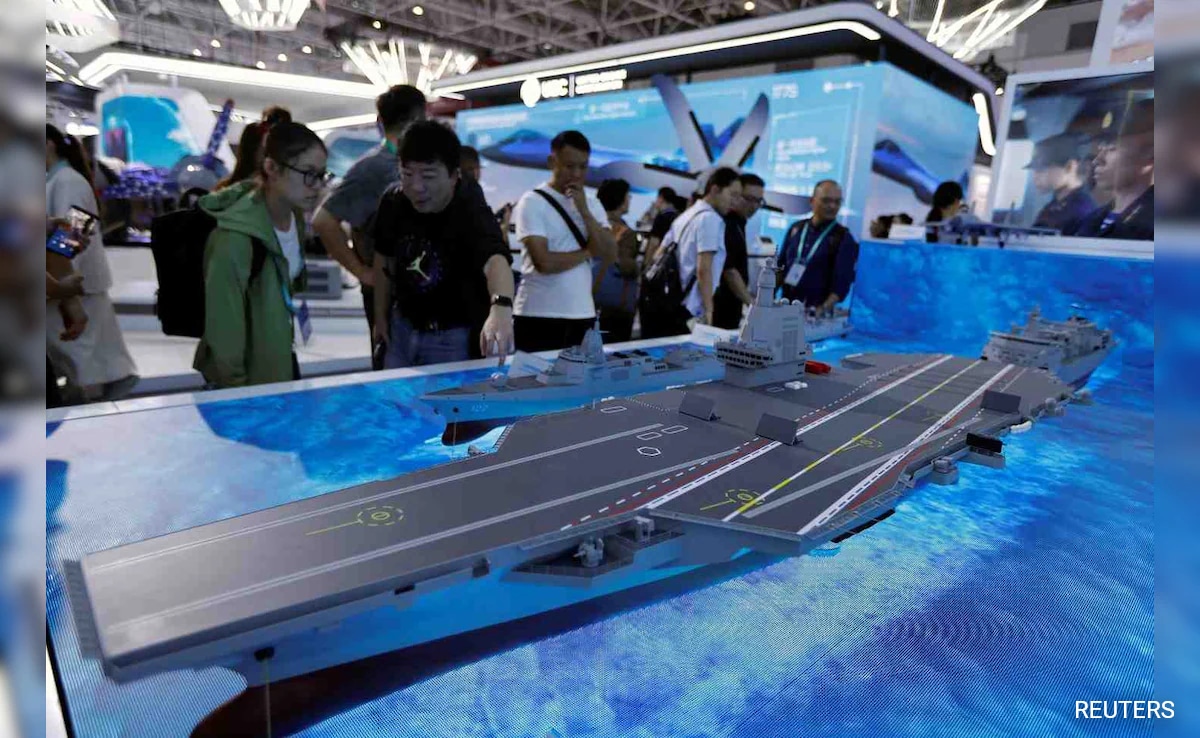
Visitors observe a model of China's Type 003 aircraft carrier Fujian.
China has officially commissioned its third aircraft carrier, the Fujian, making it the nation with the second largest fleet of such vessels globally, though still significantly behind the United States Navy's eleven carriers.
The Fujian was formally put into service during a ceremony attended by President Xi Jinping, as announced by Xinhua news agency on Friday.
The vessel's advanced electromagnetic catapult launch system represents a significant technological achievement that will enhance China's ability to project naval power into the Pacific Ocean, particularly in contested waters of the East China Sea, Taiwan Strait, and South China Sea.
The Fujian marks China's first fully domestically designed carrier. China's first carrier, the Liaoning, was developed from an unfinished Soviet vessel purchased from Ukraine, while the second, Shandong, was built in China following the Liaoning's design. All three carriers bear the names of Chinese coastal provinces.
With these three carriers, China now surpasses India, the United Kingdom, and Italy, each of which operates two aircraft carriers.
The Fujian is China's first carrier equipped with a catapult launch system, enabling it to deploy heavily loaded warplanes including early-warning and control aircraft. This capability allows the carrier to conduct operations against distant targets while at sea without relying on land-based reconnaissance aircraft. The aircraft launched can carry more armaments and fuel, extending their operational range and combat effectiveness.
Unlike the Fujian, the Shandong and Liaoning feature ski-jump decks that limit them to launching fighter jets with reduced payloads and prevent them from operating larger support aircraft.
Globally, the Fujian is only the second carrier to utilize an electromagnetic catapult launch system, following America's USS Gerald R. Ford.
While all eleven American carriers employ catapult launchers, ten Nimitz-class carriers use steam-powered systems rather than electromagnetic technology.
Steam catapults place greater stress on both aircraft and vessel, requiring more maintenance and occupying additional space.
The electromagnetic system operates more efficiently and accommodates a wider range of aircraft, as its launch power can be adjusted for various aircraft types from lightweight drones to heavier planes.
These include China's KJ-600 early warning and control aircraft, along with the advanced J-35 stealth fighter and J-15T heavy fighter.
Unlike American carriers, China's vessels are not nuclear-powered, which restricts their operational duration and range. The Fujian's estimated operational range is between 8,000 to 10,000 nautical miles. U.S. carriers, being nuclear-powered, have virtually unlimited range without refueling requirements.
China appears to be developing nuclear propulsion for future carrier generations, though the timeline remains unclear. Zhang Junshe, a researcher at China's naval research institute, indicated to CCTV in September that the country's carrier development is progressing toward nuclear propulsion.
The Fujian has a full-load displacement exceeding 80,000 tons, compared to the 100,000 tons of America's Nimitz and Ford-class carriers.
While China has not revealed the Fujian's aircraft capacity, experts estimate it can accommodate between 40 to 60 planes. U.S. carriers can deploy 60 to 70 aircraft.
The Fujian features two aircraft elevators versus the USS Ford's three, a smaller flight deck, and three catapults compared to Ford's four. Military analysts suggest these differences mean the American vessel can launch aircraft at a faster rate.
The U.S. Navy expects delivery of its second Ford-class carrier in 2027.
Source: https://www.ndtv.com/world-news/china-commissions-third-aircraft-carrier-fujian-all-you-need-to-know-9592362