
Supreme Court Scrutinizes Legality of Trump's Tariff Authority in Landmark Case
- Date & Time:
- |
- Views: 56
- |
- From: India News Bull
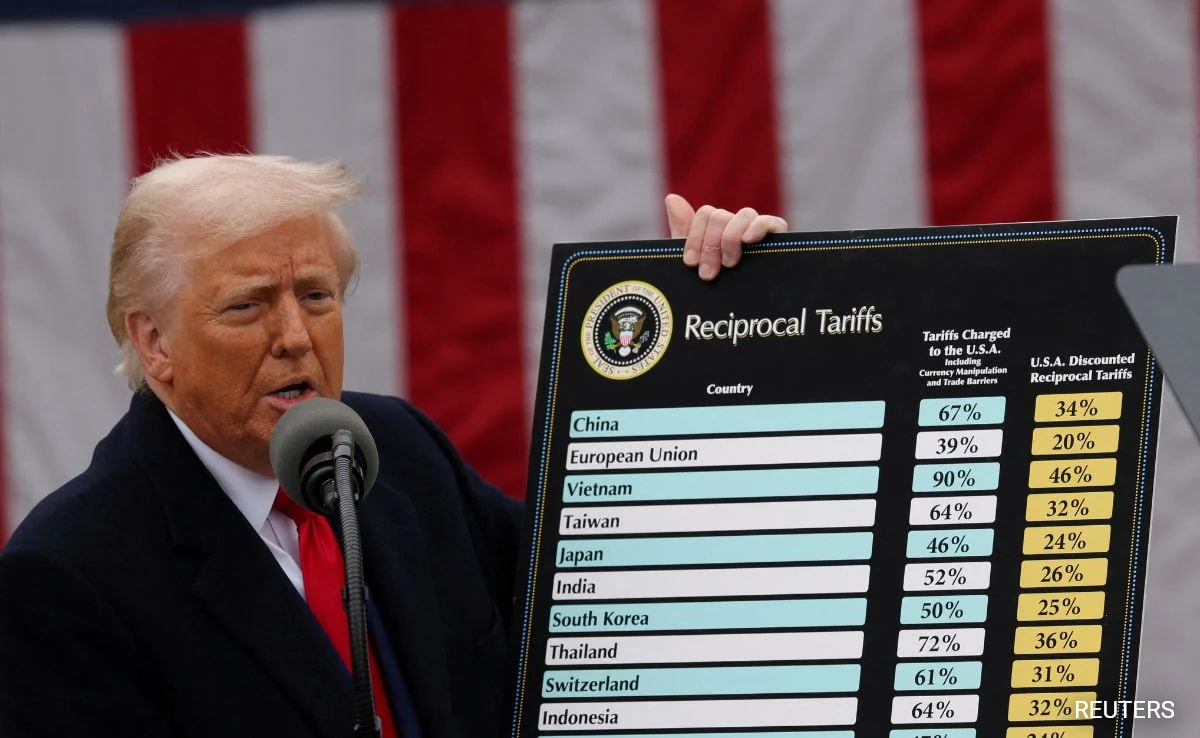
The Supreme Court has demonstrated historical deference to Trump regarding foreign policy matters.
Washington:
On Wednesday, US Supreme Court justices expressed significant skepticism about the legality of President Donald Trump's extensive tariffs in a case that could profoundly impact the global economy and serves as a critical test of presidential authority.
Justices from both conservative and liberal perspectives aggressively questioned the administration's lawyer regarding whether the president had encroached upon congressional power by imposing tariffs under a 1977 law designed for national emergencies.
Several conservative justices, however, also indicated they were grappling with their recognition of inherent presidential powers in foreign affairs, suggesting the court may deliver a deeply divided ruling. The court currently maintains a 6-3 conservative majority.
During arguments extending beyond two and a half hours, justices questioned US Solicitor General D. John Sauer about whether Trump's application of this statute to impose indefinite tariffs constituted a major executive action requiring clear congressional authorization.
These inquiries related to the Supreme Court's "major questions" doctrine, which requires executive branch actions of substantial economic and political significance to have explicit authorization from Congress.
The arguments arose from appeals pursued by the administration after lower courts determined that Trump's unprecedented use of the law exceeded his authority. The tariffs were challenged by affected businesses and twelve US states, predominantly Democratic-led.
These tariffs—taxes on imported goods—could accumulate to trillions of dollars for the United States over the next decade.
Trump has intensely pressured the Supreme Court to uphold tariffs that he has utilized as a crucial economic and foreign policy instrument.
Several conservative justices also directed pointed questions at the two lawyers arguing against the tariffs—Neal Katyal, representing businesses, and Benjamin Gutman, representing Oregon, one of the states involved.
Sauer began by defending the president's legal rationale but immediately faced questions revealing skepticism about the administration's arguments concerning the language and purpose of the relevant statute.
Trump invoked the International Emergency Economic Powers Act, or IEEPA, to impose tariffs on nearly every US trading partner. This law permits a president to regulate commerce during a national emergency.
Sauer argued that Trump determined US trade deficits had brought the nation to the brink of an economic and national security catastrophe. He maintained that the tariffs have helped Trump negotiate trade deals, and dismantling these agreements "would expose us to ruthless trade retaliation by far more aggressive countries and drive America from strength to failure with ruinous economic and national security consequences."
The US Constitution grants Congress, not the president, the authority to issue taxes and tariffs. The administration has contended that IEEPA allows tariffs by authorizing the president to "regulate" imports to address emergencies.
Conservative Chief Justice John Roberts told Sauer that imposing taxes on Americans "has always been the core power of Congress," adding that these tariffs appear to be raising revenue, which the Constitution establishes as a congressional role.
Trump invoked IEEPA to apply tariffs on goods imported from individual countries to address what he called a national emergency related to US trade deficits, as well as in February as economic leverage against China, Canada and Mexico to curb trafficking of fentanyl and illicit drugs into the United States.
Conservative Justice Amy Coney Barrett questioned Sauer about his argument that IEEPA's language granting presidents emergency power to "regulate importation" encompasses tariffs.
"Can you point to any other place in the code or any other time in history where that phrase together 'regulate importation' has been used to confer tariff imposing authority?" Barrett asked.
Trump is the first president to use IEEPA for tariffs, one of many ways he has aggressively pushed the boundaries of executive authority since taking office, spanning areas from immigration enforcement to firing federal agency officials and domestic military deployments.
US Treasury Secretary Scott Bessent stated before the arguments that if the Supreme Court rules against Trump's use of IEEPA, his tariffs would likely remain in place because the administration would employ alternative legal authorities to support them.
Conservative Justice Samuel Alito inquired whether Section 338 of the Tariff Act of 1930, which has received less attention, could provide an alternative basis for Trump's tariffs. Trump has imposed additional tariffs under other laws not at issue in this case.
Trump initiated a global trade war upon taking office in January, alienating trading partners, increasing financial market volatility, and fueling global economic uncertainty. He has wielded tariffs to extract concessions, renegotiate trade deals, and punish countries that provoke his displeasure on non-trade political matters.
Sauer argued that the president's tariff actions did not violate the Supreme Court's "major questions" doctrine. The Court previously applied this doctrine to strike down key policies of Trump's Democratic predecessor Joe Biden.
A lower court ruling against Trump found the tariffs impermissible under this doctrine.
Several justices, questioning Sauer on whether Trump's tariffs would survive scrutiny under the "major questions doctrine," noted that Congress did not include the word "tariffs" in IEEPA.
Roberts challenged Sauer to explain why the court's major questions doctrine wouldn't apply to Trump's tariffs under IEEPA.
"The justification is being used for a power to impose tariffs on any product, from any country, in any amount, for any length of time. I'm not suggesting it's not there, but it does seem like that's major authority, and the basis for that claim seems to be a misfit. So why doesn't it apply?" Roberts asked.
Sauer responded that the doctrine doesn't apply in foreign affairs contexts, but Roberts expressed doubt that presidential power in this domain could override inherent congressional powers.
The Supreme Court has historically shown deference to presidents on foreign policy matters. Roberts emphasized this point while questioning Katyal.
Roberts asked Katyal, "Sure, the tariffs are a tax, and that's a core power of Congress, but they are a foreign-facing tax, right? And foreign affairs is a core power of the executive."
Roberts acknowledged that Trump's tariffs have undoubtedly provided him leverage in negotiating foreign trade agreements. Katyal countered that presidential emergency powers aren't unlimited, and the public needs to understand these limitations.
Barrett noted potential consequences if the justices rule against Trump's tariffs, observing it could be "a mess" for courts to administer refunds to US importers who have already paid these taxes.
The Supreme Court has supported Trump in several emergency decisions issued this year. While the Court typically takes months to issue rulings after arguments, the Trump administration has requested swift action in this case, though the timing remains uncertain.
Liberal Justice Elena Kagan pressed Sauer about his claim that Trump's tariffs are supported by the president's inherent constitutional powers. Kagan stated that taxation power and foreign commerce regulation are typically considered "quintessential" congressional powers, not presidential ones.
Liberal Justice Ketanji Brown Jackson said IEEPA was intended to limit presidential authority, not expand it.
"It's pretty clear that Congress was trying to constrain the emergency powers of the president," Jackson remarked.
Conservative Justice Brett Kavanaugh signaled potential support for Trump, noting that former President Richard Nixon imposed a worldwide tariff under IEEPA's predecessor statute in the 1970s using language similar to "regulate importation."
"That's a good example for you," Kavanaugh told Sauer.
Katyal argued to the justices that common sense clearly shows the administration's interpretation of IEEPA is flawed.
"It is simply implausible that in enacting IEEPA, Congress handed the president the power to overhaul the entire tariff system and the American economy in the process," Katyal stated.
Questions from conservative Justice Neil Gorsuch suggested he believes Sauer's claims about the president's inherent foreign affairs powers could undermine the Constitution's separation of powers between executive and legislative branches.
"What would prohibit Congress from just abdicating all responsibility to regulate foreign commerce - or for that matter, declare war - to the president?" Gorsuch asked.
Gorsuch observed that practically speaking, Congress cannot reclaim authority over tariffs if IEEPA is interpreted as transferring that power to the president. Such interpretation would create a "one-way ratchet toward the gradual but continual accretion of power in the executive branch and away from the people's elected representatives," Gorsuch said.
The IEEPA-based tariffs have generated $89 billion in estimated collections between February 4 and September 23, according to the most recent data from the US Customs and Border Protection agency.
IEEPA empowers the president to address "an unusual and extraordinary threat" during a national emergency. Historically, it had been used for imposing sanctions on enemies or freezing their assets, not for implementing tariffs. When passing IEEPA, Congress placed additional restrictions on presidential authority compared to predecessor legislation.
Source: https://www.ndtv.com/world-news/donald-trump-tariffs-us-supreme-court-questions-legality-of-donald-trumps-sweeping-tariffs-9582801