
Dick Cheney: The Legacy of America's Most Powerful Vice President and His Final Break with the Republican Party
- Date & Time:
- |
- Views: 57
- |
- From: India News Bull
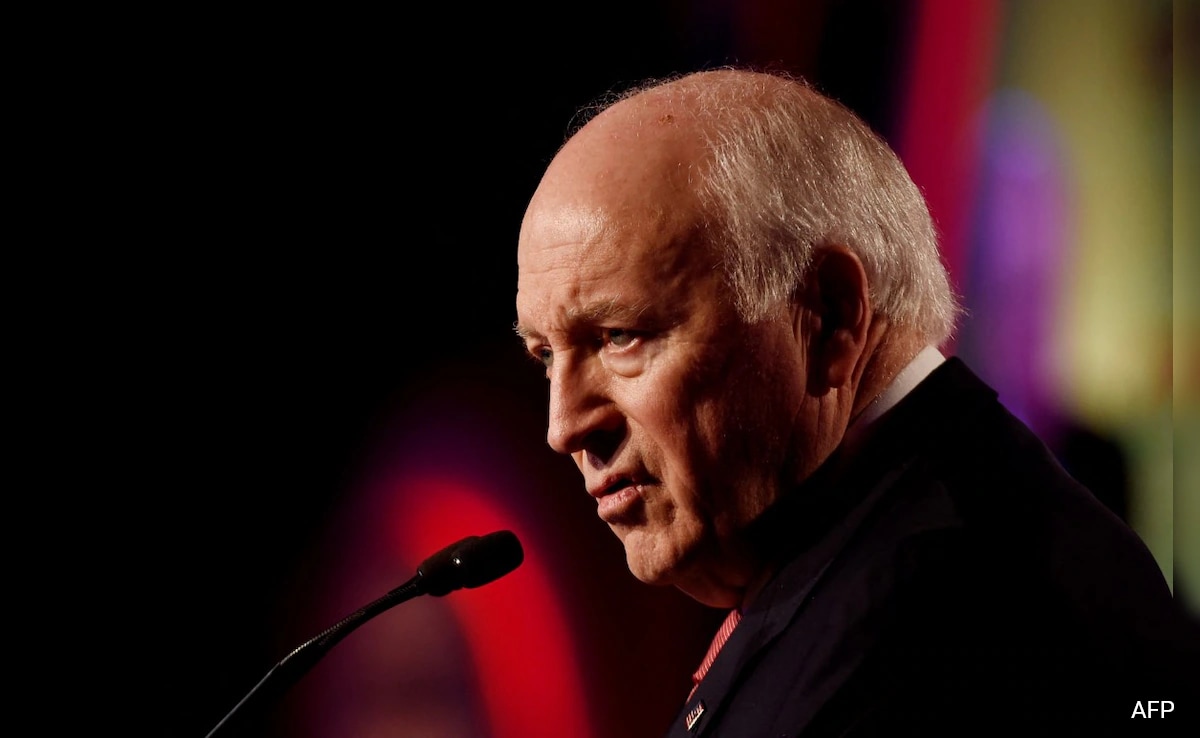
Dick Cheney, one of the most influential and controversial vice presidents in American history, has died at the age of 84.
The conservative political heavyweight passed away Monday night due to complications from pneumonia and cardiac and vascular disease, according to a statement released by his family.
"For decades, Dick Cheney served our nation, including as White House Chief of Staff, Wyoming's Congressman, Secretary of Defense, and Vice President of the United States," his family stated. "Dick Cheney was a great and good man who taught his children and grandchildren to love our country and to live lives of courage, honour, love, kindness, and fly fishing. We are grateful beyond measure for all Dick Cheney did for our country. And we are blessed beyond measure to have loved and been loved by this noble giant of a man."
Cheney's political career spanned generations, serving under both Bush presidencies in key roles that shaped American policy. As defense secretary during George H.W. Bush's administration, he oversaw military operations during the Persian Gulf War. Later, as vice president to George W. Bush, he became arguably the most powerful second-in-command in U.S. history.
Operating as essentially the chief operating officer of the younger Bush's presidency, Cheney wielded extraordinary influence in policy decisions, particularly regarding national security following the September 11, 2001 terrorist attacks. He consistently defended controversial surveillance, detention, and interrogation methods implemented during this period.
In later years, Cheney found himself at odds with the direction of the Republican Party under Donald Trump. His daughter Liz Cheney became Trump's most prominent Republican critic, and the elder Cheney voiced unprecedented criticism of a fellow Republican. "In our nation's 246-year history, there has never been an individual who was a greater threat to our republic than Donald Trump," Cheney declared in a campaign ad for his daughter.
In a remarkable political evolution, the staunchly conservative Cheney even endorsed Democratic candidate Kamala Harris in the most recent presidential election rather than supporting Trump.
Throughout his career, Cheney battled serious health issues, surviving five heart attacks and eventually receiving a heart transplant. He once revealed that he had the wireless function of his defibrillator disabled out of fear that terrorists might remotely trigger a fatal shock.
Cheney redefined the vice presidency from a largely ceremonial position to a power center with significant influence over policy on national security, terrorism, presidential powers, and energy. His half-smile—critics called it a smirk—became his trademark as he embraced his reputation as a behind-the-scenes operator.
"Am I the evil genius in the corner that nobody ever sees come out of his hole?" he once quipped. "It's a nice way to operate, actually."
His unwavering support for the Iraq War became increasingly controversial as many of his assertions proved incorrect. He claimed links between the 9/11 attacks and Iraq that didn't exist, predicted U.S. troops would be welcomed as liberators, and prematurely declared the Iraqi insurgency "in its last throes" in 2005 when the conflict was far from over.
As Bush's second term progressed, Cheney's influence diminished. Courts ruled against his expansive views of presidential authority, and his hawkish positions on Iran and North Korea weren't fully embraced by the administration.
Following the 9/11 attacks, Cheney often operated from undisclosed locations as a security precaution to ensure continuity of government. During the attacks themselves, he maintained a steady presence in the White House until Secret Service agents physically removed him to safety.
Cheney and Bush established an unusual power-sharing arrangement from the beginning. Forgoing any personal presidential ambitions, Cheney was granted authority rarely seen in a vice president.
"I made the decision when I signed on with the president that the only agenda I would have would be his agenda," Cheney once explained. "I was not going to be like most vice presidents – and that was angling, trying to figure out how I was going to be elected president when his term was over with."
His penchant for secrecy occasionally proved problematic, particularly after a 2006 hunting accident in which he shot his friend Harry Whittington. The delayed disclosure of the incident became fodder for comedians for months, though Whittington recovered and forgave Cheney before his death in 2023.
Cheney's path to the vice presidency came through an unexpected route. Initially tasked with leading Bush's search for a running mate, he ultimately became the selection himself. After the contentious 2000 election and its lengthy recount process, Cheney took charge of the presidential transition even before victory was officially secured.
His political career began in 1968 as a congressional fellow, where he became a protégé of Donald Rumsfeld. He served as White House chief of staff under President Gerald Ford at just 34 years old before returning to Wyoming to run for Congress. Despite suffering a mild heart attack during his first House campaign, he won decisively and went on to serve five more terms.
Between his government service, Cheney led Halliburton Corporation, a major oil industry engineering and construction company.
Born in Lincoln, Nebraska, to a family headed by an Agriculture Department worker, Cheney was his high school's senior class president and football co-captain in Casper, Wyoming. Though he initially attended Yale on full scholarship, he left with failing grades before eventually graduating from the University of Wyoming.
He married his high school sweetheart, Lynne Anne Vincent, in 1964. He is survived by his wife and their two daughters, Liz and Mary.
Source: https://www.ndtv.com/world-news/dick-cheney-former-us-vice-president-and-republican-giant-dies-at-84-9574642