
Displaced 11 Times In Two Years, A Palestinian Family Is Now Facing Starvation
Exhaustion, despair and anger are grinding away at Ne'man Abu Jarad. Once again, for the 11th time, he and his family have been forced to uproot and move across the Gaza Strip.
- Date & Time:
- |
- Views: 83
- |
- From: India News Bull
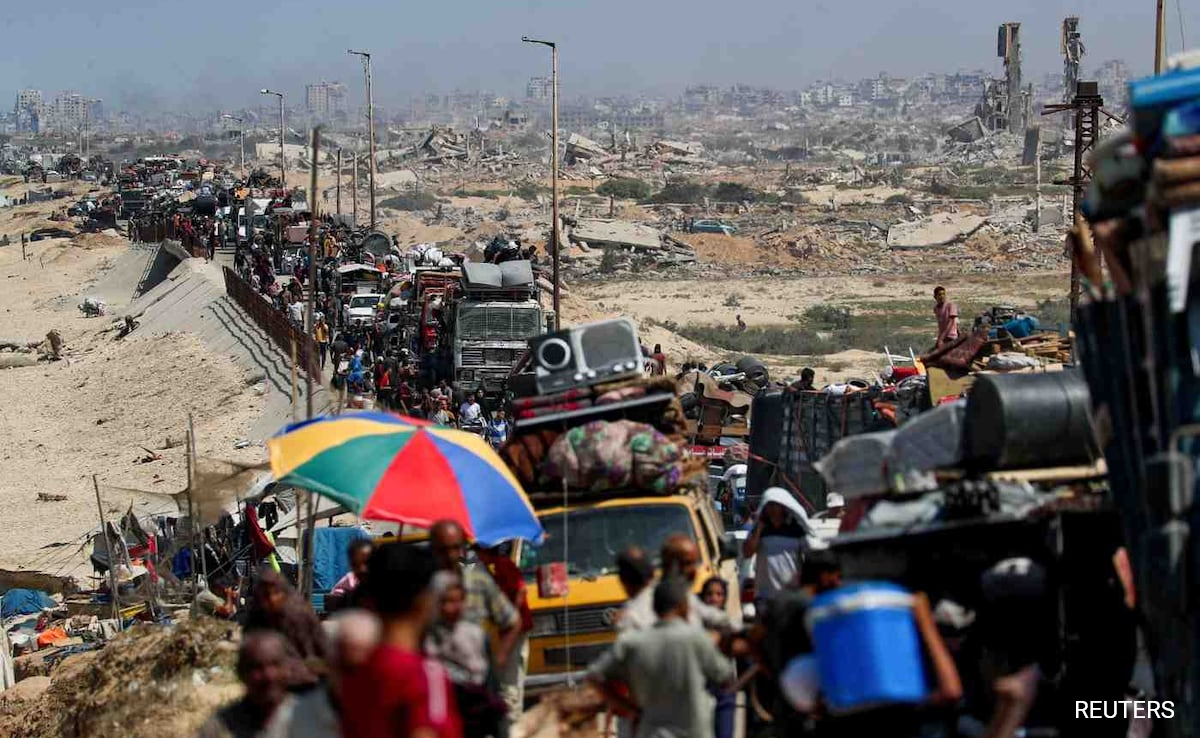
Palestinians fleeing northern Gaza amid ongoing Israeli military operations
Ne'man Abu Jarad and his family are being crushed under the weight of exhaustion, despair, and anger. For the eleventh time since the Gaza conflict began, they've been forced to relocate across the war-torn territory.
"This isn't displacement—it's a continuous cycle of torture. We're not just moving; we're slowly dying," Ne'man lamented last week as his family packed their meager belongings and dismantled their tents in Gaza City, fleeing the intensifying Israeli bombardment preceding a planned military invasion.
The following day, they established a new temporary home on barren former farmland outside Khan Younis in southern Gaza, facing the immediate challenge of securing food and water in unfamiliar surroundings.
This nomadic existence has defined the Abu Jarads' reality for nearly two years, since they first evacuated their northern Gaza home shortly after Israel launched its offensive following Hamas' October 7, 2023 attack. Like countless Palestinian families, they've traversed Gaza repeatedly, forced to relocate every few months as Israeli forces target each new refuge. The Associated Press has documented much of their ongoing ordeal.
During January's ceasefire, they experienced a bittersweet homecoming to their damaged but still standing house. However, within two months, the ceasefire collapsed, forcing the Abu Jarads to abandon their home once again.
Throughout each relocation, Ne'man and his wife Majida strive to maintain some semblance of normalcy for their six daughters and 2-year-old granddaughter amid the hardships of tent living. Their children range from 8-year-old Lana to Balsam, who is in her twenties and married.
The sense of futility grows heavier with each passing day. Ne'man sees no end in sight and fears worse to come.
"The future looks bleak," he said. "We might be expelled from Gaza completely. We might perish... Death feels ever-present. We're just scurrying from place to place, trying to outrun it."
"It's increasingly difficult for our daughters. They struggle to adapt each time they finally adjust to new circumstances," Majida added.
Since May, the family had found temporary shelter in a tent in Gaza City. Despite challenges, they had established a routine—becoming familiar with the neighborhood and neighbors, identifying water sources and medical facilities.
Their daughters reconnected with pre-war friends who were also displaced nearby. A neighboring family allowed their daughter Sarah to use their internet connection for online high school studies. The girls downloaded books to their phones for education and to pass time.
Food acquisition proved more challenging as Israeli restrictions on humanitarian aid pushed Gaza City toward famine. Ne'man joined hundreds waiting for aid trucks entering from Israel—a dangerous endeavor where Israeli forces regularly fired upon crowds. Majida recounted how her husband witnessed people being killed and wounded, yet he sometimes returned with vital supplies.
Recently, they found a school for Lana. "She was thrilled at the prospect of having structure in her life again," Majida recalled.
However, Israel ordered another evacuation in preparation for a new military offensive in Gaza City, ostensibly to dismantle Hamas, free hostages, and establish security control. The bombardment intensified—one strike demolished an apartment building just a block away, sending shrapnel through the Abu Jarads' tent. Another destroyed a house across the street, killing family members sitting outside, according to Ne'man.
Lana had attended only three days of classes before they were forced to flee. Last Thursday, they joined the growing exodus of Palestinians heading southward.
The next day in their new encampment, Lana, wearing pink pajamas and leaning against her father, described how her best friends Sila and Joudi had bid her farewell as they left Gaza City. They embraced her, expressed their love, and wept—but Lana remained stoic.
"I didn't cry," she asserted firmly. "I won't cry at all. I refuse to be sad."
Majida and Ne'man worry particularly about Lana's development. Their older daughters experienced normal life before the conflict, but Lana was only six when war upended their existence.
"She's developing her worldview amid warfare, bombardment, and tent living," Majida observed.
Lana displays a stubborn, impatient temperament. "My sisters tolerate things I cannot," she stated plainly. The discomforts of displacement—particularly makeshift sanitation—deeply upset her. "Even simple activities like reading are uncomfortable," she added.
Over months of displacement, numerous pressures push the family to their breaking point—monotony, lack of privacy, the daily struggle to obtain water, gather firewood, search for food, and maintain their tent. Underlying these practical challenges are darker anxieties: the fear this might be their permanent reality, and the constant threat of deadly airstrikes.
Confined in close quarters, sibling conflicts inevitably erupt among the daughters.
"We were once a model family—understanding and harmonious," Ne'man reflected. "I never imagined reaching this point. I fear our family might fracture under such relentless pressure."
Their latest relocation depleted their remaining funds—hundreds of dollars to purchase a new tent and rent transportation for their belongings.
It also stripped away everything that had made their situation somewhat bearable. Their new location sits in a desolate area of dirt and abandoned fields. Markets and schools are nonexistent. Internet access requires a two-kilometer walk. They're surrounded by strangers.
"We're essentially living in a desert," Ne'man observed.
Last Friday morning, their daughters walked over a kilometer to reach a passing water truck, which ran dry before they could fill all their containers.
The family spent that day preparing their plot of land and assembling two tents—one for the immediate family and another for Ne'man's sister. As they worked, an Israeli airstrike resonated in the distance. They watched black smoke rise over Khan Younis. Despite exhaustion by day's end, Ne'man still needed to dig a latrine and construct a bathroom facility.
Their current location was a restricted Israeli military zone until recently, when Israel announced displaced persons could relocate there. An Israeli military position remains nearby, with visible tank movements.
"This area isn't secure," Ne'man stated.
Majida tried focusing on practical matters to maintain hope.
She suggested that if water deliveries eventually come closer, her daughters wouldn't need to walk as far and would complain less. Establishing a designated cooking and washing area would help create daily structure.
"The more elements of normal daily life we can establish, the more comfortable we'll become," Majida said, repeatedly insisting, "Things will improve," though her voice betrayed no genuine optimism.
Four days later, on Tuesday, Ne'man sent a voice message to the Associated Press.
"We're sitting here unable to eat," he reported. With virtually no money for food and no humanitarian aid reaching them, their situation had deteriorated further.
More distressingly, a man claiming land ownership had arrived with armed associates, demanding rent payment or eviction. Ne'man can afford neither rent nor the expenses of another relocation, yet may have no alternative.
"We face starvation soon," he said. "After two years, we're completely depleted—physically, mentally, financially. We cannot endure any more hardship."