
SNAP Suspension: How Federal Food Aid Cuts Disproportionately Impact Black Americans
- Date & Time:
- |
- Views: 47
- |
- From: India News Bull
Black unemployment has increased from 6.2% to 7.5% this year, reaching its highest point since October 2021.
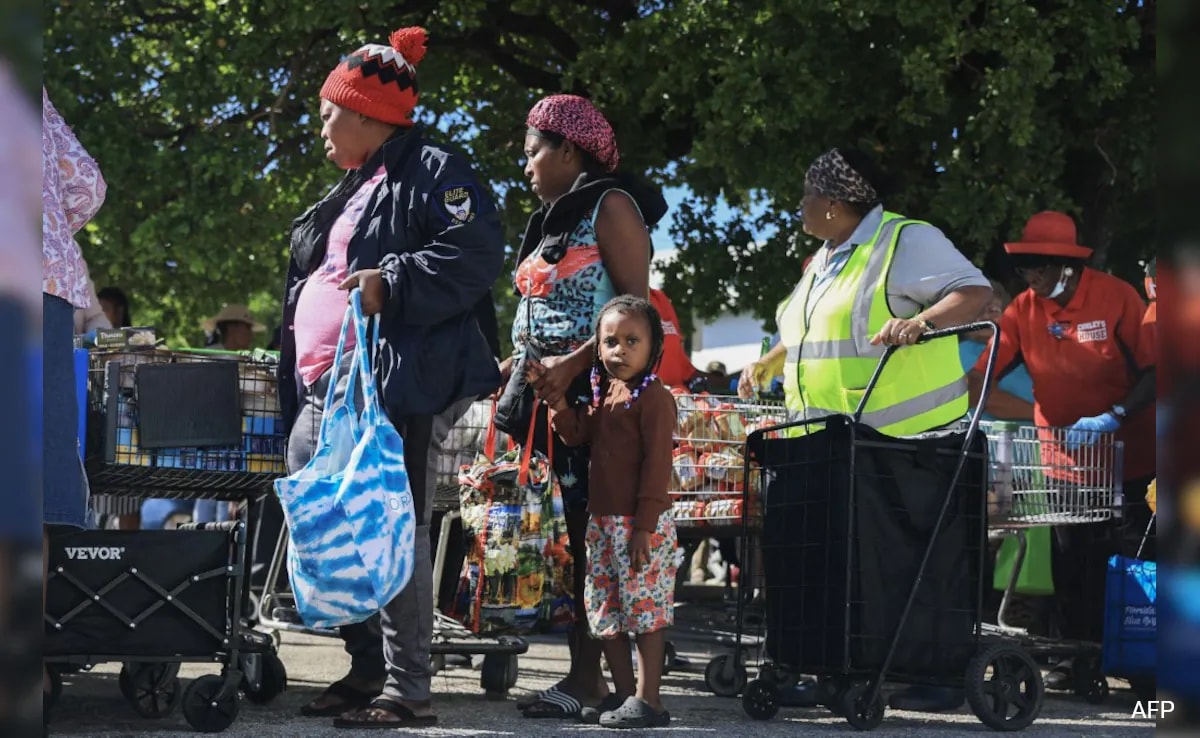
In one of America's wealthiest neighborhoods, people line up alongside the Holy Apostles Soup Kitchen and Pantry seeking assistance.
Willy Hilaire, a 63-year-old homeless and unemployed man, resides in a New York shelter with his two grandchildren. He frequently goes hungry to ensure his grandchildren can eat the food he receives through the Supplemental Nutrition Assistance Program (SNAP).
Many days, Hilaire's only nourishment comes from the hot meal provided by Holy Apostles in Manhattan's Chelsea district. With SNAP benefits threatened, he worries about having enough food for himself and the children, requiring even more sacrifice.
"I always tell them, 'Grandpa is there for you,'" he shared. "'Whatever I have, I'll give it to you.'"
On Friday, two federal judges ruled almost simultaneously that President Donald Trump's administration must continue funding SNAP, the nation's largest food assistance program, using contingency funds during the government shutdown. However, officials indicated it was too late to prevent recipients from losing benefits on Saturday and restoring them would likely take at least a week.
While one in eight Americans utilizes SNAP, its interruption will disproportionately affect Black Americans like Hilaire. Black people comprise 12.6% of the population but represent more than a quarter of SNAP recipients, the largest overrepresentation of any ethnic or racial group. Other racial groups participate in SNAP at rates lower than their overall population share.
Historians and advocates describe this disparity as an example of systemic racism. Though no explicitly racist policy may exist, America's extensive history of racism—from slavery to discriminatory zoning regulations—has left Black communities with numerous structural disadvantages and significantly less accumulated generational wealth.
Non-Hispanic white people constitute 58.1% of the population but only 35.4% of SNAP recipients, according to the latest data.
Hispanic and Asian populations are underrepresented in SNAP statistics. Native Americans participate in SNAP at approximately the same rate as their representation in the general population.
Asian Americans living in poverty face challenges including limited English proficiency and neighborhood gentrification. In New York City, 253,000 of the 1.5 million Asian residents receive SNAP benefits, according to the nonprofit Asian American Federation. Over 91% of them are employed. However, limited English proficiency restricts their job opportunities, explained CEO Catherine Chen. Families who have lived comfortably in cultural enclaves like Chinatown for one or two generations are being priced out of their neighborhoods.
Most adult SNAP recipients who can work do so. Some still qualify for SNAP—typically $187 monthly—despite holding one or more jobs, according to nonprofit advocates. These are often low-wage positions without benefits such as paid sick leave.
A National Urban League report last year found that the racial income gap has remained virtually unchanged for over 20 years, with Black Americans earning, on average, 64% of what white people earn.
"There's so much discrimination in the work force, so much discrimination in America today, that Black people who were enslaved and segregated for 350 years are still fighting for economic parity," said Marc Morial, president of the civil rights group. "While we have a growing number of African American, middle-class Americans, we still have a disproportionate number of poor (Black) Americans."
At the current rate, it could take between one and three centuries for most Black Americans to achieve parity with their white counterparts, depending on where they live, according to the McKinsey Institute for Black Economic Mobility.
This year, Black unemployment rose from 6.2% to 7.5%, the highest level since October 2021. Black homeownership fell to its lowest level in four years, according to an analysis by real estate brokerage Redfin. The Census Bureau reported that median Black household income decreased 3.3% last year to $56,020—approximately $36,000 less than white household earnings.
The impending absence of grocery funds would almost certainly make it harder for families to afford rent, gas, and other expenses. Even if SNAP benefits are restored before November ends, nonprofit leaders warn that low-income residents could experience financial setbacks into next year.
For tribal nations, food and nutrition assistance programs represent part of the US government's trust and treaty responsibilities—legal and moral obligations to fund tribes' health and well-being. The US pledged to uphold these rights in exchange for land and resources taken from Indigenous peoples.
However, these rights continue to be chronically underfunded and particularly vulnerable during government shutdowns, according to a report released last week by the Brookings Institution. The study found that in 2024, over two-thirds of trust and treaty responsibilities were funded through discretionary spending, meaning they aren't guaranteed during a shutdown. It also noted that one of the largest sources of mandatory spending owed to tribes comes through SNAP benefits.
Another US Department of Agriculture program that provides food to income-eligible Native American households, the Food Distribution Programme in Indian Reservations, continues to operate. However, Native Americans already enrolled in SNAP cannot participate in that program. FDPIR President Mary Greene-Trottier said in October that her agency requested a waiver from USDA Undersecretary Patrick Penn, which was granted for November, according to a letter Greene-Trottier received Friday.
She anticipates a substantial increase in demand for her program once SNAP benefits cease.
"I've heard the pleas from people in the community and outside the community who are really concerned about not having enough food to eat and choosing between paying medical bills or utility bills that are increasing," Greene-Trottier said.
"I can't say this loud enough, but this is the weaponization of food again," she added, referencing the US government's historical policies of withholding or cutting off food supplies to starve tribal nations during the country's expansion.
Meanwhile, tribal nations across the country—including Spirit Lake Nation, Cherokee Nation, Blackfeet Nation, Standing Rock Sioux Tribe, and the Shawnee Tribe—have declared states of emergency ahead of the loss of SNAP benefits.
The disproportionate need for food stamps among non-white households has contributed to misinformation and stereotypes. Beginning in the 1960s, the term "welfare queen" gained popularity, playing into assumptions that poor people of color were profiting from government assistance rather than seeking employment.
However, two-thirds of the over 40 million SNAP beneficiaries are individuals not typically expected to work. Thirty-nine percent are children, 20% are elderly, and 10% are children or non-elderly adults with disabilities, according to the Urban Institute.
Pastor Cleo Lewis, who usually conducts street ministry in Phoenix, organized a food drive for the first time to help cushion the blow for the 30 families he counsels at a local shelter.
"We usually are dealing with areas that are spiritually related," Lewis said. "Now we're having to increase our presence, and dealing with issues of substance and material issues that we know are significant, but we relied on other professionals to deal with this."
Source: https://www.ndtv.com/world-news/how-end-of-federal-food-aid-could-hit-black-americans-9564249