
Amazon Rainforest Time Machine: Scientists Simulate Future Climate Conditions to Test Forest Resilience
- Date & Time:
- |
- Views: 47
- |
- From: India News Bull
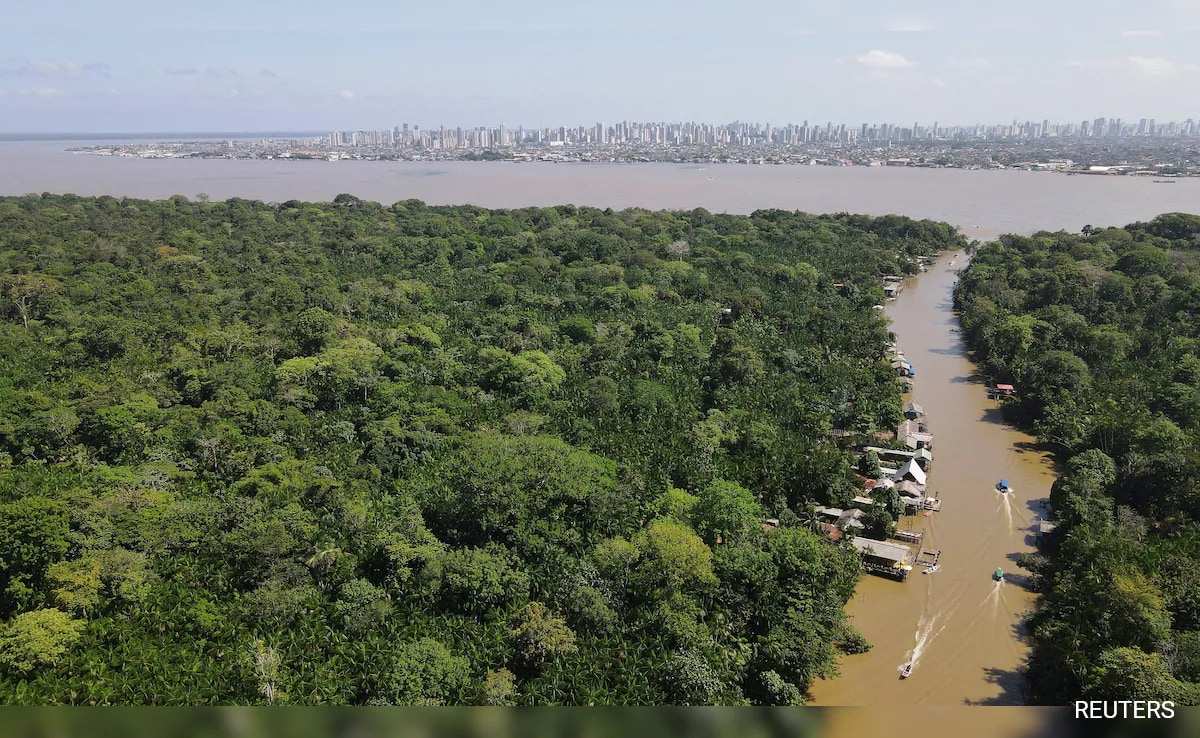
Amazon rainforest in Brazil
Scientists deep within Brazil's Amazon have constructed a remarkable "time machine" that pumps carbon dioxide into the rainforest canopy to simulate future atmospheric conditions. This innovative approach aims to evaluate how the vital biome will adapt to climate change—a critical question that will be addressed at the upcoming COP30 United Nations climate summit hosted by Brazil next month.
Near Manaus, the Amazon's largest urban center, the AmazonFACE project features six imposing rings of steel towers that extend above the jungle canopy, each encircling clusters of 50 to 70 mature trees.
Following baseline testing, researchers will expose trees in three rings to carbon dioxide concentrations that mirror climate predictions for coming decades, while the remaining rings function as control samples.
"We're trying to create the atmosphere of the future," explained Carlos Quesada, a coordinator at the National Institute for Amazon Research (INPA), which is spearheading this experiment in partnership with Universidade Estadual de Campinas.
Scientists emphasize that protecting tropical rainforests like the Amazon is essential for mitigating the worst effects of climate change. At the climate conference scheduled for November 10-21 in Belem, where the Amazon Basin meets the Atlantic Ocean, policymakers will confront uncertainties about the rainforest's capacity to adapt to a warming planet and changing atmospheric conditions.
FACE, which stands for Free-Air CO2 Enrichment, will enable Quesada and his scientific team to investigate how elevated carbon dioxide levels affect the rainforest giants and surrounding vegetation. The project receives support from Brazil's federal government and the United Kingdom.
While FACE experiments have been conducted globally—including in the United States, where the Department of Energy tested temperate biomes—AmazonFACE represents groundbreaking research, according to forestry engineer Gustavo Carvalho.
"This is the first experiment in a natural forest of this size in the tropics," Carvalho stated beneath the Amazon's canopy shade.
With baseline testing currently underway, sensors record the forest's responses to changing conditions every 10 minutes, demonstrating how tree foliage absorbs carbon dioxide while releasing oxygen and water vapor in reaction to rain, storms, and sunshine, Carvalho explained.
Future experimentation will create artificial microclimates with increased carbon dioxide concentrations.
"If a model predicts a certain amount (of carbon dioxide in the atmosphere) in 2050 or 2060, then we'll increase to that amount in these plots to try to understand how the forest responds," Carvalho noted. "We'll have a small plot here in the forest that we can enter and know what will happen in the future."
Source: https://www.ndtv.com/world-news/can-brazils-amazon-rainforest-survive-future-scientists-test-it-with-time-machine-ahead-of-cop30-9550510