
Rio Police Raid Leaves 132 Dead in Controversial Anti-Gang Operation
- Date & Time:
- |
- Views: 56
- |
- From: India News Bull
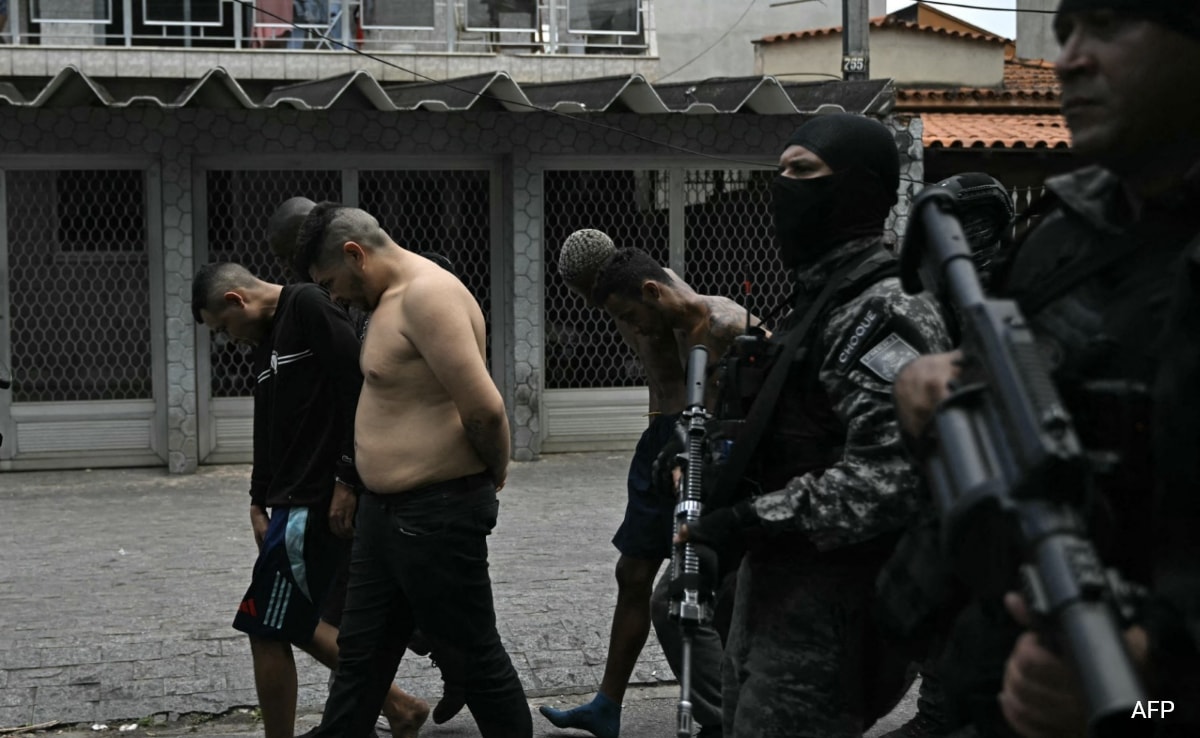
A massive police operation in Rio de Janeiro's low-income neighborhoods resulted in at least 132 fatalities, officials confirmed Wednesday, following widespread criticism regarding the use of excessive force during the raid.
The death toll, comprising 115 suspects and 4 police officers, significantly exceeded the initial report of 60 suspect casualties from Tuesday's large-scale operation, which involved approximately 2,500 police officers and military personnel in the favelas of Penha and Complexo de Alemao.
Rio state police secretary Felipe Curi revealed at a press conference that additional bodies were discovered in a wooded area where suspects had reportedly used camouflage during confrontations with security forces. Curi noted that local residents had apparently removed tactical gear and clothing from the bodies, an action he described as evidence tampering that would be investigated.
"These individuals were positioned in the woods wearing camouflage clothing, vests and carrying weapons. Many bodies were later found in underwear or shorts, without equipment, as if they had somehow changed clothes," Curi explained.
Earlier Wednesday in Penha, residents surrounded numerous bodies that had been collected in trucks and displayed in a main square, shouting "massacre" and "justice" until forensic authorities arrived to retrieve the remains.
Curi reported that 113 suspects had been arrested, an increase from the previously cited 81. The state government also announced the seizure of 93 rifles and over half a ton of narcotics during the operation.
The raid had been executed via helicopters, armored vehicles, and ground forces, targeting the Red Command gang. Security forces encountered fierce resistance, including gunfire from gang members, resulting in chaos throughout the city on Tuesday. Educational institutions in affected areas closed, a local university canceled classes, and roads were blocked by buses used as barricades.
Local activist Raull Santiago reported Wednesday morning that he participated in a team that discovered approximately 15 bodies before dawn in Penha.
"We discovered executed individuals: shot in the back, head wounds, stab injuries, and bound victims. The level of brutality and hatred can only be characterized as a massacre," Santiago stated.
Rio state Governor Claudio Castro declared on Tuesday that Rio was engaged in a war against "narco-terrorism," terminology reminiscent of the Trump administration's campaign against drug trafficking in Latin America.
Rio's state government maintained that those killed had resisted police intervention.
Rio has a long history of deadly police operations. In March 2005, approximately 29 people were killed in Rio's Baixada Fluminense region, while 28 fatalities occurred in May 2021 in the Jacarezinho favela.
However, Tuesday's operation was unprecedented in both scale and lethality. Non-governmental organizations and the United Nations human rights body promptly expressed concerns regarding the high number of casualties and called for thorough investigations.
The operation's stated purpose was to capture Red Command leadership and restrict the criminal organization's territorial expansion, which has increased its control over favelas in recent years.
Gang members allegedly deployed at least one drone against police forces. Rio de Janeiro's state government shared video footage on social media platform X appearing to show a drone launching a projectile from the air.
Governor Castro, representing the conservative opposition Liberal Party, claimed Tuesday that Rio was "alone in this war" and suggested that the federal government should provide greater support in combating crime—a criticism directed at leftist President Luiz Inácio Lula da Silva's administration.
The Justice Ministry contested Castro's remarks, stating it had responded to requests from Rio's state government to deploy national forces in the region, renewing their presence on 11 separate occasions.
Gleisi Hoffmann, the Lula administration's parliamentary liaison, acknowledged the need for more coordinated action while highlighting a recent money laundering crackdown as evidence of federal government efforts against organized crime.
President Lula's chief of staff, Rui Costa, requested an emergency meeting Wednesday in Rio with local authorities and Justice Minister Ricardo Lewandowski.
Criminal organizations have expanded their influence across Brazil in recent years, including into the Amazon rainforest region.
Filipe dos Anjos, secretary general of favela rights organization FAFERJ, criticized these police operations as ineffective, noting that casualties are easily replaced within criminal hierarchies.
"Within approximately thirty days, organized crime will have reorganized in the territory, continuing its typical activities: drug sales, cargo theft, and extortion," he observed.
"In terms of tangible benefits for the population and society, this type of operation accomplishes virtually nothing," dos Anjos concluded.
Source: https://www.ndtv.com/world-news/why-a-police-raid-in-rio-turned-deadly-leaving-132-dead-9541074