
The Evolution of Modern Warfare: How Drones and Missiles Are Reshaping the Ukraine Conflict
- Date & Time:
- |
- Views: 44
- |
- From: India News Bull
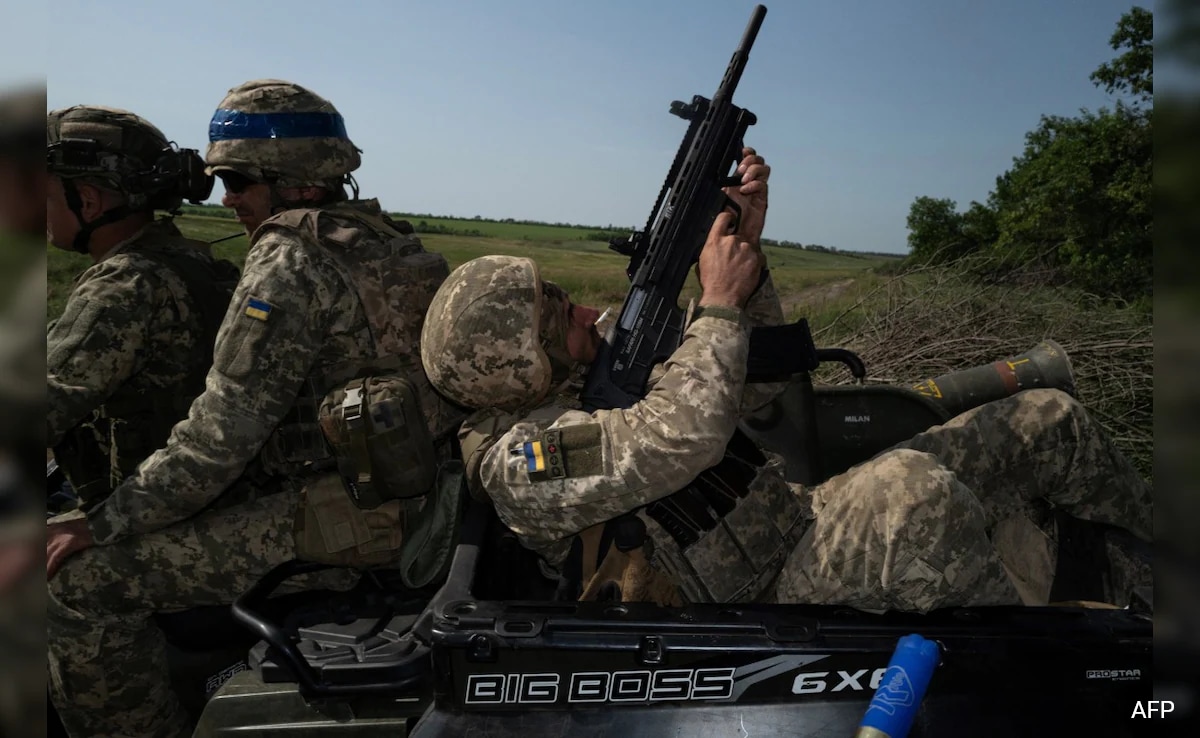
A marksman fires an automatic weapon into the air during a training exercise with Ukrainian Forces
Ukraine's allies are convening in London on Friday with President Volodymyr Zelensky and British Prime Minister Keir Starmer advocating for the delivery of additional long-range missiles to Kyiv.
These missiles represent just one component of a rapidly evolving arsenal being deployed across both sides of the front line, as the three-and-a-half-year conflict has transformed the landscape of modern warfare.
Below are the primary weapons utilized throughout the conflict, as both sides have shifted toward developing more cost-effective and agile armaments, particularly drones, in an effort to gain strategic advantage.
Drones have emerged as the conflict's most lethal weapon, being launched by the hundreds daily by both sides. They have fundamentally reshaped battlefield dynamics and forced soldiers to seek underground protection.
On the frontline, these unmanned aerial vehicles can detect troop movements, survey skies deep behind enemy territory, or direct artillery strikes with precision.
The compact FPV (first-person view) devices are remotely controlled and can be equipped with explosive ordnance including shells and grenades.
This technology continues to evolve rapidly, incorporating artificial intelligence and fiber-optic drones tethered by cables extending up to 40 kilometers to prevent wireless signal jamming.
Both sides also employ larger attack drones capable of carrying explosives, particularly for striking infrastructure far from the frontlines at minimal cost.
Russia utilizes Geran drones, based on Iranian Shaheds, and Lancet drones, frequently deployed against Ukraine in substantial numbers.
Ukraine relies on Turkish-manufactured Bayraktar drones and various models produced domestically or by Western allies.
Near the front, critical roadways have been covered with anti-drone netting, while Russia has draped extensive nets over certain energy facilities that Ukraine frequently targets.
Missiles, though significantly more expensive, are typically deployed against strategic targets after drones have overwhelmed air defense capabilities.
Russia maintains dominance in this sector with an arsenal comprising cruise missiles flying quasi-horizontal trajectories (Kh-101, Kalibr), ballistic missiles following curved trajectories (Iskander), and hypersonic missiles capable of extreme speeds and mid-flight trajectory adjustments (Kinzhal).
In November 2024, Moscow fired an experimental missile called Oreshnik for the first time, capable of carrying multiple nuclear warheads, targeting a military factory in central Ukraine.
Ukraine possesses a limited inventory of missiles supplied by allies: British Storm Shadow and French SCALP, alongside American ATACMS and HIMARS. However, these lack the range of Russian missiles, which can travel hundreds or thousands of kilometers.
Kyiv has been requesting Tomahawk cruise missiles from Washington to enable deeper strikes, though these requests have thus far been declined by President Donald Trump.
Ukraine also aims to mass-produce its own missile, designated Flamingo.
For airspace protection, both nations heavily depend on air defense systems.
Ukraine utilizes modern American Patriot or European IRIS-T, NASAMS, and SAMP/T batteries supported by mobile brigades. Russia relies on S-400/S-300, Buk, Tor, and Pantsir batteries.
In 2024, Ukraine received F-16 fighter jets from Western allies to counter Russian aerial attacks. Kyiv has acknowledged losing at least four of these aircraft in combat operations.
Tanks and armored vehicles—once crucial battlefield elements at the war's outset—have become substantially less prominent on the front line, being considered too costly and vulnerable to inexpensive drone attacks.
Russian forces have lost numerous T-90, T-80, and T-72 tanks during their offensive campaigns, according to open-source intelligence assessments.
Ukraine, which received Western Leopard, Challenger, and Abrams tanks for its major 2023 counter-offensive, encountered Russian defensive positions that proved impenetrable.
Some units on both sides now utilize motorcycles for transportation.
Others have modified their vehicles for enhanced durability, many resembling props from the post-apocalyptic "Mad Max" film franchise.
Artillery has also been extensively employed along the front, with a 2024 European estimate indicating that Russia's army alone fires approximately 10,000 shells daily—equivalent to one-tenth of France's annual production capacity.
In August, Zelensky stated that Russia was firing almost two-and-a-half times more artillery than Ukrainian forces.
Source: https://www.ndtv.com/world-news/drones-glide-bombs-patriots-inside-the-arsenal-powering-ukraine-war-9510807