
Botox And Beards In Afghanistan: Cosmetic Surgery Flourishes Under Taliban Rule
Decked out with fake crystal chandeliers and velvet sofas, cosmetic surgery clinics in Afghanistan's capital are a world away from the austerity of Taliban rule, where Botox, lip filler, and hair transplants reign.
- Date & Time:
- |
- Views: 73
- |
- From: India News Bull
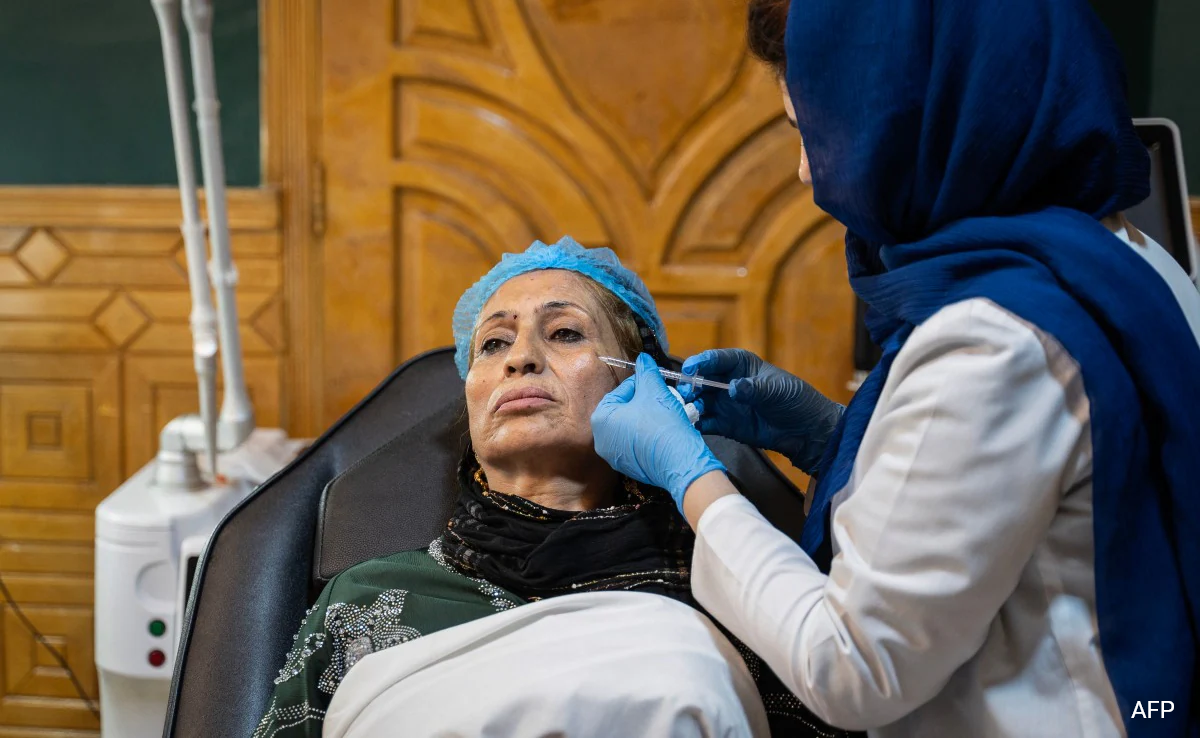
A medical professional administers Botox to a female patient at a Kabul beauty clinic
In Kabul's cosmetic surgery clinics, adorned with faux crystal chandeliers and plush velvet sofas, a stark contrast emerges to the austere Taliban governance. Here, treatments like Botox, lip fillers, and hair transplants have become increasingly popular.
Despite Afghanistan's prevailing conservative atmosphere, widespread poverty, and the Taliban's strict theological rule, approximately 20 cosmetic clinics in Kabul have seen remarkable growth since the country's decades-long conflict ended.
Professionals from Turkey regularly visit to train Afghan practitioners, who also complete internships in Istanbul. The clinics import their equipment from European and Asian suppliers.
The clientele in waiting areas typically consists of affluent individuals, including men seeking solutions for hair loss. However, women form the majority – sometimes wearing heavy makeup but always fully covered, with fewer wearing the all-encompassing burqa.
Twenty-five-year-old Silsila Hamidi opted for her second facelift, believing that Afghanistan's challenging environment for women had negatively affected her skin.
"We may be hidden from others, but we see ourselves – looking beautiful in the mirror provides us with energy," Hamidi explained before undergoing surgery to lift her upper face, which "was beginning to droop".
The medical graduate alluded to her skin suffering from the "numerous pressures" experienced by Afghan women without elaborating further.
Under Taliban restrictions, women face severe limitations on employment opportunities, must travel with male guardians for long distances, are expected to remain quiet outside their homes, and are prohibited from universities, parks, and fitness centers.
While surgical aesthetic procedures thrive, beauty salons serving women have been outlawed.
"If these establishments remained open... our skin wouldn't deteriorate to this condition, and surgery wouldn't be necessary," said Hamidi, who had her first facial procedure at 23.
The Taliban leadership, who generally prohibit altering physical features according to their interpretation of Islamic law, did not respond to multiple comment requests regarding cosmetic surgery.
Industry professionals maintain that these procedures are permitted because they're classified as medical treatment.
Clinic staff informed AFP that the government doesn't interfere with their operations, though morality police ensure gender segregation: male nurses attend to male patients, while female nurses care for female patients.
Some suggest that Taliban members themselves are customers.
"In this society, lacking hair or a beard is viewed as a sign of weakness," explained Sajed Zadran, assistant director of Negin Asia clinic, which features cutting-edge Chinese equipment.
Since Taliban authorities mandated that men grow beards at least a fist's length, transplants have become fashionable, according to Bilal Khan, co-director of EuroAsia clinic, which is expanding with a second location.
Since not all clients are wealthy, some "borrow money for hair transplants before their weddings," Khan noted.
In the four-level residence converted into a clinic, procedures mirror international standards and present "no danger," according to dermatologist Abdul Nassim Sadiqi.
His clinic charges $43-87 for Botox treatments and $260-509 for hair implants.
These amounts represent significant sums for many Afghans – with nearly half the population living in poverty according to World Bank figures – but offer value to people like Mohammed Shoaib Yarzada, an Afghan restaurant owner based in London.
Deterred by the thousands of pounds required for the same procedure in Britain, he utilized his first visit to Afghanistan in 14 years to address his thinning hair.
"Entering the clinic feels like being abroad, in Europe," he remarked.
To attract clients, clinics heavily promote their services on social media, promising beauty transformations: smooth skin, fuller lips, and abundant hair.
Afghanistan, like Western nations, feels the influence of social media personalities, explained Lucky Khaan, 29, co-director of Negin Asia, which registers dozens of new patients daily.
"Many patients arrive without actual issues but desire surgery after seeing trends on Instagram," said Khaan, a Russian physician of Afghan descent with a wrinkle-free complexion.
While the UN reports 10 million Afghans suffering from hunger and one-third lacking access to basic healthcare, some "who struggle to afford food prefer to invest in their appearance," the surgeon added.