
Trump's Hands-Off Approach to Government Shutdown Frustrates Democrats and Some Republicans
- Date & Time:
- |
- Views: 60
- |
- From: India News Bull
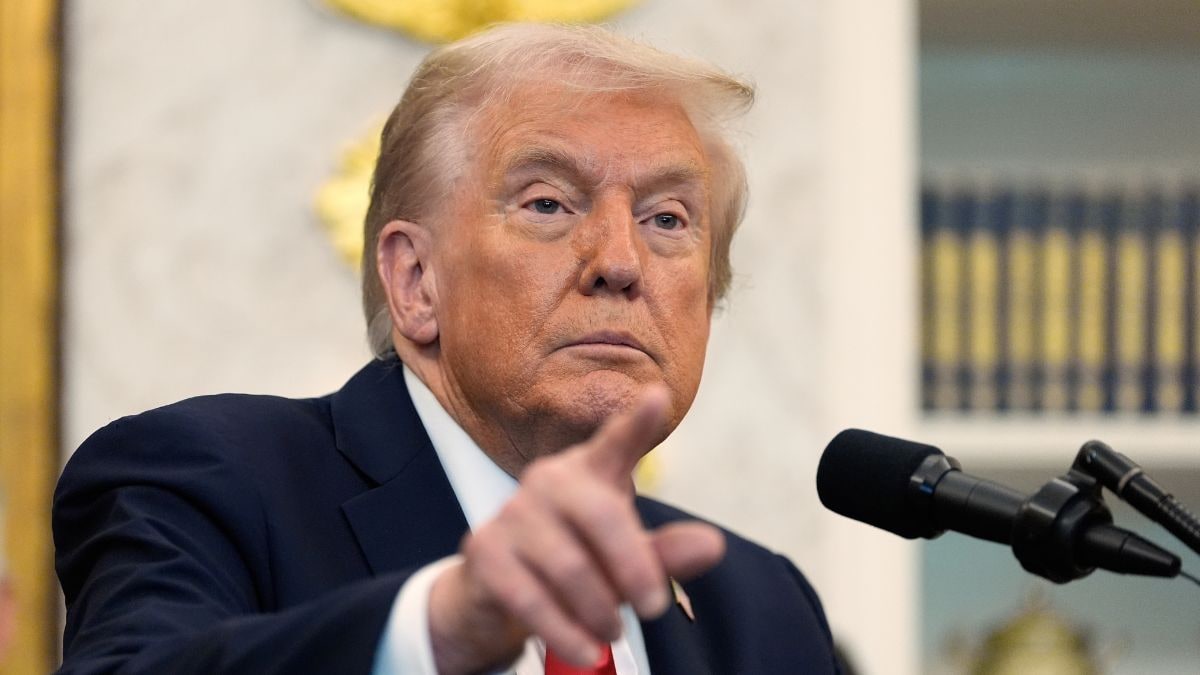
President Donald Trump is exhibiting minimal urgency to facilitate a compromise that could end the government shutdown, despite Democrats insisting his direct engagement is essential for any breakthrough.
Washington:
Three weeks into the government shutdown, Congress remains at an impasse. The House hasn't convened for a month, and senators departed Washington on Thursday with frustration over the lack of progress. Republican leadership refuses to negotiate until a short-term funding bill reopens the government, while Democrats won't agree without guarantees on health insurance subsidy extensions.
Trump appears comfortable remaining disengaged from the negotiations.
Throughout the week, he celebrated his role in the Israel-Hamas ceasefire agreement, hosted a memorial event for conservative activist Charlie Kirk, and redirected attention to the Russia-Ukraine conflict. Meanwhile, his administration has managed the shutdown unconventionally, continuing military payments while furloughing other federal employees.
When questioned Thursday about applying his dealmaking experience to resolve the shutdown, Trump appeared disinterested.
"Well, look, I mean, all we want to do is just extend. We don't want anything, we just want to extend, live with the deal they had," he told reporters in the Oval Office. Later that day, he dismissed Democratic healthcare demands as "crazy," adding, "We're just not going to do it."
Spokesperson Karoline Leavitt informed Fox News that Democrats must first vote to reopen the government before "we can have serious conversations about health care."
Senate Majority Leader John Thune reinforced this stance before the weekend recess, stating that Trump is "ready to weigh in and sit down with the Democrats or whomever, once the government opens up."
However, frustration is emerging even within Trump's party, where lawmakers recognize that congressional progress largely depends on his direction.
GOP Sen. Lisa Murkowski acknowledged while leaving the Capitol Thursday that "We're not making much headway this week." She recognized Trump's crucial role in moving forward: "I think he's an important part of it."
"I think there are some folks in his administration that are kind of liking the fact that Congress really has no role right now," she added. "I don't like that. I don't like that at all."
While Congress remains paralyzed by the shutdown, Trump has moved swiftly to implement his vision for the federal government.
He has dubbed budget chief Russ Vought the "grim reaper," who has used this opportunity to withhold billions in infrastructure funding and lay off thousands of federal workers, signaling potentially more severe workforce reductions ahead.
Simultaneously, the administration has unilaterally funded Trump's priorities, including this week's military payments, which relieved pressure on what could have been a major deadline for ending the shutdown.
Several of these actions, particularly the layoffs and funding reallocations, face legal challenges and criticism for potential illegality. A federal judge on Wednesday temporarily blocked the administration from terminating workers during the shutdown, ruling that the cuts appeared politically motivated and lacked sufficient justification.
With Congress focused on the funding dispute, lawmakers have little bandwidth for other issues.
In the House, Speaker Johnson has stated the chamber won't reconvene until Democrats approve the funding bill and has refused to swear in Rep.-elect Adelita Grijalva. Democrats claim this prevents her from becoming the 218th signature on a discharge petition aimed at forcing a vote to release documents related to Jeffrey Epstein's sex trafficking investigation.
Thus far, the shutdown has minimally impacted public opinion.
An AP-NORC poll released Thursday showed that 3 in 10 Americans maintain a "somewhat" or "very" favorable view of the Democratic Party, comparable to September's poll results. Four in 10 view the Republican Party favorably, also relatively unchanged from the previous month.
Senate Minority Leader Chuck Schumer and House Democratic Leader Hakeem Jeffries have criticized Republicans for showing little seriousness in negotiating to end the shutdown.
"Leader Thune has not come to me with any proposal at this point," Schumer stated Thursday.
Frustrated with congressional leadership, Democrats increasingly look to Trump for resolution.
During a CNN town hall Wednesday featuring Rep. Alexandria Ocasio-Cortez and Sen. Bernie Sanders, both repeatedly cited the president's absence when asked about stalled negotiations.
"President Trump is not talking. That is the problem," Sanders emphasized.
Ocasio-Cortez added that Trump should more regularly "be having congressional leaders in the White House."
Democrats' focus on Trump reflects both his leadership style—which leaves little room for congressional action without his approval—and the reality that any funding bill requires presidential signature to become law.
However, Republican leaders controlling both chambers resist pressure for Trump's intervention.
"You can't negotiate when somebody's got a hostage," said South Dakota Sen. Mike Rounds, adding that Trump's involvement would enable Democrats to employ similar tactics in future legislative disputes.
Trump has largely adhered to this guidance. After previously expressing openness to negotiating healthcare subsidies with Democrats, he retracted his position after Republican leaders suggested he misspoke.
This stance appears unlikely to change soon. According to a senior White House official speaking anonymously about private discussions, Trump has no plans to personally broker a deal with Democrats. The official added that Democrats should expect only the already-proposed stopgap funding bill.
"The President is happy to have a conversation about health care policy, but he will not do so while the Democrats are holding the American people hostage," White House spokesperson Abigail Jackson stated Thursday.
In his second term, Trump has implemented a top-down approach that leaves little congressional movement without his approval.
"What's obvious to me is that Mike Johnson and John Thune don't do much without Donald Trump telling them what to do," observed Democratic Sen. Mark Kelly of Arizona.
His influence is particularly strong in the GOP-led House, where Speaker Mike Johnson effectively owes his position to Trump and relies on his influence to navigate challenging legislative battles.
When Republicans have withheld support for Trump's priorities, he has personally called or summoned them to sway their votes. When unsuccessful, he has threatened to support primary challengers in upcoming elections. This has led many Democrats to believe that resolution must come through the White House rather than the Speaker's office.
Democrats also seek assurances that the White House won't abandon agreements once reached. Earlier this year, the administration circumvented Congress with a $4.9 billion foreign aid reduction in August through a legally questionable "pocket rescission." Before taking office last year, Trump and ally Elon Musk undermined a bipartisan funding agreement that both parties had negotiated.
"I think we need to see ink on paper. I think we need to see legislation. I think we need to see votes," said Ocasio-Cortez. "I don't accept pinky promises. That's not the business that I'm in."
Both parties see little reason to compromise under public pressure, each believing they're winning the messaging battle.
"Everybody thinks they're winning," Murkowski observed. "Nobody is winning when everybody's losing. And that's what's happening right now. The American public is losing."
Source: https://www.ndtv.com/world-news/democrats-say-trump-be-involved-in-shutdown-talks-hes-shown-little-interest-9471115