
12,000-Year-Old Mummies Reveal Evidence Of Human Mummification
Smoke-drying mummification of human remains was practised by hunter-gatherers across southern China, southeast Asia and beyond as far back as 12,000 years ago.
- Date & Time:
- |
- Views: 49
- |
- From: India News Bull
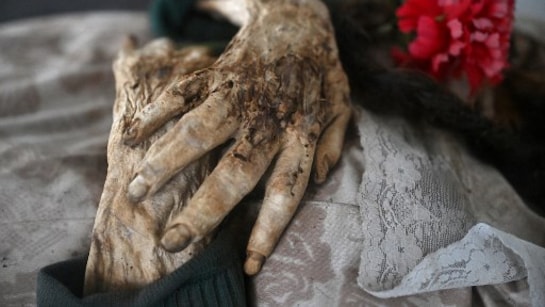
New research reveals the earliest global evidence of mummification practices. (Representational)
Recent research published today in the Proceedings of the National Academy of Sciences demonstrates that hunter-gatherers across southern China, southeast Asia, and beyond practiced smoke-drying mummification of human remains as far back as 12,000 years ago, according to findings from my colleagues and myself.
This discovery represents the world's earliest known evidence of mummification, significantly predating the famous examples from ancient Egypt and South America.
Our study examined remains from archaeological sites dating between 12,000 and 4,000 years ago, though this tradition has remarkably persisted into modern times in certain areas of the New Guinea Highlands and Australia.
Throughout southern China and Southeast Asia, archaeologists have long encountered tightly crouched or squatting burials characteristic of hunter-gatherer communities from approximately 20,000 to 4,000 years ago.
These graves were traditionally classified by researchers as "primary burials," suggesting the body was interred intact during a single burial ceremony.
Hunter-gatherer burials in crouched or squatting positions have been discovered throughout southern China and southeast Asia. Hung et al. / PNASOur colleague Hirofumi Matsumura, an experienced physical anthropologist and anatomist, observed that some skeletons were positioned in ways that contradicted normal anatomical arrangement.
Additionally, we frequently noticed partial burning on certain bones. These burning indicators, such as charring, were primarily visible on body areas with minimal muscle mass and thinner soft tissue coverage.
These observations led us to question whether the deceased underwent more complex treatment than simple burial.
A breakthrough moment occurred in September 2017 during a brief pause in our excavation work at the Bau Du site in central Vietnam.
The late Kim Dung Nguyen pointed out difficulties interpreting skeletons that appeared deliberately positioned seated against large rocks. Matsumura noted inconsistencies in their bone arrangements.
The team excavating an ancient hunter-gatherer cemetery in Guangxi, southern China. Hsiao-chun HungI recall spontaneously asking, "Could these burials be similar to the smoked mummies of Papua New Guinea?" - partly in jest but genuinely curious.
Matsumura considered this suggestion seriously. With substantial support and collaboration from numerous colleagues, this moment initiated our genuine investigation into this archaeological mystery.
With renewed interest, we began examining photographs of contemporary smoke-dried mummification practices in the New Guinea Highlands through books and online resources.
In January 2019, we traveled to Wamena in Papua (Indonesia) to examine several modern smoked mummies preserved in private households. The resemblance to our ancient specimens was remarkable, though most skeletons from our excavations showed no obvious external signs of burning.
A modern smoke-dried mummy kept in Pumo Village, Papua (Indonesia). Hsiao-chun HungWe recognized the need for scientific testing to validate our hypothesis. If bodies were smoked using low-temperature fires while still protected by skin, muscle, and tissue, the bones wouldn't display obvious blackening but might retain subtle or microscopic evidence of past smoking.
The COVID pandemic subsequently restricted travel, separating our research team across different regions, but we explored various approaches to continue our investigation.
Eventually, we analyzed bones from 54 burials across 11 sites using two independent laboratory techniques: X-ray diffraction and Fourier-transform infrared spectroscopy. These methods can detect microscopic structural changes in bone material resulting from heat exposure.
The results confirmed the remains had been subjected to low heat – effectively, almost all had been smoked.
These samples, discovered across southern China, Vietnam, and Indonesia, constitute the oldest known examples of mummification, significantly predating the well-documented practices of northern Chile's Chinchorro culture (approximately 7,000 years ago) and ancient Egypt's Old Kingdom (about 4,500 years ago).
Remarkably, this burial tradition was widespread throughout East Asia, likely including Japan, and may extend back more than 20,000 years in Southeast Asia.
The practice continued until around 4,000 years ago when new cultural patterns began emerging. Our research reveals a distinctive combination of technique, tradition, and belief – a cultural practice that persisted for millennia across an extraordinarily broad region.
Ethnographic records document this tradition's survival in southern Australia well into the late 19th and early 20th centuries.
In the New Guinea Highlands, some communities have maintained this practice into recent times. Significantly, the hunter-gatherer groups of southern China and Southeast Asia shared close connections with Indigenous peoples of New Guinea and Australia, both in physical characteristics and genetic ancestry.
Ethnographic records from southern Australia and Papua New Guinea reveal that preparing a single smoked mummy could require up to three months of continuous attention. Such extraordinary dedication could only stem from profound love and powerful spiritual convictions.
This tradition reflects a fundamental human truth: the timeless desire for families and loved ones to remain connected forever – preserved across ages, in whatever form that connection might endure.
Hsiao-chun Hung, Senior Research Fellow, School of Culture, History & Language, Australian National University
This article is republished from The Conversation under a Creative Commons license. Read the original article.