
Colossal Statues of Pharaoh Amenhotep III Restored in Luxor After Two Decades of Renovation
- Date & Time:
- |
- Views: 43
- |
- From: India News Bull
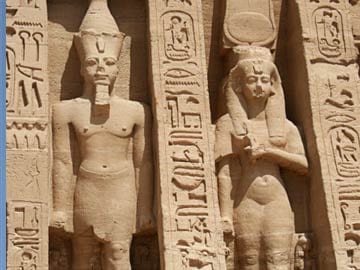
The colossal statues represent Pharaoh Amenhotep III, who governed ancient Egypt approximately 3,400 years ago.
Luxor:
Egypt unveiled the restoration of two massive alabaster statues of a prominent pharaoh in Luxor on Sunday, marking another milestone in the government's archaeological initiatives designed to attract more tourists to the nation.
The giant statues, known as the Colossi of Memnon, have been meticulously reassembled through a renovation project spanning about two decades. These impressive monuments depict Amenhotep III, who ruled ancient Egypt approximately 3,400 years ago.
"Today we are celebrating the completion and erection of these two colossal statues," stated Mohamed Ismail, secretary-general of the Supreme Council of Antiquities, in an interview with The Associated Press prior to the ceremony.
Ismail emphasized the colossi's great importance to Luxor, a city renowned for its ancient temples and archaeological treasures. The restoration also aims to "revive the appearance of King Amenhotep III's funerary temple as it looked in ancient times," Ismail added.
Amenhotep III was one of Egypt's most distinguished pharaohs, ruling during the New Kingdom period, which represents the most prosperous era in ancient Egyptian history. This pharaoh, whose mummified remains are displayed in a Cairo museum, reigned between 1390-1353 BC, a peaceful time characterized by prosperity and significant construction projects, including his mortuary temple where the Colossi of Memnon stand, and another temple called Soleb in Nubia.
The colossal statues were toppled by a powerful earthquake around 1200 BC that also destroyed Amenhotep III's funerary temple, according to Mohamed Ismail.
The monuments became fragmented and partially quarried away, with their pedestals scattered. Some blocks were repurposed in the Karnak temple, but archaeologists later retrieved them to reconstruct the colossi, as reported by the Antiquities Ministry.
In the late 1990s, an Egyptian-German mission led by German Egyptologist Hourig Sourouzian began working in the temple area, including the assembly and renovation of these impressive statues.
"This project aims to preserve the last remains of a once-prestigious temple," Sourouzian explained.
The statues depict Amenhotep III seated with his hands resting on his thighs, facing eastward toward the Nile and the rising sun. They wear the traditional nemes headdress topped with double crowns and the pleated royal kilt, symbolizing the pharaoh's divine authority.
Two smaller statues at the pharaoh's feet represent his wife, Tiye.
The colossi—measuring 14.5 meters (48 feet) and 13.6 meters (45 feet) respectively—stand guard at the entrance of the king's temple on the Nile's western bank. The 35-hectare (86-acre) complex is considered the largest and most opulent temple in Egypt, often compared to the magnificent temple of Karnak, also located in Luxor.
These monumental statues were carved from Egyptian alabaster sourced from the Hatnub quarries in Middle Egypt. They rest on large pedestals inscribed with the temple's name and quarry information.
Unlike other monumental Egyptian sculptures, the colossi were partially assembled with separately sculpted pieces that were attached to each statue's main monolithic alabaster core, according to the ministry.
Sunday's unveiling in Luxor occurred just six weeks after the inauguration of the long-awaited Grand Egyptian Museum, a centerpiece of the government's strategy to enhance the country's tourism industry and strengthen the struggling economy. This mega-project is situated near the famous Giza Pyramids and the Sphinx.
Egypt's tourism sector, which relies heavily on the country's rich pharaonic heritage, has endured years of political upheaval and violence following the 2011 uprising. Recently, the industry has begun to recover after the coronavirus pandemic and despite Russia's war on Ukraine—both countries being significant sources of tourists to Egypt.
"This site will be an attraction point for years to come," said Tourism and Antiquities Minister Sherif Fathy, who attended the unveiling ceremony. "There are always new discoveries happening in Luxor."
A record 15.7 million tourists visited Egypt in 2024, contributing approximately 8% to the country's GDP, according to official statistics.
Minister Fathy has indicated that about 18 million tourists are expected to visit Egypt this year, with authorities aiming to attract 30 million annual visitors by 2032.
Source: https://www.ndtv.com/world-news/two-colossal-statues-of-pharaoh-restored-in-luxor-after-2-decades-9809360