
Benjamin Netanyahu On A Mission To Realise A 'Greater Israel'?
- Date & Time:
- |
- Views: 95
- |
- From: India News Bull
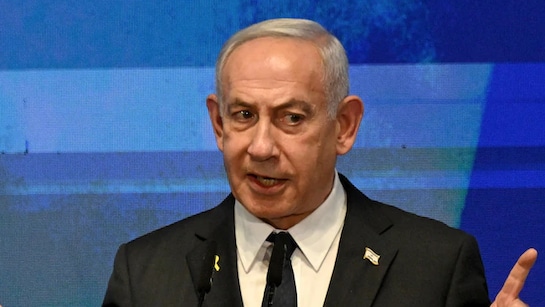
Netanyahu appears to be making significant progress toward his territorial ambition.
While global attention remains fixed on advocating for a two-state solution to the Israeli-Palestinian conflict, Israeli Prime Minister Benjamin Netanyahu seems firmly committed to pursuing his vision of a "Greater Israel" instead.
Despite widespread international criticism of Israel's military campaign in Gaza and the country's growing diplomatic isolation, Netanyahu appears to have made considerable headway toward this territorial goal.
The two-state solution has increasingly become merely rhetorical for governments worldwide wishing to demonstrate solidarity with Palestinians, even as Israel systematically works to render this concept obsolete.
The possibility of establishing an independent Palestinian state comprising the West Bank, East Jerusalem, and Gaza Strip to coexist peacefully alongside Israel has reached its lowest point in history.
Israel continues to enjoy Trump's steadfast support. Following Israel's strike on Hamas leadership in Qatar earlier this month, Qatar organized an emergency Arab-Muslim summit to coordinate a response.
The gathering proved largely ineffective. While the assembled leaders strongly condemned the attack on Qatar, they offered no concrete strategy to prevent Israel from attacking neighboring countries or to stop what a United Nations commission has now characterized as genocide in Gaza.
Instead, the summit produced only a mild statement declaring they would:
take all possible legal and effective measures to prevent Israel from continuing its actions against the Palestinian people.
Regional leaders recognize that only the United States, as Israel's committed strategic partner, possesses sufficient influence to restrain Israel.
Washington shows no inclination to do so. Though President Donald Trump has assured the region that Israel will not repeat its attack on Qatar, Secretary of State Marco Rubio promptly traveled to Israel to reaffirm America's unwavering alliance with the Jewish state.
By praying alongside Netanyahu at the Western Wall while wearing a kippah, Rubio demonstrated the Trump administration's unconditional support for the prime minister.
Netanyahu quickly asserted that Israel maintains the right to strike "Hamas terrorists" anywhere. He has demanded Qatar expel Hamas officials or face Israeli retaliation again.
The pursuit of a "Greater Israel" appears to be a priority based on rhetoric from Netanyahu and his extremist ministers.
In recent weeks, Netanyahu has publicly acknowledged his strong connection to this concept.
The term "Greater Israel" emerged after the 1967 Six-Day War, referring to territories Israel conquered: the West Bank, East Jerusalem, Gaza, the Golan Heights, and the Sinai peninsula (which was subsequently returned to Egypt).
This concept was codified in 1977 in the founding charter of Netanyahu's Likud Party, which stated "between the [Mediterranean] Sea and the Jordan [River] there will only be Israeli sovereignty".
Last year, Netanyahu emphasized that Israel must maintain "security control over the entire territory west of the Jordan River," adding, "That collides with the idea of [Palestinian] sovereignty. What can we do?"
Netanyahu now appears positioned to annex the Gaza Strip, potentially followed by formally extending Israeli jurisdiction over all illegal Israeli settlements in the West Bank—home to over 700,000 settlers protected by the Israel Defence Forces (IDF)—and possibly annexing the entire territory.
Additionally, Israel has made extraterritorial gains in Lebanon and Syria after weakening Hezbollah and conducting strikes in southern Syria and Iran. Netanyahu has indicated the IDF's presence in both countries will remain for the foreseeable future.
Arab and Muslim leaders have vehemently condemned Netanyahu's references to a "Greater Israel." The US has not publicly endorsed this vision, though US Ambassador to Israel Mike Huckabee has supported the concept.
Netanyahu and his colleagues have endured international criticism regarding their devastating Gaza operations for nearly two years, bolstered by unwavering US security, economic, and financial support.
Critics argue Netanyahu has shown minimal concern for the remaining Israeli hostages in Hamas custody, dismissing the majority of Israelis' desire for a ceasefire and hostage release.
For Netanyahu's administration, the end justifies the means. Consequently, the anticipated recognition of Palestinian statehood by numerous Western countries at this week's UN General Assembly will likely have minimal impact on Israel or the United States. Both have already rejected this as a meaningless symbolic gesture.
This raises questions about what actions could divert Israel from its current path. The only potentially effective approach would involve sanctioning Netanyahu's government and severing all military, economic, and trade relationships with Israel.
Anything less substantial would allow Israeli leadership to continue pursuing a "Greater Israel," if this indeed represents their ultimate objective.
Such a course would exact a tremendous price not only for Palestinians and the region but also for Israel's global standing. When Netanyahu eventually departs office, he will leave behind a state with a severely damaged international reputation—one that may take generations to restore.
Amin Saikal, Adjunct Professor of Social Sciences, The University of Western Australia, Victoria University, Australian National University
This article is republished from The Conversation under a Creative Commons license. Read the original article.