
Ancient Galaxy Alaknanda Discovered: Milky Way-Like Spiral Formation Challenges Early Universe Theories
- Date & Time:
- |
- Views: 37
- |
- From: India News Bull
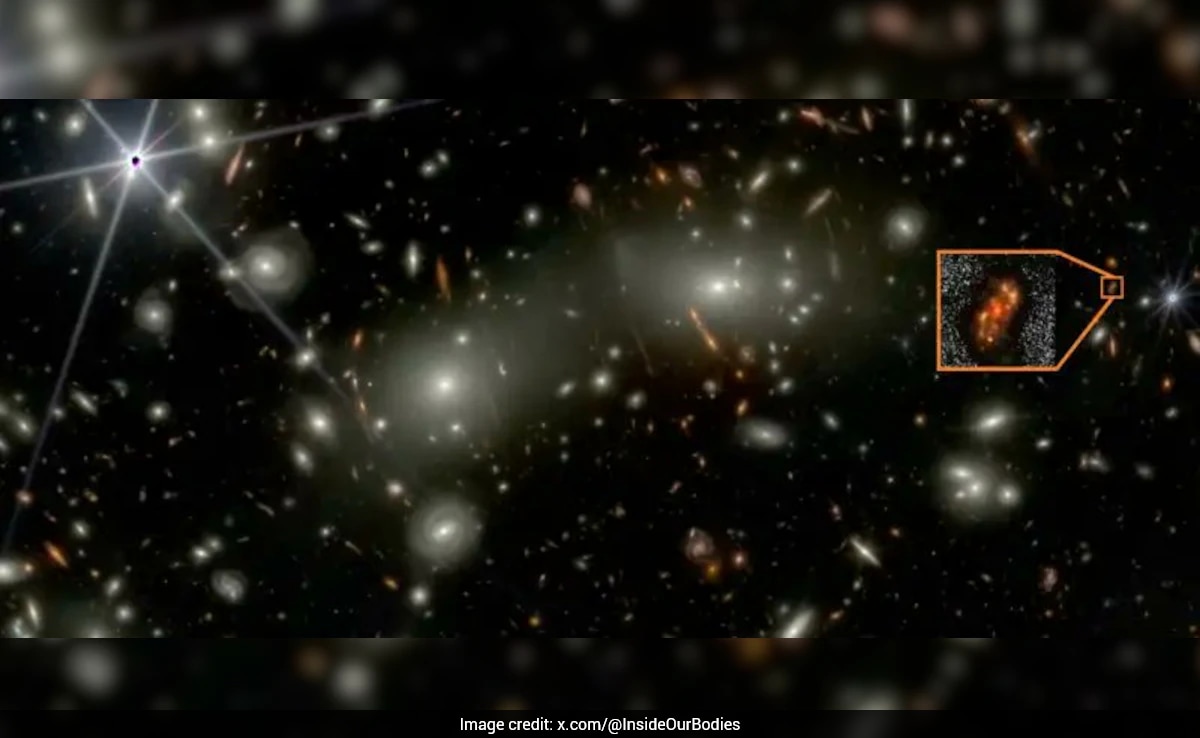
Indian astronomers have made a groundbreaking discovery of an ancient galaxy named Alaknanda, which remarkably resembles our Milky Way with distinct spiral arms. The findings have been published in the prestigious European journal Astronomy & Astrophysics.
This massive galaxy formed when the universe was merely 1.5 billion years old, challenging previous understanding of early galaxy formation. For context, the universe is currently estimated to be 13.8 billion years old.
Professor Yogesh Wadadekar from the National Centre for Radio Astrophysics of the Tata Institute of Fundamental Research (NCRA-TIFR) described Alaknanda as "a regular, well-structured system." This observation is particularly significant as conventional scientific understanding suggests that galaxies typically require at least three billion years to develop stable spiral arms.
Unlike the chaotic, small, and unstable galaxies that typically characterized the early universe, Alaknanda features a classic grand design spiral structure with two clear, symmetric arms, similar to our Milky Way.
PhD student Rashi Jain, who led this research under Professor Wadadekar's guidance, emphasized: "The galaxy looks remarkably similar to our own Milky Way despite being present when the universe was only 10 percent of its current age."
The name "Alaknanda" was thoughtfully chosen, as Jain explained: "Just as the Alaknanda is the sister river of the Mandakini river, which is also the Hindi name for our own Milky Way galaxy, we thought it fitting to name this distant spiral galaxy after the Alaknanda river."
The researchers utilized the James Webb Space Telescope (JWST) to identify Alaknanda, which is approximately 12 billion light-years away and spans about 30,000 light-years across.
This discovery challenges existing theories about galaxy formation. Scientists previously believed that stable spiral galaxies like our Milky Way could only emerge several billion years after the universe's formation, once galaxies had sufficient time to cool and develop well-formed disks.
Professor Wadadekar noted that Alaknanda managed to accumulate stellar mass equivalent to 10 billion suns and form a large spiral-shaped disk in just a few hundred million years.
"Alaknanda reveals that the early Universe was capable of far more rapid galaxy assembly than we anticipated," he concluded, highlighting how this discovery fundamentally reshapes our understanding of cosmic evolution.
Source: https://www.ndtv.com/world-news/indian-scientists-discover-ancient-milky-way-like-galaxy-alaknanda-9741803