
Taiwan's T-Dome: The $40 Billion Air Defense System to Counter China's Military Threat
- Date & Time:
- |
- Views: 56
- |
- From: India News Bull
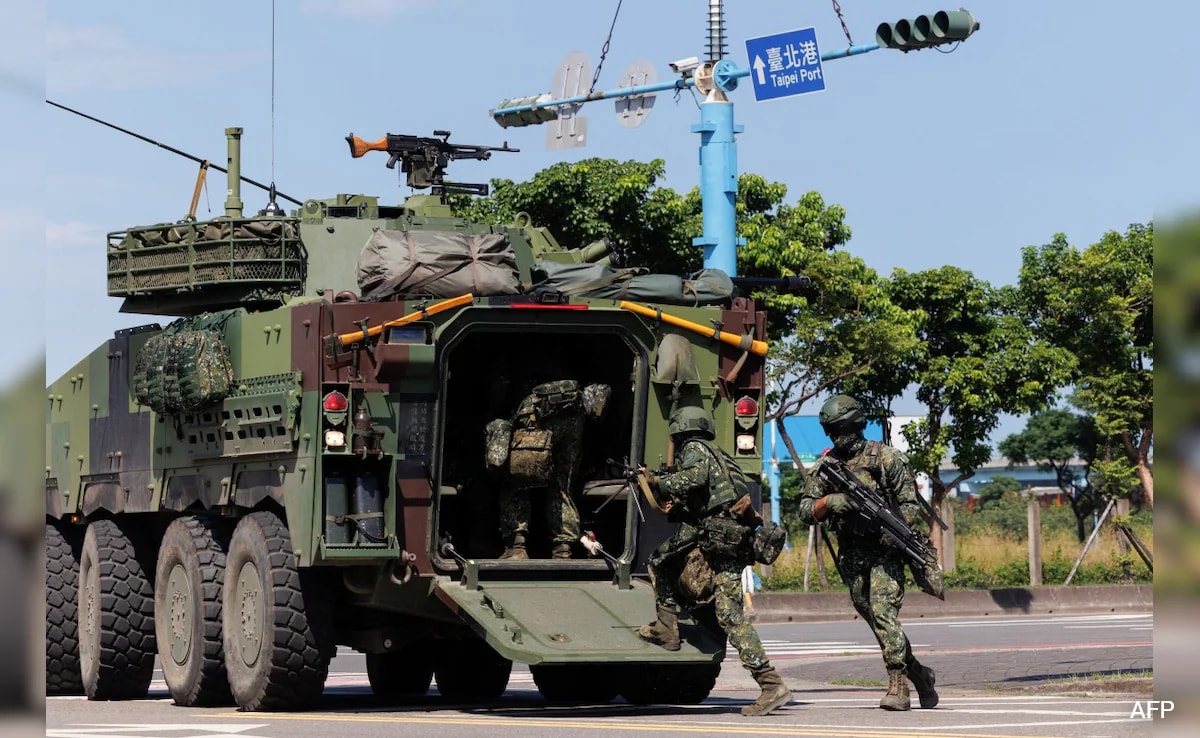
Taiwan's government has proposed a substantial $40 billion in additional defense spending over several years, primarily focusing on developing a sophisticated multi-layered air defense system called "T-Dome."
This advanced system is being designed specifically to protect the democratic island from potential attacks by Chinese fighter jets, missiles, or drones.
China maintains its claim that Taiwan is part of its territory and has repeatedly threatened to use military force to annex it.
Taiwanese President Lai Ching-te has committed to accelerating the construction of the T-Dome to establish "a safety net" for Taiwan and counter what he describes as China's "intensifying" threat to both the island and the broader region.
The T-Dome initiative was officially announced by President Lai on October 10, drawing some comparisons to Israel's Iron Dome anti-missile system.
However, significant differences exist between the two systems. While Israel's Iron Dome primarily addresses short-range weapons, Taiwan's T-Dome must confront a "much wider array of threats," according to Taipei-based security analyst J. Michael Cole.
"This is aimed at PLA aircraft, ballistic and cruise missiles, as well as, increasingly, drones," Cole explained, referring to China's People's Liberation Army.
Taiwan currently operates several air defense systems, including US-built Patriot and domestically-produced Sky Bow systems. The island is also awaiting delivery of National Advanced Surface-to-Air Missile System fire units from the United States.
The T-Dome will integrate these existing systems with radars, sensors, and other cutting-edge technologies to provide what President Lai describes as "high-level detection and effective interception."
Defense Minister Wellington Koo emphasized the importance of integration: "If you do not integrate these detection devices, then those air-defense missiles, whether for counter-fire, counter-attack or counter-drone purposes, can't achieve efficient interception or effective fire coordination and allocation."
According to Su Tzu-yun, a military expert at Taipei's Institute for National Defense and Security Research, the T-Dome will feature two major components. First, a command and control system that "collects radar data, identifies threats, decides which interceptor should fire, and coordinates all units so they react within seconds."
The second component will be the "interceptor layer" – the weapons deployed to "shoot down incoming threats" at various altitudes.
Taiwan has drawn crucial lessons from Ukraine regarding the importance of having robust air defense systems capable of protecting combat forces, critical infrastructure, and civilian buildings.
While Taiwan has been upgrading its military capabilities over the past decade and has invested billions in US armaments, it would still be outmatched in a direct conflict with China.
Su noted that developing the ability to "neutralize" a sudden Chinese missile strike would significantly enhance Taiwan's deterrence against potential Beijing aggression.
He highlighted that Chinese warships routinely deployed near Taiwan can launch hundreds of missiles targeting Taiwan's airports, radar sites, and military bases "within three minutes," not counting the additional hundreds of missiles China maintains on land.
"This is why Taiwan needs an integrated air defense system capable of responding to these emerging challenges," Su emphasized.
The timeline for T-Dome's completion depends on various factors, particularly when the United States can deliver the necessary weapons and technology.
Taiwan is already in line for billions of dollars' worth of US arms.
The defense ministry has published a procurement list for the new budget, including precision artillery, long-range precision-strike missiles, anti-ballistic and anti-armor missiles, and unmanned systems.
While the opposition-controlled parliament has not yet approved the budget, and specific US purchases remain unclear, President Lai indicated there would be "significant" US arms acquisitions.
Lai stated on Wednesday that Taiwan's military aims to achieve a "high level" of joint combat readiness by 2027 – a year US officials have previously cited as a possible timeline for a Chinese attack – and "highly resilient and comprehensive deterrent defense capabilities by 2033."
Su realistically assessed that "completing the entire T-Dome architecture before 2027 is impossible."
"System integration and the production of new interceptors – missiles, anti-aircraft guns, and directed-energy weapons – will all take time."
Drew Thompson, a senior fellow at Singapore's Nanyang Technological University's S. Rajaratnam School of International Studies, noted that readiness involves more than just equipment delivery.
"It really comes down to how you define effectiveness, how you define readiness and what's included in T-Dome," Thompson explained.
"Are they counting war reserve munitions? Do they have enough missiles in storage? Are they distributed?"
Furthermore, Thompson emphasized that effective implementation requires the military to thoroughly master "how to operate" these complex systems.
Source: https://www.ndtv.com/world-news/what-is-multi-layered-air-defence-system-t-dome-that-taiwan-plans-to-build-to-counter-china-threats-9723835