
How India's Historic Constitution is Preserved in a State-of-the-Art Nitrogen Chamber
- Date & Time:
- |
- Views: 78
- |
- From: India News Bull
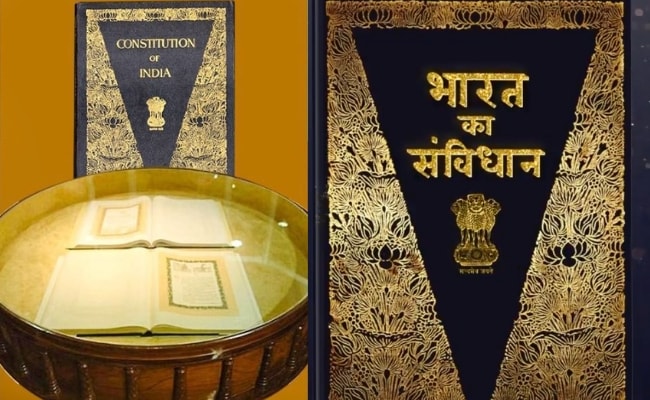
The Indian Constitution stands as the world's longest constitutional document, representing the nation's democratic foundation.
Each year on November 26, India celebrates Samvidhan Divas to commemorate the adoption of its Constitution. The original handwritten manuscripts, meticulously penned by Prem Behari Narain Raizada and artistically enhanced by talented craftsmen from Shantiniketan, are now housed in a specialized nitrogen chamber within Parliament.
The Constituent Assembly formally adopted the Constitution on November 26, 1949, though it officially came into effect on January 26, 1950. This momentous occasion marked India's transition into a sovereign, democratic republic. Initially, the precious original document was simply wrapped in flannel cloth with naphthalene balls for preservation.
In 1994, following conservation practices similar to those used in the United States, India decided to place its Constitution in a specially engineered gas chamber located in the Parliament House Library. This sophisticated preservation system was developed through collaboration between India's National Physical Laboratory and the Getty Institute of America.
The nitrogen chamber serves a crucial purpose in preservation. The Constitution's text, written in black ink, naturally deteriorates through oxidation over time. To prevent this degradation, the chamber maintains precise humidity levels around 50 grams per cubic meter. The nitrogen-filled, hermetically sealed display case contains less than 1 percent oxygen.
This controlled environment shields the manuscripts from oxidation, harmful sunlight exposure, microbial growth, and atmospheric pollutants. Environmental monitors continuously regulate conditions, the nitrogen gas is replenished annually, and the chamber undergoes inspection every two months under perpetual CCTV surveillance.
The scientific approach to preservation recognizes that paper consists primarily of cellulose, composed of glucose molecule chains. Air pollutants and acids can degrade these chains, compromising the paper's structural integrity.
The nitrogen environment effectively halts acid hydrolysis, ensuring long-term conservation. The glass display case, constructed by the Getty Conservation Institute in the United States, undergoes annual evaluation by New Delhi's National Physical Laboratory. The chamber consistently maintains relative humidity between 40-50 percent.
The Indian Constitution comprises a Preamble, 22 parts containing 448 articles, 12 schedules, 5 appendices, and 115 amendments, making it the world's most extensive constitution.
Each Constituent Assembly member signed two handwritten copies – one in Hindi and one in English. These elegant manuscripts were subsequently photolithographed by the Survey of India in Dehradun. Artists from Shantiniketan, including Beohar Rammanohar Sinha and Nandalal Bose, embellished the pages with decorative elements, transforming them into unique artistic treasures.
In a recent letter, Prime Minister Narendra Modi described the Constitution as a sacred document, stating: "It is our responsibility to fulfill the dreams envisioned by the framers of our Constitution. When we work with this sense of duty, our nation's social and economic progress will multiply manifold..." He further remarked, "The power of the Constitution enabled a person like me, coming from a humble and economically disadvantaged family, to serve as the Head of the Government continuously for over 24 years."
Source: https://www.ndtv.com/india-news/constitution-day-2025-why-indias-original-constitution-is-preserved-in-a-nitrogen-gas-chamber-9701814