
Operation Sindoor: How India's Army Chief Describes the 22-Minute Military Precision Strike
- Date & Time:
- |
- Views: 48
- |
- From: India News Bull
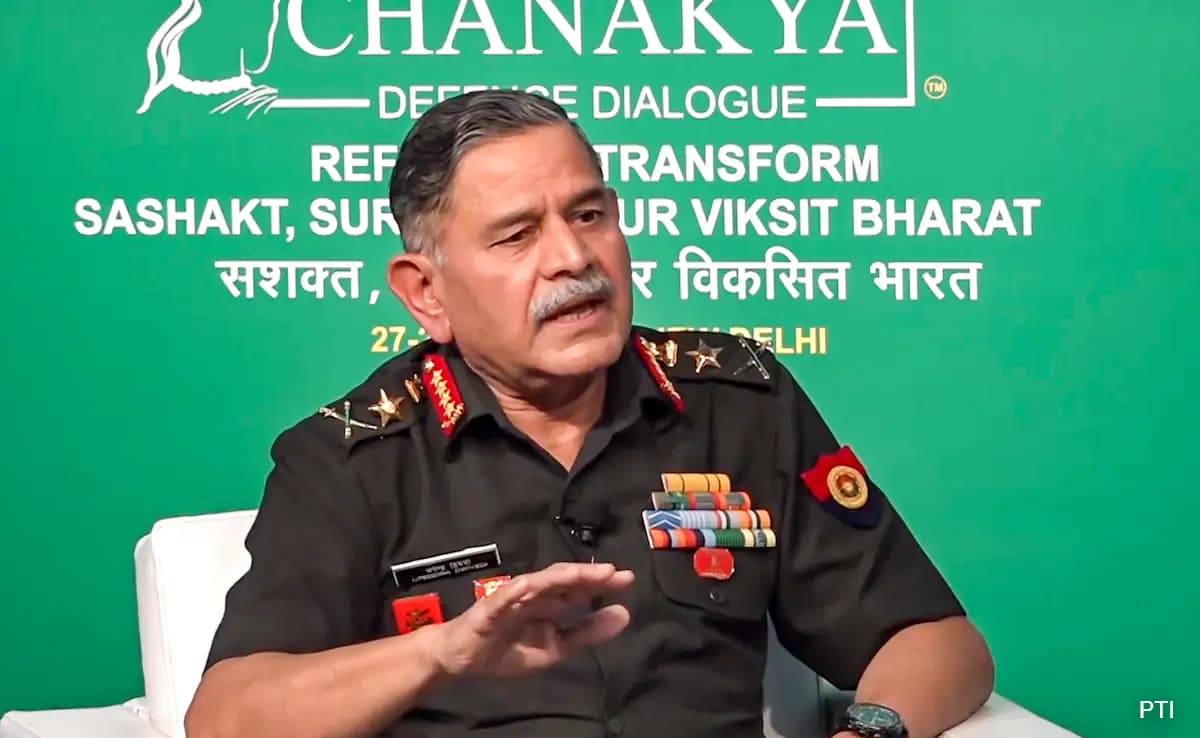
The Army Chief highlighted the critical role of technology in modern military evolution during his address. (File)
Operation Sindoor exemplified a "trusted orchestra" where each participant performed a "simultaneous or synergistic role," enabling the Indian armed forces to neutralize nine terrorist targets in just 22 minutes, Army Chief Gen Upendra Dwivedi stated on Saturday.
Speaking at a Delhi-based management institute's convocation ceremony, he emphasized that the military operation demonstrated remarkable "foresight" in anticipating evolving situations.
The operation represented "a response crafted not in the moment, but through years of envisioning how intelligence, precision and technology could merge into decisive action," the general explained.
India initiated this military operation in the early hours of May 7, successfully destroying multiple terrorist infrastructures in Pakistan and Pakistan-occupied Kashmir (PoK).
Pakistan launched counteroffensives against India, with all subsequent Indian retaliatory actions conducted under Operation Sindoor.
The military confrontation between the two nuclear-armed neighbors lasted approximately 88 hours before concluding with an understanding reached on the evening of May 10.
"Operation Sindoor functioned as a trusted orchestra where every musician performed a simultaneous or synergistic role. This coordination enabled us to eliminate nine terrorist targets in 22 minutes and conclude hostilities within 80 hours. Crucially, there was no time for decision-making during execution – success depended on prior visualization and complete team trust," the Army Chief explained.
Addressing graduates at the New Delhi Institute of Management (NDIM) ceremony, Gen Dwivedi encouraged them to lead with "wisdom, humility and power."
"As you move forward today, remember that the world remains in constant motion – markets shift, technology evolves, and your ambitions transform. Within this perpetual change lies your greatest strength: the courage to learn, the agility to adapt, and the vision to lead purposefully. Change isn't merely what happens to us; it's what we choose to become through our response," he advised.
The general's address, themed 'Navigating Change: The Real Constant,' explored evolving global dynamics, technology's disruptive influence, and forward-looking reflections.
"As the 21st century unfolded, long-standing peace gave way to a contested landscape of competition, contestation and conflicts. Today, over 55 conflicts rage worldwide, involving more than 100 nations either directly or indirectly, blurring traditional boundaries between peace and conflict," he observed.
The Army Chief noted that battlefield blurring extends to markets as well.
"The emergence of nationalism, protectionism and sanctions has given rise to geoeconomics, a framework articulated by Edward Luttwak, who characterized it as 'war logic expressed through commercial grammar,'" he elaborated.
Gen Dwivedi explained that today's strategic grammar differs substantially from traditional approaches, comprising "cooperation, collaboration, co-existence, competition, contestation and conflict itself."
"These six Cs represent fundamental concepts we must comprehend together. They guide our strategic interactions, and you will encounter them throughout your future careers," he added.
The Army Chief underscored technology's transformative impact on military operations.
"Technology has revolutionized warfare, progressing from muddy trenches to intelligent networks, rifles to drones, boots to bots, while similarly transforming businesses – from shampoo sachets to Gemini AI," he noted.
He emphasized the necessity of adaptation and what he termed "velocity of relevance" in responding to change.
"Recognizing opportunity differs from responding effectively to it. This response begins with embracing change proactively rather than reactively. When I joined the Army, computers were nonexistent in our operations. Today, I lead an Army that leverages data sciences and AI in modern warfare," Gen Dwivedi reflected.
He outlined the Army's ongoing transformation journey, including force restructuring for enhanced agility, strengthened jointness with Navy, Air Force and other domains, accelerated modernization through cutting-edge technologies, human resource system reforms, and continuous refinement of processes to improve efficiency and responsiveness.
General Dwivedi mentioned that he currently leads "a community of approximately 1.3 crore soldiers, veterans and families," representing one percent of India's population.
"I often tell my corporate colleagues that while they manage hundreds of resumes, we are responsible for millions of lives – individuals prepared to face danger at a moment's notice." He also discussed finding opportunities during turbulent periods.
"Let me share an approach that has served the Indian Army well – the ability to discover opportunity within uncertainty. In 1971, when turmoil in East Pakistan triggered refugee movements and regional instability, India transformed crisis into liberation, fundamentally reshaping the subcontinent's destiny," the officer stated.
Regarding leadership, he concluded, "Whether on battlefields or in boardrooms, speed and success stem not from control but from trust."
"Your ability to identify the optimal balance between centralized control and delegation, while accepting accountability for all outcomes – positive or negative – is what defines exceptional leadership."
Source: https://www.ndtv.com/india-news/trusted-orchestra-army-chief-on-how-operation-sindoor-was-executed-9683327