
Understanding the LCA Tejas Crash: Former IAF Vice Chief Explains Investigation Process and Airshow Flying Challenges
- Date & Time:
- |
- Views: 47
- |
- From: India News Bull
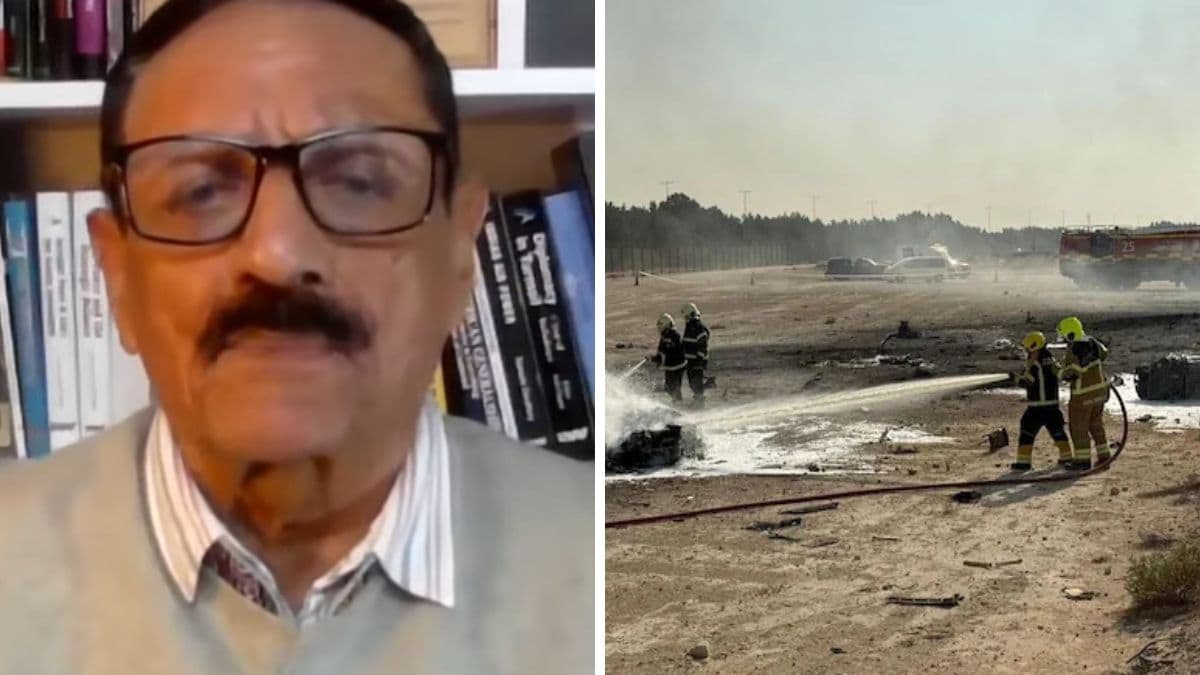
Air Marshal Anil Chopra (retired) provides insights to NDTV regarding the Tejas crash
New Delhi:
Air Marshal Anil Chopra (retired) has shared with NDTV the probable immediate actions authorities would undertake as they commence investigation into the LCA Tejas crash that occurred during an airshow in Dubai today.
The pilot lost his life when the aircraft crashed while attempting to transition to level flight following a negative G manoeuvre.
"The investigation will proceed very quickly. Both the Indian Air Force and government will scrutinize this incident closely. The HAL team is already on site as they were involved in the entire exercise," Air Marshal Chopra explained to NDTV.
Since the Light Combat Aircraft (LCA) Tejas crashed in foreign territory, there will be a formal procedure to transport the wreckage back to India.
"Certainly, the local airshow organizer must be involved. Each country's ground crew accompanying their aircraft will stand by. However, operating in a foreign country requires administrative assistance. Local police will need to secure the area and provide substantial support," the retired IAF officer stated.
"While HAL and IAF will handle the court of inquiry and technical aspects, diplomatic support from the government would be necessary. All these contingencies are already factored into display protocols. They have prepared for such eventualities, and established protocols exist because numerous air shows take place worldwide annually," Air Marshal Chopra added.
Video footage of the incident indicates the pilot could not recover from a negative G manoeuvre executed at low altitude. This particular manoeuvre has been a signature element of Tejas demonstrations at aerial shows.
Just before impact, the Tejas appeared with level wings, but by then, the aircraft's vertical speed was too great, causing it to hit the ground. The pilot did not eject.
Reflecting on the final moments of the LCA Tejas, which belonged to one of two active LCA Tejas squadrons, the former test pilot noted that few aircraft worldwide perform negative G turns.
"They execute this manoeuvre to demonstrate that the fuel system and various onboard systems can withstand sustained negative G. It also showcases both pilot skill and aircraft capabilities," Air Marshal Chopra explained.
"What precisely occurred during the transition between the negative G turn and the subsequent repositioning turn, I personally cannot determine from the videos I've viewed on your channel and others," he admitted.
According to him, investigators will examine the transition phase - from negative G manoeuvre to level flight - with particular scrutiny.
"The numerous videos captured by professionals, media channels, and team members will prove helpful. Investigators can analyze frame by frame to assess which manoeuvres were correct or incorrect, then match this detailed analysis with flight data recordings."
Air Marshal Chopra's background as a test pilot involved the demanding task of evaluating aircraft by testing their limits. The LCA Tejas that crashed during today's Dubai airshow was also being flown by a test pilot.
He pointed out that airshow flying differs from aircraft testing. "During an airshow, you operate much closer to the ground," Air Marshal Chopra noted.
"Test flying involves evaluating whether an aircraft performs adequately and meets manufacturer specifications. Display flying differs considerably. An aerobatic display pilot's mindset may vary - they aim to impress not just the general public but global manufacturers, other professionals, and fellow test pilots in attendance. It's an entirely different scenario," he explained.
"This requires exceptional maturity. The aircraft must undergo multiple thorough inspections. In aviation generally, no one flies an aircraft if there's even the slightest doubt about its condition."
Following the recent decommissioning of the vintage Russian-origin MiG-21, the LCA Tejas was positioned as the IAF's next primary aircraft. This compact fighter jet boasts an exceptional safety record within the IAF - the Dubai airshow crash represents only the second incident in 24 years.
The first crash occurred in Rajasthan's Jaisalmer in March 2024 - a remarkable 23 years after the aircraft's inaugural test flight in 2001.
The LCA Tejas features an inherently unstable design to maximize agility. Consequently, it requires a highly sophisticated fly-by-wire system (flight computer) to maintain stability.
Source: https://www.ndtv.com/india-news/at-air-shows-you-are-much-closer-to-ground-retired-iaf-vice-chief-on-lca-tejas-crash-9677885