
Rajasthan's Anta By-Election: How Congress Defeated BJP in Hadoti Power Politics
- Date & Time:
- |
- Views: 43
- |
- From: India News Bull
Enhanced electoral management at the booth level could have potentially altered the outcome.
The by-election results in Anta, Rajasthan, have inflicted a significant setback on the Bharatiya Janata Party (BJP), while simultaneously rejuvenating the Congress party before the imminent panchayat and municipal elections. This victory serves as a crucial lifeline for Congress, especially following their defeats in recent by-elections.
Political discourse has centered more on BJP's defeat rather than Congress's victory. Political analysts suggest that had BJP secured a win, Vasundhara Raje would have received all credit - consequently, she now faces criticism for the defeat. Reports indicate that Hadoti's regional power dynamics and behind-the-scenes political maneuvering ultimately overpowered Raje's electoral strategy.
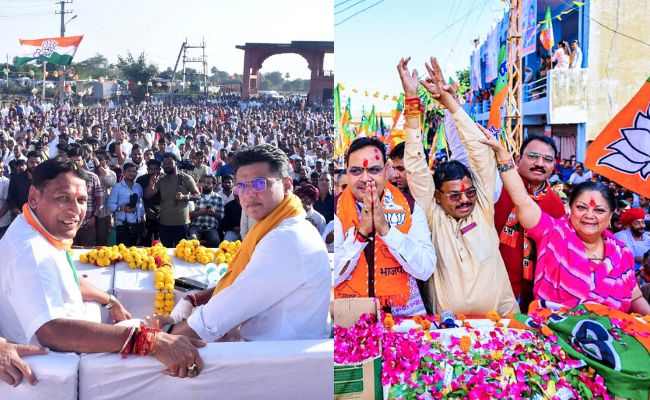
Vasundhara Raje had maintained complete control over the election campaign. Her team from Jhalawar operated on the ground. While Chief Minister Bhajanlal Sharma and BJP MP Madan Rathore conducted roadshows, Raje and her son Dushyant retained overall management of the election. Consequently, the meticulous organizational management characteristic of previous elections was notably absent. The BJP experienced prolonged internal conflict regarding candidate selection. After numerous deliberations, the party ultimately nominated local leader Morpal Suman, Raje's preferred candidate. This decision ultimately proved counterproductive.
Political observers suggest that had the BJP nominated someone from previous winner Kanwarpal Meena's family, or chosen Prabhulal Saini, who had previously defeated Pramod Jain Bhaya, the electoral outcome might have differed considerably.
The BJP also failed to consolidate its traditional voter base. While many expected Independent candidate Naresh Meena to significantly undermine Congress's support, he instead eroded BJP's voter base. Securing over 50,000 votes as an independent candidate and finishing merely 128 votes behind the BJP candidate represents a remarkable achievement for Naresh Meena. Though unsuccessful in securing victory, he mounted a formidable challenge. This marks Naresh Meena's third electoral defeat within 20 months - yet he has demonstrated his capacity to challenge established political parties across constituencies including Chhabra, Deoli, and Anta.
More effective booth management could have potentially altered the electoral results.
This by-election also confounded political experts and betting markets. Merely two days before the election, the Phalodi betting market predicted Pramod Bhaya would finish third. However, high voter turnout, particularly among women voters, transformed the electoral landscape. Over recent years, Bhaya has established a robust grassroots presence. His involvement with 'gaushalas', mass marriage events, and religious activities helped cultivate broad social support. The Congress party also dedicated substantial resources to supporting his candidacy.
State Congress President Govind Singh Dotasra assigned specific responsibilities down to the gram panchayat level. Sachin Pilot conducted roadshows. Opposition Leader Tikaram Jully implemented door-to-door campaigning strategies. Ashok Chandna's management as the campaign in-charge proved highly effective. On the final day of campaigning, Ashok Gehlot visited Anta to prevent the Mali community from shifting their support to BJP - a strategy that yielded visible results.
The BJP and Naresh Meena attempted to make corruption allegations against Pramod Bhaya a central campaign issue, but these aggressive attacks ultimately generated sympathy for Bhaya. Congress repeatedly questioned why the BJP government wasn't taking legal action if legitimate charges existed. Bhaya, meanwhile, characterized Naresh Meena as BJP's 'B-team', which helped consolidate Congress's voter base. Ultimately, Pramod Bhaya secured victory with a 15,594 vote margin. Following his previous electoral defeat, this represents a significant comeback. For the first time, he enters the Assembly as an opposition legislator; previously, he had only won when Congress held power. This victory has reinforced Govind Singh Dotasra's strategic position as state Congress president and energized the party before upcoming municipal and panchayat elections.
Conversely, Naresh Meena now confronts a period of self-evaluation - questioning why he consistently fails to secure electoral victories despite repeated attempts. Additionally, he must consider whether to join an established national or regional party, or perhaps form his own political organization in preparation for the 2028 Assembly elections.
Source: https://www.ndtv.com/india-news/anta-by-election-rajasthan-bjps-defeat-to-hadoti-power-politics-rajasthans-anta-by-election-an-analysis-9635826