
NDTV's Front-Row Seat To Tejas' Flight Into History
- Date & Time:
- |
- Views: 69
- |
- From: India News Bull
NDTV's Front-Row Seat To Tejas' Flight Into History
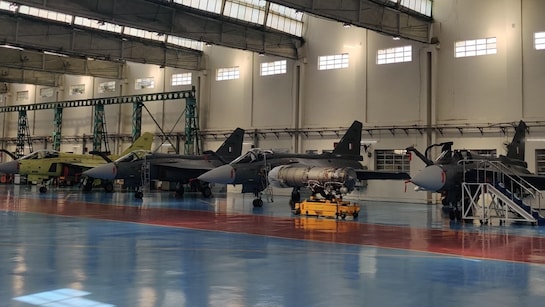
Nine Tejas fighter jets stand ready at Hindustan Aeronautics Limited (HAL), awaiting only their GE-404 engines from American manufacturer General Electric
The distinctive aroma of fresh paint permeates the assembly floor of HAL in Bengaluru, where rows of India's homegrown Tejas fighter aircraft await their final preparations before taking to the skies.
This journalist, having closely documented the Tejas journey, recalls first viewing a simple brown composite wing being constructed back in the 1990s in a small facility at India's defense laboratory.
Currently, approximately 38 of these aircraft serve in combat roles with the Indian Air Force.
In the near future, over 200 planes will be deployed to protect India's boundaries. The project began in 1986, with the aircraft completing its inaugural flight in 2001.
While touring the production facility at Hindustan Aeronautics Limited in Bengaluru, NDTV's Science Editor Pallava Bagla observed firsthand the culmination of decades of Indian aerospace development - the indigenous Tejas fighter jet, with at least nine fully assembled aircraft waiting for their final component: the engine.
This reporter has witnessed the Tejas evolution since its early designation as the Light Combat Aircraft (LCA). From initial prototype to cockpit access, NDTV's Science Editor Pallava Bagla documents the rise of Tejas.
NDTV's Science Editor Pallava Bagla positioned in the pilot's seat of the Tejas fighter aircraft cockpit
In an exclusive conversation with NDTV, HAL Chairman and Managing Director Dr DK Sunil revealed that while HAL has completed the airframes for the current batch of Tejas jets, delivery to the Indian Air Force is delayed due to awaiting engines from American manufacturer General Electric.
"We stand ready to install the engines and deliver the aircraft. Currently, all aircraft frames have been constructed. The bottleneck remains the engine supply," Dr Sunil explained, gesturing toward the line of Tejas jets arranged in the assembly facility.
The GE 404 engine that powers the Tejas is a sophisticated turbofan engine delivering thrust between 70-80 kilo Newton. Despite its proven reliability, supply chain constraints have become a significant challenge.
"General Electric has committed to expediting deliveries. However, had we possessed our own domestically developed engine, this constraint could have been eliminated," Dr Sunil noted.
Dr DK Sunil, Chairman and Managing Director of HAL, in Bengaluru with a Tejas aircraft
This view reflects a long-held aspiration within India's defense sector - developing an indigenous jet engine capability. HAL has already made progress in this direction, designing two engines: one for helicopters and another for Hawk-class aircraft.
The more powerful engine, intended for the forthcoming Advanced Medium Combat Aircraft (AMCA), is also in active development.
"HAL is currently developing two proprietary engines. One designed for helicopters and another for the Hawk class. The larger engine being considered for AMCA is attracting interest and investment now. I anticipate that within a decade, we will have our own engine technology," stated Dr Sunil.
The Tejas represents a 4.5-generation fighter equipped with advanced technologies including Active Electronically Scanned Array (AESA) radar, electronic warfare suites, helmet-mounted displays, and beyond-visual-range missile capabilities.
Its ergonomic cockpit configuration and sophisticated avionics create a pilot-friendly platform with integrated safeguards against operational errors.
"The aircraft's flying characteristics are exceptional, designed to prevent pilot error. Its software control systems are so advanced that even if a mistake occurs, the aircraft will automatically correct itself," Dr Sunil explained, as NDTV's Science Editor Pallava Bagla occupied the Tejas cockpit - a moment representing his full-circle journey from observing early prototypes with partial wings to experiencing the fully operational aircraft.
Despite being production-ready, HAL's delivery timeline for Tejas jets depends on the prompt arrival of GE engines. The company had planned to deliver 12 aircraft this fiscal year but may adjust the target to 10 due to engine procurement delays.
"Our airframe production line is operational and continues to function. However, engine availability remains the limiting factor," Dr Sunil explained.
HAL's contributions to India's defense and aerospace sectors extend significantly beyond the Tejas program.
The company produces various helicopter models including the Dhruv (utility), Rudra (weaponized), and the Light Combat Helicopter (LCH), with over 350 units serving in the Army, Navy, Air Force, and Coast Guard.
Additionally, HAL manufactures the Hindustan Turbo Trainer-40 (HTT-40) basic trainer aircraft, the upgraded Hawk-I jet trainer, and is actively collaborating with the Aeronautical Development Agency (ADA) of the Defence Research and Development Organisation (DRDO) on the Advanced Medium Combat Aircraft (AMCA) fighter program.
"HAL offers a comprehensive portfolio of aircraft for the entire aerospace ecosystem. If it's manufactured in India today, HAL has likely played a crucial role," Dr Sunil stated proudly.
The company's dedication to innovation is demonstrated by its substantial annual R&D investment of Rs 3,000 crore, representing 8-9% of its total revenue.
"R&D represents a significant investment priority for us. For future growth, developing our own products - both software and hardware - is essential," emphasized Dr Sunil.
As India advances its Atmanirbhar Bharat (self-reliant India) initiative, HAL's role becomes increasingly central.
The Tejas program, despite its current engine-related challenges, exemplifies India's aerospace capabilities and the vision of developing indigenous defense platforms.