
Top Maoist Leaders Surrender Reveals Secret Peace Plan: General Secretary Wanted to End Armed Struggle
- Date & Time:
- |
- Views: 57
- |
- From: India News Bull
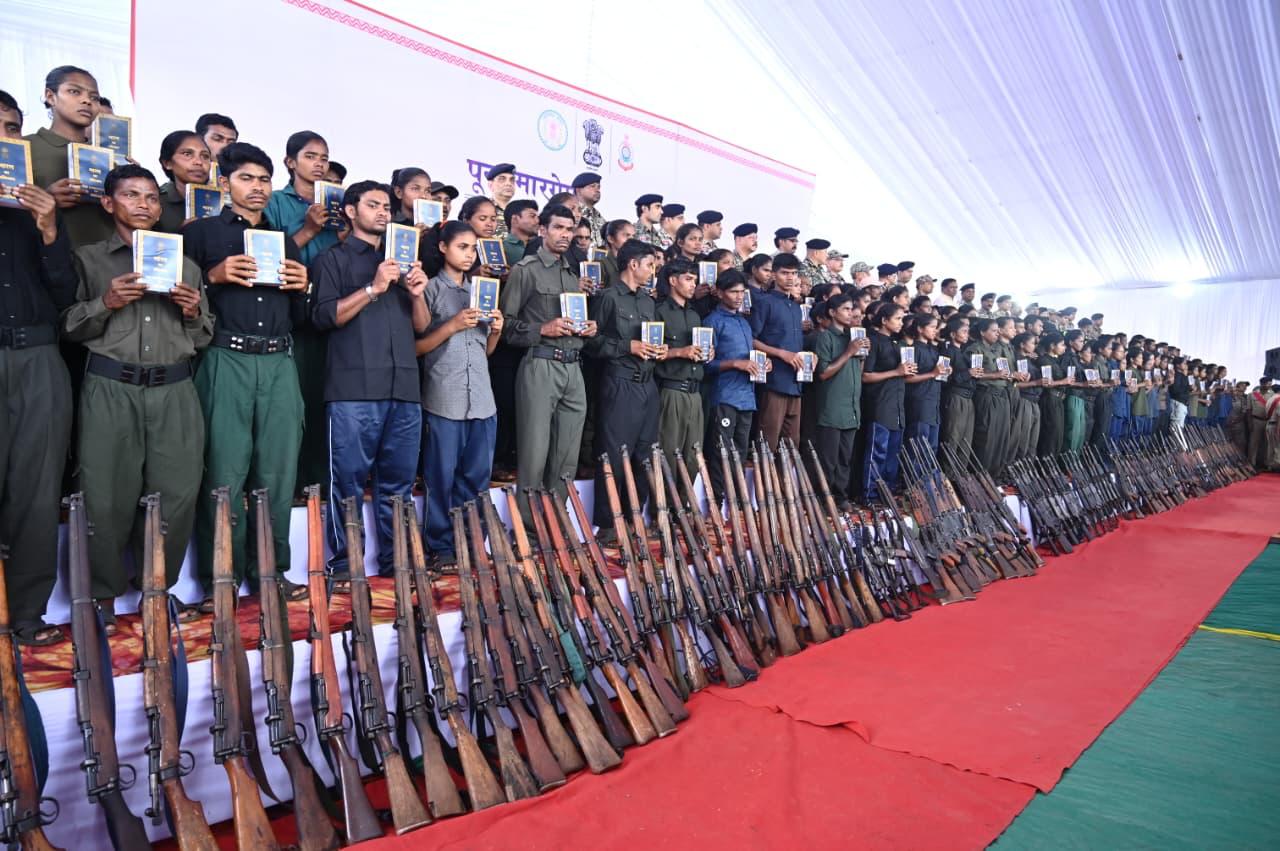
Official records indicate that since January of last year, more than 2,100 insurgents have laid down their arms.
Bhopal:
In a remarkable development within India's long-standing Maoist insurgency, two high-ranking Maoist Central Committee members, Rupesh (also known as T Vasudev Rao) and Sonu (alias Bhupati), have surrendered to authorities, creating widespread anxiety and suspicion within the Maoist organization. The Central Committee has labeled both individuals as "traitors," while security forces describe this as the most significant breakthrough in the Bastar region in recent years.
Rupesh, who had a Rs 1 crore reward on his head, surrendered in Bastar alongside hundreds of fellow fighters on October 17. Meanwhile, Bhupati and 60 of his followers surrendered earlier in Maharashtra. In a massive collective surrender at Jagdalpur, 210 Maoists gave up their armed struggle, surrendering 153 weapons to police authorities. Three busloads of Maoist cadres arrived at police headquarters under heavy security, in what officials are describing as a "historic shift in the Red Corridor."
The radical left leadership responded immediately with shock. Abhay, the spokesperson for the organization's Central Committee, issued a strongly worded statement denouncing both Rupesh and Bhupati as "traitors who betrayed the revolution." The statement alleged that Rupesh had been secretly communicating with government officials and police personnel for months prior to his surrender.
Within two days, Rupesh responded through a video message. In this recording, the formerly feared Maoist commander stated that his decision was not betrayal but part of a broader peace initiative that had been started by general secretary Basavaraju himself, who was killed in an encounter earlier this year. "This was not just my decision," Rupesh explained in the video. "Basavaraju himself wanted to end the armed struggle and explore peace talks with the government. He had even written to the leadership about this before he was killed. We wanted to save our people and our party. There was no other way."
Rupesh disclosed that peace discussions had already commenced at the highest levels of the Maoist leadership. "We had planned to bring the matter to the core committee. The government insisted that we first give up our arms. We were preparing to do that when Basavaraju was killed," he revealed, adding that he had personally communicated with another senior leader, Devji, regarding peace dialogues.
He strongly rejected the Central Committee's accusations of betrayal. "We have not done anything that deserves blame. None of us harmed our comrades. We only want those still inside to come out and see the truth. No one was forced to surrender; it was a decision of conscience."
According to officials, the timing of these surrenders is particularly devastating for the Maoist leadership, which has been steadily losing ground across Chhattisgarh, Maharashtra, and Odisha. The concurrent surrender of two senior Central Committee members is being interpreted as both a psychological and organizational collapse for the Maoist movement.
Official data shows that since January 2024, over 2,100 rebels have surrendered, 477 have been killed in encounters, and 1,785 have been arrested in coordinated operations. Security agencies believe that this wave of surrenders, combined with increasing fatigue among the ranks, directly results from sustained counter-insurgency pressure and diminishing support in forest territories.
The surrender of Rupesh and Bhupati has not only weakened the Maoist organization's leadership structure but also revealed internal divisions. For decades, the Maoist movement has presented a unified ideological front and command structure. However, with Basavaraju's death and two of his senior commanders choosing peace over continued conflict, the Red Corridor is displaying unprecedented fractures.
For the first time, a high-ranking Maoist leader has publicly confirmed that their own General Secretary desired an end to armed struggle—a revelation that may signal the beginning of the end for India's longest-running internal insurgency.
Source: https://www.ndtv.com/india-news/slain-maoist-commander-wanted-peace-talks-rebels-big-post-surrender-claim-9522279