
"India Coming To The Table": Top Trump Aide Ahead Of Trade Talks
Donald Trump's trade adviser Peter Navarro made remarks as the US chief negotiator arrived in Delhi on Monday for a day-long talk on the trade deal.
- Date & Time:
- |
- Views: 58
- |
- From: India News Bull
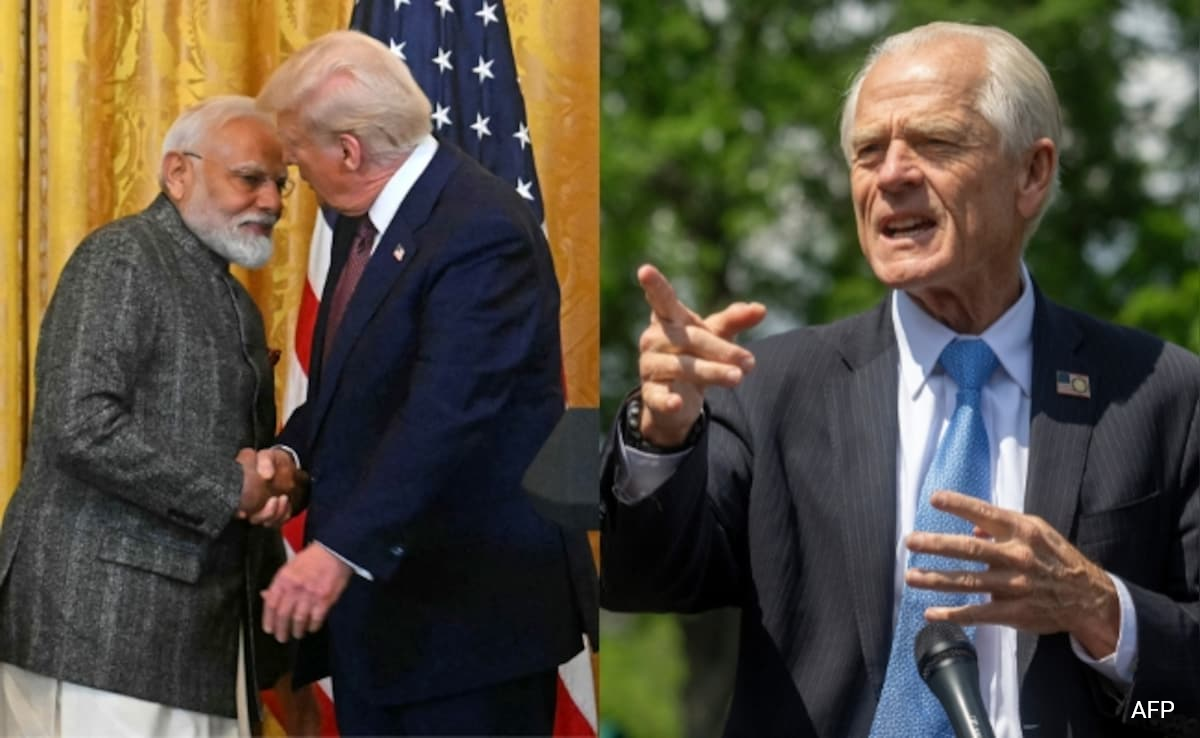
Peter Navarro, President Donald Trump's trade adviser, stated on Monday that India is "coming to the negotiating table," a comment made as a US delegation prepares to arrive in Delhi for crucial bilateral trade discussions with Indian officials.
"India is coming to the table. Prime Minister Modi sent a very conciliatory, constructive tweet, and President Trump responded accordingly. We'll see how this develops," Navarro told CNBC in his remarks.
Last week, President Trump mentioned that the US and India are "continuing negotiations to address trade barriers" between the nations.
"I'm looking forward to speaking with my good friend, Prime Minister Modi, in the coming weeks. I'm confident we'll reach a successful conclusion beneficial for both countries," Trump posted on Truth Social.
In his response, Prime Minister Modi expressed confidence that "our trade negotiations will unlock the unlimited potential of the India-US partnership." He emphasized that India and the US are "natural partners and close friends" in his message on X.
"Our teams are working diligently to conclude these discussions as soon as possible. I'm also eager to speak with President Trump. Together, we'll work toward securing a more prosperous future for our people," Prime Minister Modi stated.
Navarro, who previously described India as the "Maharaja of tariffs," reiterated his position that India maintains the "highest tariffs" among major economies.
"They implement very high non-tariff barriers as well. We need to address this issue, just as we're addressing similar practices with other countries," he explained.
ALSO READ | Peter Navarro Tried To Start Fight Between Trump, PM Modi: Ex US NSA
He also criticized India's purchase of Russian oil, noting that India hadn't engaged in this practice before the Russia-Ukraine conflict began in 2022.
"Indian refiners established relationships with Russian suppliers immediately following the invasion, and they're profiting substantially. It's concerning because they benefit from unfair trade with us, hurting American workers. Then they use those profits to purchase Russian oil, which Russia uses to fund weapons. Meanwhile, American taxpayers bear increased costs for Ukraine's defense," Navarro argued.
Additionally, he suggested that Prime Minister Modi likely felt uncomfortable sharing the stage with Chinese President Xi Jinping and Russian President Vladimir Putin earlier this month.
"Seeing Modi on stage with China, India's long-term existential threat, and Putin was quite remarkable. I don't believe he was comfortable in that situation," Navarro said, referencing the leaders' meeting at the Shanghai Cooperation Organisation summit in Tianjin on September 1.
US Chief Trade Negotiator In Delhi
Navarro's comments came shortly before US chief negotiator Brendan Lynch arrived in Delhi on Monday for day-long discussions regarding the proposed India-US bilateral trade agreement (BTA).
Washington and New Delhi have completed five rounds of negotiations thus far. The sixth round, originally scheduled for August 25-29, was postponed after Trump imposed a 50 percent tariff on Indian goods, including a 25 percent tariff related to India's Russian oil purchases.
"We've previously indicated that discussions are ongoing. The US chief negotiator is arriving in India tonight and will hold talks tomorrow to explore possibilities. This isn't formally the sixth round of negotiations, but rather discussions aimed at determining how we might reach an agreement between India and the US," explained Rajesh Agarwal, India's chief negotiator and special secretary in the commerce ministry, on Monday.
ALSO READ | Not Far Apart On Trade Deal With India: Trump's Ambassador Pick
He further noted that India and the US have maintained regular weekly discussions through virtual channels.
"Discussions have continued, though progress was limited because the overall environment wasn't conducive. Now we see a potential window of opportunity," Agarwal stated.
He clarified, however, that Tuesday's talks shouldn't be considered the formal sixth round of negotiations, but rather a meeting to determine future direction.
"Tomorrow's discussions will serve as a precursor to the sixth round of negotiations," Agarwal concluded.