
'My Friend Narendra...': Decoding Donald Trump's Midnight Birthday Wish For PM
US President Donald Trump's late-night phone call to Prime Minister Narendra Modi - ostensibly for his 75th birthday - has injected fresh momentum into a bilateral relationship battered by stand-offs over the 50 per cent tariffs on Indian exports.
- Date & Time:
- |
- Views: 86
- |
- From: India News Bull
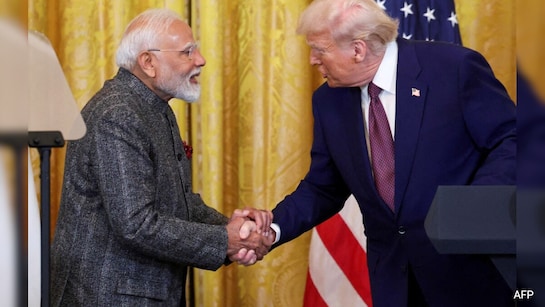
Prime Minister Narendra Modi with US President Donald Trump at the White House in an earlier meeting (File).
New Delhi:
US President Donald Trump's late-night birthday call to Prime Minister Narendra Modi on his 75th birthday appears to signal a potential turning point in bilateral relations that have recently been strained by several contentious issues: 50% tariffs on Indian exports, stalled trade negotiations, and Washington's frustration over India's continued purchase of Russian oil despite sanctions related to the Ukraine conflict.
Analysts widely interpret the call as Trump's olive branch to reset relations after months of tension over various matters, including Trump's unfounded claims regarding the Op Sindoor ceasefire, his push for a Nobel Peace Prize endorsement, and the escalating tariff dispute.
These tensions have overshadowed what experts consider "one of the most consequential partnerships in the Indo-Pacific region, if not globally," culminating in Trump's harsh characterization of India's economy—the world's fourth-largest by nominal GDP—as "dead."
Trump's call therefore carries significant diplomatic weight, but the nuances reveal even more.
Analyzing the Modi-Trump Communication
Perhaps the most telling aspect wasn't the conversation itself but the timing of subsequent social media posts, with PM Modi beating President Trump by 37 minutes—Modi posting at 10:53 pm and Trump at 11:30 pm on his Truth Social platform.
This timing matters because Trump, ever the media-savvy entrepreneur, typically values first-mover advantage in public communications. Consider his previous Truth Social post announcing the Op Sindoor ceasefire before either India or Pakistan made statements, which fueled his unsubstantiated claims of diplomatic brokerage despite India's firm denials.
Similarly, recall his announcement of an Iran-Israel ceasefire in June, apparently surprising both Tehran and Tel Aviv, who were actively exchanging missile strikes at the time.
PM Modi's first-mover advantage in this instance likely unsettled Trump, prompting him to reassert control by referring to the Prime Minister by his first name—a notable first in Trump's social media communications regarding Modi, a familiarity he typically reserves only for Russia's Vladimir Putin and Israel's Benjamin Netanyahu.
Conversely, Modi maintained formal protocol by using "President" in his reference and, unlike previous communications, noticeably omitted calling Trump his "friend," raising additional speculation.
The second significant element concerns both leaders' references to Ukraine.
According to official readouts, Modi expressed "support" for Trump's efforts to end the Ukraine conflict—a war Trump promised to resolve within weeks of his January 20 inauguration.
This reference is widely interpreted as India's reciprocal diplomatic gesture. Trump's attempts to end the Ukraine conflict have been hampered by Vladimir Putin's resistance and Russia's continued ability to sell oil and gas despite sanctions, generating crucial war funding.
The US has previously criticized India, which purchases discounted Russian crude, for indirectly enabling this situation—leading to Trump's additional 25% tariff.
Modi's Ukraine reference appears to placate Trump without committing India to any concrete actions, particularly regarding Russian oil purchases.
Trade Negotiations Gain Momentum
The Trump-Modi call also provided a welcome boost to previously stalled trade negotiations. A bilateral trade agreement has languished as Delhi has resisted Washington's push for access to India's sensitive agricultural and dairy markets.
Modi remains committed to protecting the livelihoods of India's numerous farmers, livestock herders, and fishing communities, especially with key state elections approaching this year and next.
Nevertheless, a sixth round of talks occurred in India this week, with US chief trade negotiator Brendan Lynch meeting India's Rajesh Agrawal. Sources describe the outcome as positive, with Commerce Minister Piyush Goyal suggesting initial agreements could materialize by November.
Lingering Effects of June Communication
These developments unfold against the backdrop of a June phone call where Modi firmly established India's position regarding Trump's ceasefire claims and India's stance on Pakistan-occupied Kashmir.
Since then, the leaders reportedly had not spoken directly, with The New York Times claiming Modi declined four calls from Trump—an unusual diplomatic stance for most global leaders.
Instead, Modi focused on strengthening ties with China and Russia, highlighted by his prominent visit to the Shanghai Cooperation Organisation meeting, signaling an important improvement in Beijing-Delhi relations.
The prospect of India, China, and Russia collaborating closely—the "elephant" and "dragon" dancing together with Russian involvement—would concern Washington, potentially motivating Trump's recent outreach.
This diplomatic reset began with Trump's September 6 social media message stating he would "always be friends" with Modi, who responded with similar warmth.
Tuesday night's birthday call appears to further reinforce this renewed engagement, suggesting India-US relations may be returning to a more productive path.
NDTV is now available on WhatsApp channels. Click on the link to get all the latest updates from NDTV on your chat.