
Bhopal Bypass Collapse: Government Investigation Reveals Multiple Factors Including Construction Deficiencies
- Date & Time:
- |
- Views: 59
- |
- From: India News Bull
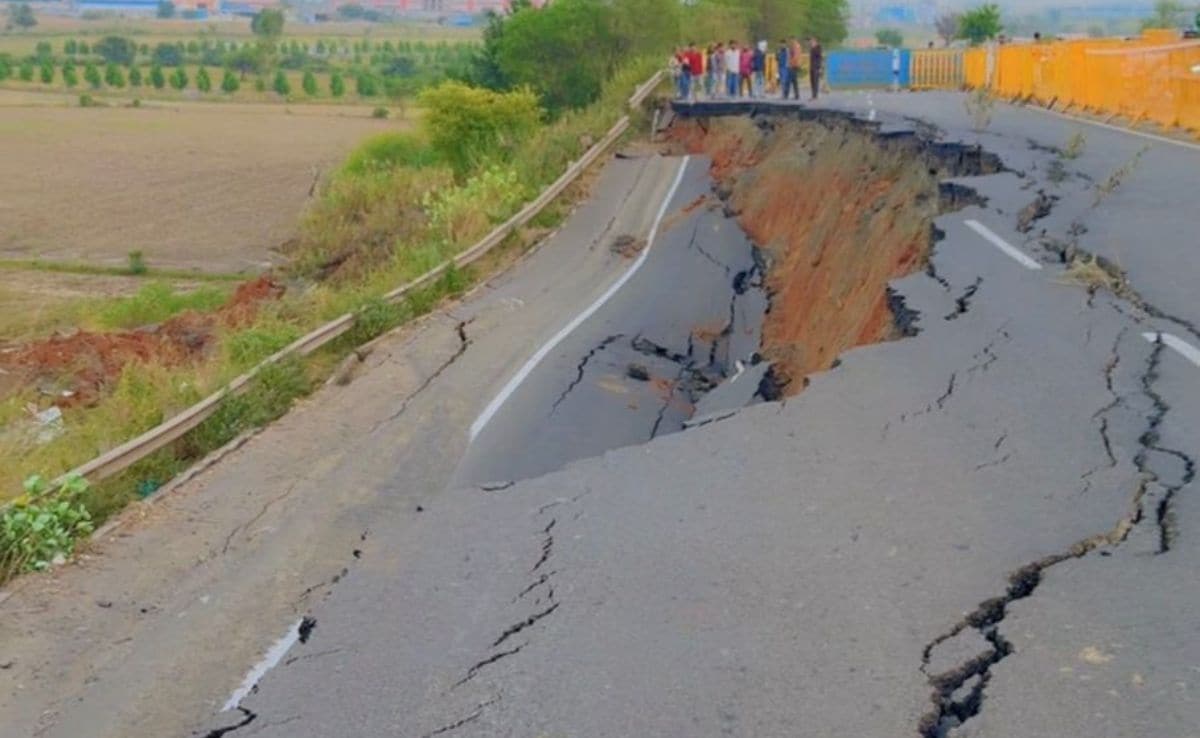
The Bhopal Bypass, constructed at an expenditure of hundreds of crores of rupees, experienced a significant structural failure on Monday.
Bhopal:
A substantial 100-metre section of the Bhopal Bypass collapsed on Monday, creating a massive 30-foot-deep crater and prompting various explanations for the failure. The Madhya Pradesh government's initial investigation points to local farmers who allegedly dug soil near the retaining wall, obstructing drainage systems and causing water accumulation within the embankment, ultimately leading to its collapse.
Fortunately, no injuries or casualties were reported in the incident. The Madhya Pradesh Road Development Corporation (MPRDC) acted swiftly, securing the area with barricades and redirecting traffic to an adjacent lane to maintain regular flow.
Officials confirmed that the road was clear of vehicles when the collapse occurred.
A technical assessment following the incident revealed several construction deficiencies. The reinforced earth (RE) wall failed to meet approved construction standards. Investigators discovered substandard soil was used, and essential stone pitching—designed to prevent erosion and water infiltration—had not been implemented.
The inspection also revealed obstructed drainage around the embankment, partially attributed to farmers excavating soil near the retaining wall. The combination of inferior construction practices, water accumulation, and structural weaknesses caused the embankment to deteriorate during monsoon season, eventually resulting in the collapse.
MPRDC Managing Director BS Meena has established a three-member investigative committee comprising Chief Engineer BS Meena, General Manager Manoj Gupta, and General Manager RS Chandel to conduct a comprehensive inquiry. This committee has been directed to deliver its findings within seven days.
In a statement to NDTV, MPRDC Divisional Manager Sonal Sinha explained, "Approximately 100 metres of the road has collapsed, creating a 30-foot-deep crater. We have assembled a team to investigate the incident. Initial findings suggest the retaining wall failed. The definitive cause will be established once the investigation report is completed."
The Bhopal Eastern Bypass, which serves as a vital connector to major routes leading to Indore, Hoshangabad, Jabalpur, Jaipur, Mandla, and Sagar, was built by M/s Transtroy Private Limited from Hyderabad under the Build-Operate-Transfer (BOT) framework. The project reached completion in 2012-13 under a 15-year concession agreement initiated in 2010.
However, in 2020, authorities terminated the contract due to non-compliance with stipulated terms, and subsequently blacklisted the company for three years. Since then, MPRDC has directly managed the bypass, outsourcing only minor maintenance work as necessary.
Repair operations on the damaged section have commenced, with officials establishing a ten-day timeline for complete restoration. Soil samples have been dispatched to the Public Works Department's Central Laboratory for analysis.
This incident is not the first instance raising concerns about road construction quality in Madhya Pradesh. The Bhopal bypass, despite its substantial construction cost, has experienced recurring maintenance issues since 2020. Engineering experts have frequently cautioned that improper soil compaction, low-quality materials, and neglected drainage systems can destabilize embankments—warnings that now appear prescient.
Source: https://www.ndtv.com/india-news/bhopal-bypass-stretch-collapses-government-report-blames-farmers-9459474