
Climate Change, Strong Winds? What's Behind Rain Fury In Dehradun
Dehradun saw heavy damage after rain triggered flash floods, inundating streets.
- Date & Time:
- |
- Views: 70
- |
- From: India News Bull
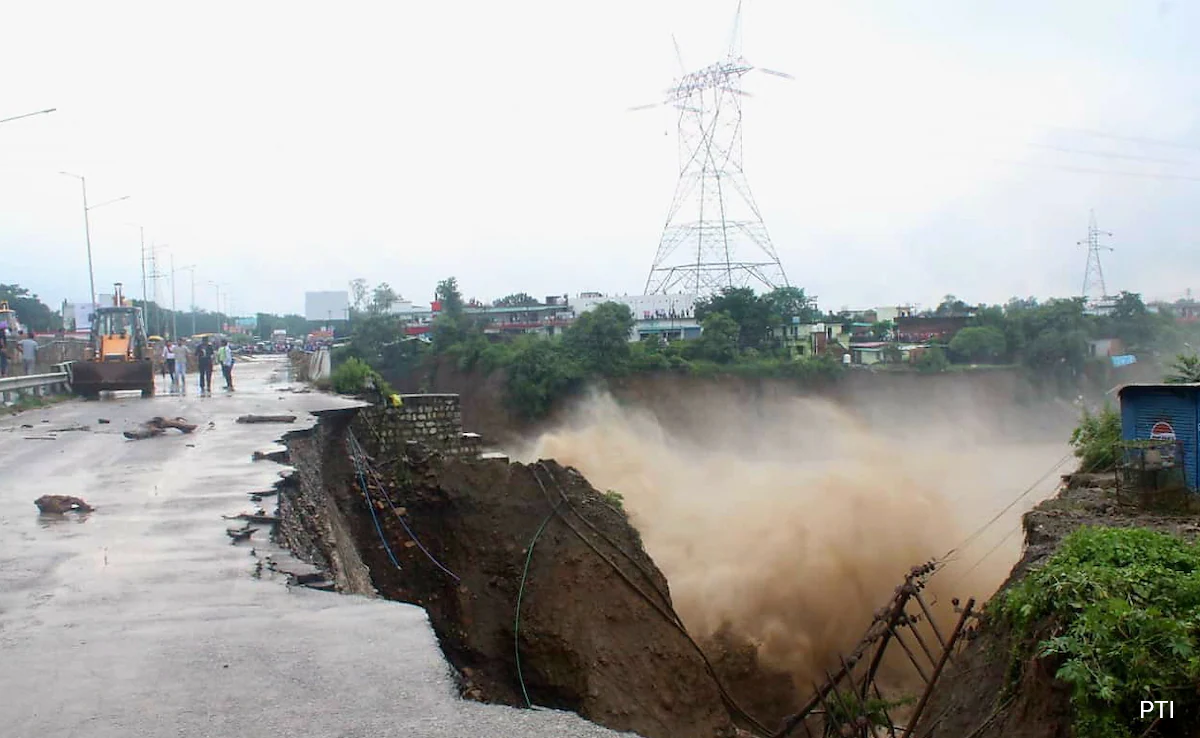
A bridge collapses due to severe rainfall on the Dehradun - Haridwar National Highway.
New Delhi:
Temples and residences inundated, a 100-meter stretch of roadway destroyed, the turbulent Tamsa river raging, and water surging across roads - the footage of extreme precipitation in Dehradun sends shivers down one's spine. While the overnight downpour has caused widespread devastation, it serves as another stark reminder that climate change is an undeniable reality, and we are experiencing its consequences through severe weather events, including flash floods, cloudbursts, and landslides.
"The recent incident involving heavy rainfall in Uttarakhand's Dehradun on Monday night cannot be classified as a cloudburst," Dr. Chander Singh Tomar, Head of India Meteorological Centre, Dehradun, explained to NDTV during a telephone conversation.
Also Read: Temple Submerged, Houses Damaged: Videos Of Dehradun Cloudburst Horror
According to the India Meteorological Department (IMD), a cloudburst is characterized by an intense rainfall event recording 100 mm (4 inches) or more precipitation within an hour over a specific area. Dehradun recorded 67 mm of rainfall per hour, noted Mr. Tomar. "This falls under the category of an extreme, intense rainfall spell," he clarified.
Elaborating on the cause of this sudden rainfall event, Mr. Tomar stated, "Interaction between easterlies (winds flowing from east to west) and westerlies (winds flowing from west to east) or air masses over the region results in heavy precipitation."
The meteorology expert described this as "normal" and mentioned that the rainfall was anticipated, with an "orange alert" issued that will remain active until September 17, 8:30 am.
"Very heavy rainfall is anticipated in Dehradun, Nainital and Champawat. Heavy rainfall in Chamoli, Udham Singh Nagar, Bageshwar and Pithoragarh regions," he further stated.
Also Read: Houses, IT Park Submerged As Heavy Rain Triggers Flash Floods In Dehradun
IMD data indicates that 1103.2 mm of rainfall is considered "normal." Since monsoon's commencement on June 1, Uttarakhand has received 1343.2 mm of rainfall, representing a 22 percent excess.
Within the state, Bageshwar district has experienced 239 percent excess rainfall.
The monsoon variations - surplus or deficit - are typical and not unusual, according to Mr. Tomar.
In contrast, Yaspal Sundriyal, Former Head and Professor, Department of Geology, HNB Garhwal University, linked these changes to climate change.
"Various air masses - cold, warm and occluded - are intersecting with one another, creating a triple junction that leads to severe weather phenomena such as heavy precipitation, thunderstorms and strong winds. This intersection can be attributed to climate change," explained Mr. Sundriyal.
The geologist noted that forest fires generate black carbon and nuclides that combine with clouds, triggering cloudbursts. "This year we haven't witnessed many forest fire incidents, but they have occurred frequently in the past," he added.
"Numerous researchers have discovered that while overall rainfall patterns show a declining trend, instances of extreme rainfall have increased. This means we now experience more concentrated rainfall causing significant damage rather than the same volume spread across several weeks," Mr. Sundriyal elaborated.
The rainfall amount we previously received over four to five days now occurs within a single day or eight to ten hours, resulting in flash floods.