
Drug-Laden Pak Drones Significant Threat To India's Internal Security: Report
A "sharp" spike has been seen in the sightings and recovery of drug-laden drones coming into India from Pakistan across the international border in Punjab over the last four years, posing a "significant" threat to the country's internal security
- Date & Time:
- |
- Views: 51
- |
- From: India News Bull
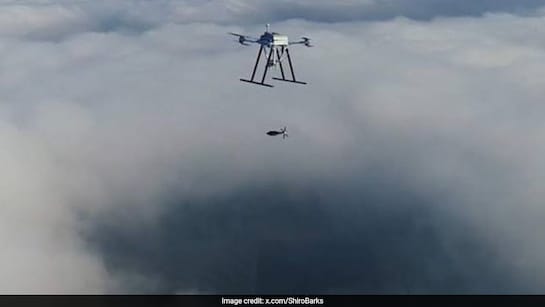
The report indicates approximately 236 kgs of narcotics were recovered. (Representational)
New Delhi:
A "significant" escalation has been observed in the detection and interception of narcotics-carrying drones entering India from Pakistan across the international boundary in Punjab during the past four years, presenting a "considerable" challenge to national internal security, according to a report published on Tuesday.
Counter-narcotics organizations have also recorded a six-fold increase in the confiscation of synthetic narcotics between 2019-24, as stated in the Narcotics Control Bureau's (NCB) annual report for 2024.
The report was unveiled by Union Home Minister Amit Shah during the 2nd national conference of anti-narcotics task force (ANTF) leaders from various states and UTs that he inaugurated on Tuesday.
The NCB functions as a federal anti-narcotics agency under the Ministry of Home Affairs.
"Drone utilization for cross-border narcotics smuggling has developed into a considerable threat to India's internal security, especially along the Pakistani frontier in Punjab.
"This emerging methodology has supplanted conventional smuggling techniques and creates a multifaceted challenge for enforcement and border protection agencies," according to the report accessed by PTI.
It further noted a "dramatic" rise in drone sightings and narcotics recoveries in border districts including Amritsar, Tarn Taran, Ferozepur, and Gurdaspur.
In 2024, such seizures "increased dramatically" to 179 cases compared to merely three cases in 2021. The intercepted drug shipments primarily contained heroin and opium, the report indicated.
Of the 179 drone-facilitated drug trafficking incidents along the India-Pakistan border documented last year, 163 occurred in Punjab, 15 along the same boundary in Rajasthan, and one in Jammu and Kashmir.
Total narcotics recovery amounted to approximately 236 kgs, according to the report.
The document highlighted a "notable" pattern with the interception of six times more synthetic drugs over the previous six years (2019-24) nationwide. These substances included ATS (amphetamine type stimulants), MDMA, mephedrone, and methaqualone, commonly abused by younger individuals.
"In 2024, approximately 11,994 kgs of synthetic drugs were intercepted compared to only 1,890 kgs in 2019. This marked increase is primarily attributed to high profitability and growing market demand for these substances," stated the report compiling nationwide narcotics statistics.
Synthetic drug seizures nationwide during 2020 totaled 1,989 kgs, 657 kgs in 2021, 4,216 kgs in 2022, and 4,209 kgs in 2023.
The report also expressed concern regarding the "substantial" increase in narcotics intercepted from maritime routes since 2020.
In 2024, maritime seizures reached 10,564 kgs, representing a nearly 500-fold increase compared to 2019, it noted.
India's "strategic" position in the Indian Ocean, according to the report, establishes it as a crucial transit point for Afghan-sourced heroin via the southern route.
The 'Death Crescent' (comprising Iran, Afghanistan, and Pakistan) remains the "primary" origin of heroin, ATS, and hashish entering India through the western coastline, while the 'Death Triangle' (Myanmar, Laos, and Thailand) functions as the "main provider" of synthetic narcotics, particularly methamphetamine smuggled through India's eastern shores.
The principal ports for shipping these consignments are Chabahar (Iran) and Gwadar and Karachi in Pakistan, the report indicated.
It also noted a "remarkable" increase in cocaine seizures nationwide.
In 2024, anti-narcotics agencies throughout the country intercepted 1,483 kgs of cocaine, approximately 78 times higher than 2020 seizures and about five times greater than in 2023, according to the report.
Other drugs showing "sharp" increases included mephedrone (also known as 4-MMC or meow meow), a widely abused party drug, with agencies confiscating 3,359 kgs nationwide in 2024 compared to 275 kgs in 2020.
Injectable drug use was identified as a "growing concern" as agencies seized over 2.75 lakh units (injections) valued at Rs 4.54 crore in 2024, with Punjab and Maharashtra experiencing "high volumes" of such seizures, the report stated.
It further revealed that a record 531 detention orders were issued under the rarely utilized provisions of the Prevention of Illicit Traffic in Narcotic Drugs and Psychotropic Substances (PITNDPS) Act, resulting in 483 detentions during 2024, compared to 93 detentions under 107 such orders during 2020.
The Union home ministry has been encouraging anti-drug agencies to employ PITNDPS more frequently to target drug syndicates, kingpins, and financiers. The Act provides for "detention of persons involved in any manner with illicit traffic in narcotic drugs and psychotropic substances for one or two year(s) to prevent them from engaging in such harmful and prejudicial activities".
The NCB report also mentioned the emergence of a new synthetic substance called mescaline. The appearance of this psychedelic drug indicates a "shift" toward synthetic hallucinogens.
Approximately 25.04 kgs of mescaline were intercepted by agencies in 2024, according to the report.