
Drying Of The Ganga In Recent Decades 'Unprecedented' In Past Millennium: Study
- Date & Time:
- |
- Views: 52
- |
- From: India News Bull
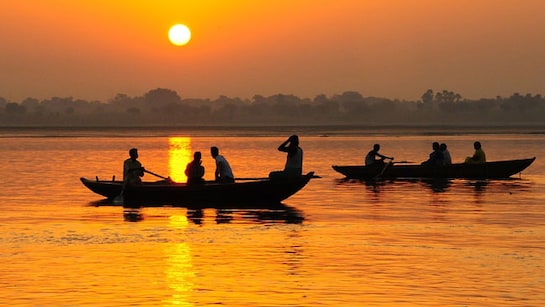
The mid-14th century was identified as the third most severe drying period for the Ganga river basin
New Delhi:
Recent analysis spanning 1,300 years reveals the Ganga river basin's current drying trend may be the most severe in a millennium, posing significant threats to water and food security for hundreds of millions of people.
Research published in the Proceedings of the National Academy of Sciences indicates that "drying from 1991 to 2020 is unmatched in the past millennium".
Scientists from IIT Gandhinagar and the University of Arizona have attributed the Ganga's drying to decreased southwest monsoon rainfall (June-September). Their comprehensive study combined contemporary instrument data, historical records, and water flow models from 1991-2020, while reconstructing flow patterns for the previous 1,300 years (700-1990 CE).
"The Ganga River basin, critical to over 600 million people, is experiencing a severe and unprecedented drying trend, threatening water and food security," according to the researchers.
The study found that the drying observed since the 1990s, characterized by frequent and prolonged droughts, "is 76 percent more intense than the 16th century drought -- the closest historical analogue."
Researchers estimated a significant 9.5 percent decline in total annual rainfall during 1951-2020, with western India experiencing a more dramatic reduction exceeding 30 percent.
Despite climate change models predicting intensified rainfall, the researchers noted that rapid Indian Ocean warming combined with subdued warming across the subcontinent has weakened the monsoon over northern India.
Additionally, reduced rainfall has diminished groundwater recharge, while excessive extraction for irrigation further exacerbates the Ganga's drying condition.
While previous research suggested increased water flow in the river basin under continued climate change due to enhanced rainfall and glacier melt, this study highlights the complexity of predicting water availability in a warming climate.
The researchers emphasize the urgent need for additional studies examining interactions between factors influencing monsoon rainfall, including both natural long-term climate variations and human-induced changes.
Based on abnormal flow patterns observed over the past three decades, researchers projected that the second most severe drying of the Ganga occurred during 1501-1530, aligning with evidence of increased aridity in northern India during the early 16th century.
The mid-14th century (1344-1373) was identified as the third driest period for the Ganga river basin.
"Overall, the river drying during 1991-2020 is unprecedented and more severe than its nearest two historical analogues during the entire record of 1,300 years," the researchers concluded.