
Video: Shubhanshu Shukla Explains Space Life In Perpetual Free Fall
- Date & Time:
- |
- Views: 50
- |
- From: India News Bull
Indian astronaut Shubhanshu Shukla has provided a fascinating glimpse into the reality of "falling forever" while aboard the International Space Station (ISS).
In a captivating video shared on X, Mr Shukla demonstrates the peculiar physics of space as he changes a camera lens. The footage shows him working with two cameras that hover freely around him. After removing a lens from one camera and releasing it, instead of dropping downward as it would on Earth, the equipment simply remains suspended in mid-air. He then reattaches the lens and releases the camera again, which continues to float effortlessly.
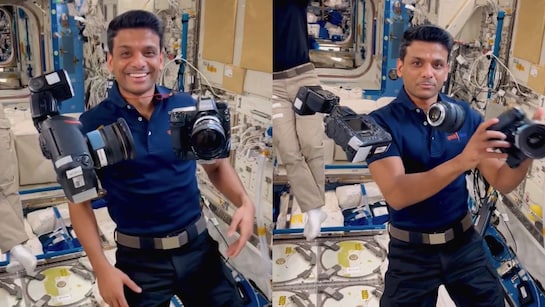
"Believe it or not - Everything you see in this frame is falling," Mr Shukla wrote in his post, illuminating one of the most counterintuitive aspects of spaceflight.
He clarifies that objects on the ISS don't appear to fall because both the astronaut and all items are orbiting Earth at identical velocities. This creates a situation where there is "no relative falling = no 'down'" sensation.
Mr Shukla traces this orbital concept back to Isaac Newton's renowned thought experiment. He explains that while a ball thrown from a mountain would normally descend to the ground, if propelled with sufficient speed, it would continuously fall around Earth without ever making contact. This perpetual falling without landing defines the nature of orbit.
"It's falling forever, but it never hits the ground," he explained on X.
The astronaut candidly shares that during his initial days on the ISS, he struggled to overcome terrestrial instincts. He found himself hesitant to release objects, concerned they would drop as they do on Earth. This led him to carefully hand items to fellow crew members rather than simply letting go.
His colleagues exhibited similar caution, resulting in what he humorously describes as an "overly careful game of 'hot potato.'"
Contrary to common misconceptions, Mr Shukla emphasizes that astronauts remain subject to gravity's influence.
"Astronauts don't feel weightless because gravity has disappeared-gravity up here is still about 90% as strong as at Earth's surface. We feel weightless because we and everything around us are constantly falling together. Floating in space is really just falling-forever," he concludes.