
Bihar's Sadaqat Ashram To Host Congress Top Body Meet: Between Memory And Mirage
- Date & Time:
- |
- Views: 50
- |
- From: India News Bull
Bihar's Sadaqat Ashram To Host Congress Top Body Meet: Between Memory And Mirage
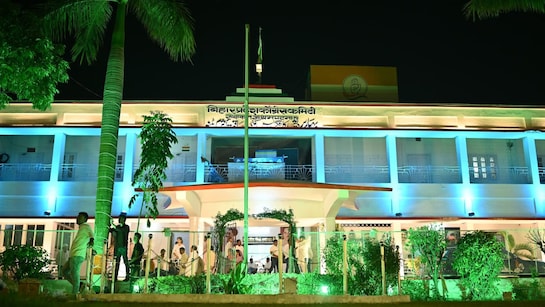
The Sadaqat Ashram embodied the foundational "Idea of India" at its inception.
Along the gentle curves of the sacred Ganga River, where its waters slow to embrace Patna, stands Sadaqat Ashram – an institution resembling less a political stronghold and more a silent witness to history's passage. The ashram's expansive 20-acre grounds, with its modest structures, shaded courtyards, and simple verandahs, have observed India's unfolding narrative through both significant and ordinary moments. In 1940, this tranquil sanctuary briefly became the nation's political epicenter. Mahatma Gandhi arrived with his ascetic simplicity; Jawaharlal Nehru brought his youthful modernist vision; Rajendra Prasad represented Bihar's steadfast character. The Congress Working Committee convened here, deliberating not merely tactical matters but the very destiny of a nation, at a time when freedom remained an aspiration struggling against British colonial rule. It was here that the Sadaqat Ashram nurtured the conceptual "Idea of India."
In Urdu, Sadaqat signifies truthfulness and honesty
Revisiting its historical significance, Sadaqat Ashram (with "Sadaqat" meaning truthfulness, honesty and integrity in Urdu) was established in Patna by Maulana Mazharul Haque in July 1921, on land contributed by his associate Khairun Miyan, as a center for independence activities. Conceived as "an honest refuge," the ashram served as both home and gathering place for prominent national leaders including Mahatma Gandhi, Pandit Jawaharlal Nehru, Dr. Rajendra Prasad (who spent his final years here), Maulana Abdul Kalam Azad, JB Kripalani, Anugrah Narayan Sinha, and Jayaprakash Narayan. It functioned as a headquarters for the national movement and an educational institution for students boycotting government universities. The ashram houses the Bihar Vidyapeeth headquarters, a national university. The campus also includes the Kamala Nehru Balika High School and Kamala Nehru Shishu Vihar School, providing education for underprivileged children. Additionally, it features the Rajendra Smriti Sangrahalaya museum, displaying Rajendra Prasad's personal possessions.
Eighty-five years after the landmark 1940 CWC meeting, the ashram is once again being prepared and adorned for another gathering of the same committee, though it now oversees a Congress Party vastly different in influence and character. Party officials invoke phrases like "India's second freedom struggle" and describe Bihar as "the political centre of India." Their rhetoric is ambitious, their messaging insistent. Yet the contrast is inescapable. In 1940, Congress embodied the nation's heartbeat; today, it registers as merely a faint pulse in Bihar, struggling with single-digit representation in an assembly it once commanded.
Past as destiny, present as mathematical calculation
The irony is unmistakable. Where these walls once resonated with freedom's forging, they now echo with more fragile contemporary slogans. During Mahatma Gandhi's era, Congress spoke for millions whose only weapon was hope. In present-day Patna, Congress discusses coalitions, seat distributions, and survival strategies – the vocabulary of a diminished political force. The past concerned matters of destiny; the present revolves around political arithmetic.
Yet dismissing this ceremonial return as merely hollow would overlook something fundamental about Indian politics, which thrives on historical symbolism. By reconvening at Sadaqat Ashram, Congress seeks to borrow gravitas, to stand in the shadow of its giants, and to suggest that the struggle continues – that freedom requires ongoing defense, whether against colonial rule then or the current majoritarian dominance of the ruling NDA. History, in this narrative, serves not simply as record but as resource, a wellspring from which to draw legitimacy.
Congress must transform itself before attempting to transform the nation
Nevertheless, visitors to Sadaqat Ashram cannot escape the dissonance. The neem trees, weathered walls, and river-mist atmosphere remind us that history echoes rather than repeats itself. Mahatma Gandhi's India was conceptualized and shaped in these spaces; today's Congress must first reinvent itself before claiming the authority to reshape the nation.
Patna, once a revolutionary crucible, now hosts a party struggling for political relevance. The 1940s Congress could engage in debates about freedom's pace and India's conceptual framework; the 2025 Congress must contemplate its very survival. Thus, Sadaqat Ashram functions as both venue and metaphor – a place where freedom once found voice, and where rhetoric now attempts to summon historical ghosts.
A question lingers in these misty courtyards: are we witnessing rebirth or merely remembrance? In Patna's autumn stillness, it remains unclear whether history is poised to repeat itself or is simply being rehearsed.
Movement versus Memory
The contrast illustrates what the ashram's walls silently acknowledge: that Congress in 1940 represented a movement carrying an entire nation's aspirations, while in 2025 it exists as a party leaning on historical memory to stabilize itself.
Then, leaders spoke of sacrifice because power remained an aspiration; now, they speak of struggle because power has receded into memory. Krishna Allavaru's invocation of a "second freedom struggle" as Congress Party leader in Bihar highlights both the ambition and irony of today's Congress – seeking revival by borrowing from its historical aura. However, Bihar's pragmatic electorate will evaluate not the echoes of Mahatma Gandhi's footsteps in Patna's dust but the credibility of Congress's current platform. Sadaqat Ashram thus functions as both shrine and mirror: a place where history was once created, and where, in 2025, the question remains whether history can be recreated – or merely commemorated.