
'Caste Census' Begins In Karnataka, Technical Glitches Reported In Some Parts
- Date & Time:
- |
- Views: 51
- |
- From: India News Bull
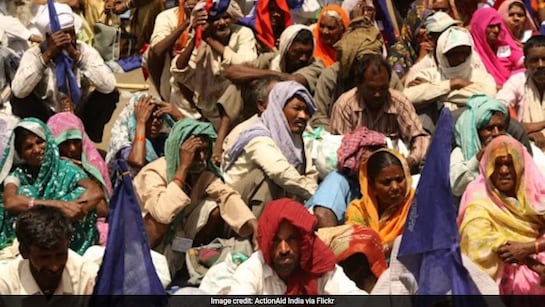
The commission is anticipated to deliver its report to the government by December. (Representational)
Bengaluru:
On Monday, the Social and Educational Survey, commonly referred to as the 'caste census' in Karnataka, began with enumerators conducting door-to-door data collection.
While the survey is progressing in most parts of the state, officials have indicated a possible delay of one or two days in the Greater Bengaluru area, where five new corporations have been formed, due to ongoing training and preparation requirements.
The Karnataka State Commission for Backward Classes is conducting the survey with approximately 1.75 lakh enumerators, primarily government school teachers, who will gather data from around 7 crore people across roughly 2 crore households throughout the state.
"The survey is in progress, and we have received reports from various locations," official sources confirmed.
However, reports have emerged of technical glitches and server issues in several areas, including Shivamogga, Haveri, Ballari, Chitradurga, and Kodagu districts, causing delays in some locations.
In many affected areas, the survey resumed after the technical problems were resolved, according to sources.
Officials have stated that the survey, estimated to cost Rs 420 crore, will be conducted "scientifically" using a 60-question questionnaire specifically designed for this purpose.
The commission is expected to submit its findings to the government by December.
Amid criticism and objections from various sections, including within the ruling Congress, regarding the prepared caste list containing dual identity castes such as 'Kuruba Christian' and 'Brahmin Christian', the commission has clarified that the names of these castes will be "masked" but not removed.
Backward Classes Commission's Chairman Madhusudan R Naik clarified on Sunday that the list of castes in the survey handbook is solely for internal use and lacks legal sanctity. It was designed merely to help enumerators locate castes in alphabetical order.
He explained that the app used for the survey will not display the 33 castes with dual identities, as they have been masked. Nevertheless, citizens remain free to declare them voluntarily.
Officials stated that each household will be geo-tagged using its electricity meter number and assigned a Unique Household ID (UHID).
During data collection, ration cards and Aadhaar details will be linked to mobile numbers.
For those unavailable during the survey and to address any grievances, a dedicated helpline number (8050770004) has been established. Citizens can also participate online, officials added.
The Karnataka High Court announced on Monday that it will hear arguments on September 23 regarding whether the ongoing survey should be stayed.
A batch of petitions challenging the legality of the survey is currently before the High Court bench.
The survey is taking place amid efforts by various castes and community groups to consolidate their respective populations, aiming to ensure their numerical strength is accurately represented.
In an effort to consolidate their caste strength, seers and leaders of the Vokkaliga community, a dominant group, have instructed their members to identify their religion as 'Hindu' and caste as simply 'Vokkaliga', with "sub-caste to be mentioned only if absolutely necessary."
A delegation of Vokkaliga Congress leaders met with AICC President Mallikarjun Kharge to request postponement of the survey. They expressed concerns about inadequate preparation and training, questioning how the survey could be completed in just 15 days and suggesting a three-month timeframe instead.
There appears to be some confusion among another dominant community, the Veerashaiva-Lingayats, as leaders have advised community members to use their own judgment when stating their religion, while encouraging them to mention Veerashaiva-Lingayat in the caste column. Some within the community have suggested identifying Veerashaiva-Lingayat as a religion rather than Hindu.
Several other communities, including Kurubas, Muslims, Scheduled Castes, and Brahmins, have also held strategic discussions to decide how to identify themselves during the survey to consolidate their numbers.
The BJP has accused the Congress government of conducting the survey "hastily" to "divide Hindus" and questioned the necessity of the exercise when the Centre has already announced caste enumeration in the national census.
State BJP President B Y Vijayendra charged the Congress government with attempting to divide Hindu society, calling it "unfortunate."
He described the caste census as a "misadventure" by the state government, which he claims lacks the authority to conduct such a survey.
The government had previously spent Rs 165.51 crore on a Social and Educational Survey in 2015, which was later discarded.
On June 12, the Karnataka Cabinet approved a fresh survey, effectively nullifying the 2015 exercise, citing Section 11(1) of the Karnataka State Commission for Backward Classes Act, 1995, which mandates a revision of the state backward classes list once every 10 years.
Several communities, particularly Karnataka's two dominant groups—Vokkaligas and Veershaiva-Lingayats—have expressed strong reservations about the 2015 survey, describing it as "unscientific" and demanding a new enumeration. Opposition voices have also emerged from within the ruling Congress party.