
India-Russia Summit 2025: Strategic Partnership Amid Global Tensions and Western Sanctions
- Date & Time:
- |
- Views: 56
- |
- From: India News Bull
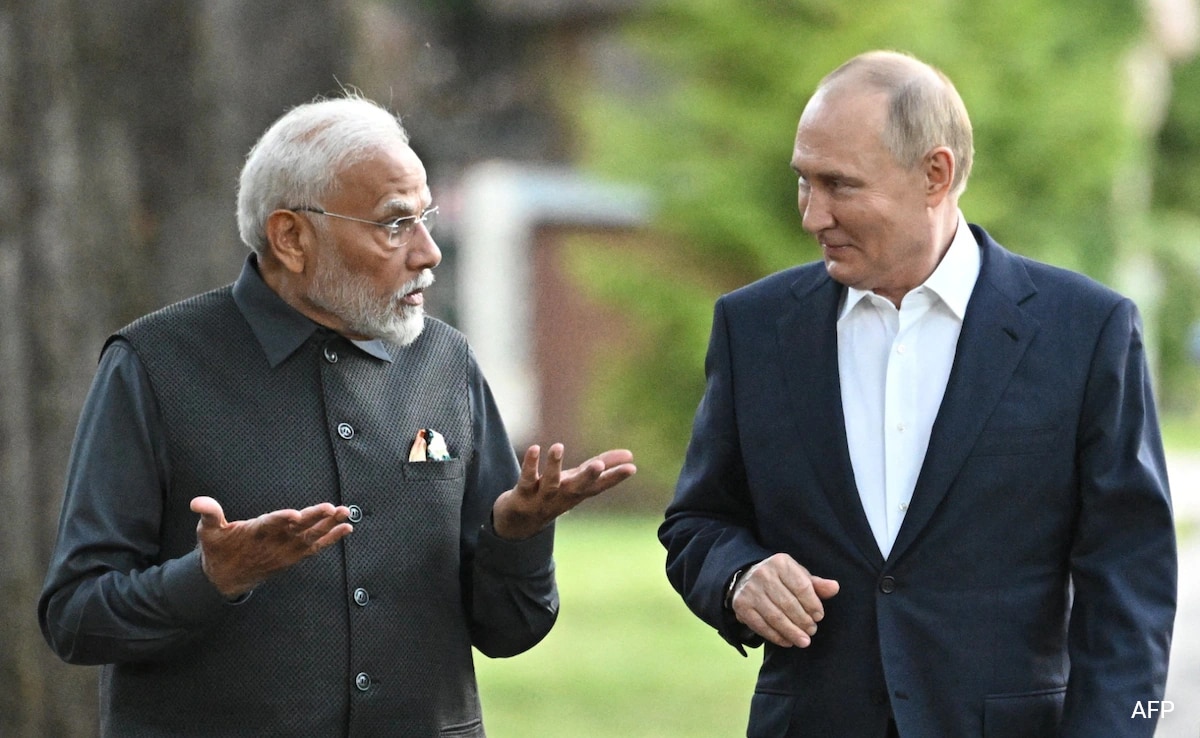
Russian President Vladimir Putin is scheduled to arrive in India tomorrow for a two-day summit with Prime Minister Narendra Modi. This marks his first visit to India since 2021, as part of the 23rd bilateral annual summit. Prime Minister Modi had previously traveled to Moscow in July last year for the 22nd summit.
This meeting comes at a particularly challenging time for both leaders. Putin faces significant pressure from the United States to end the Ukraine conflict, while Modi has experienced perhaps his most difficult year in foreign policy, including a brief conflict with Pakistan and deteriorating relations with the US. India is also operating under the shadow of the Sanctioning Russia Act of 2025 and faces pressure to reduce its profitable oil imports from Russia, for which it currently pays a 25% tariff penalty on exports to the US. Additionally, India continues to navigate the Countering America's Adversaries Through Sanctions Act (CAASTA) through special waivers for Russian defense equipment purchases.
The visit aims to revitalize the India-Russia relationship, which has seen stronger periods in the past. In the current turbulent geopolitical environment, both nations view this as an important opportunity, and reports indicate that the carefully prepared summit will yield significant outcomes.
Regarding oil transactions, India's gradual reduction of Russian oil purchases presents a challenge for Moscow, requiring New Delhi to find a balanced approach. Currently, private refiners like Reliance, Mangalore Refinery, and Hindustan Petroleum have ceased purchases, while some state-owned refiners such as Indian Oil and Bharat Petroleum are resuming purchases from non-sanctioned suppliers. Moscow believes this decline will be temporary and is working to establish alternative trade mechanisms to circumvent sanctions.
The defense relationship constitutes another critical aspect of bilateral ties. India's military cooperation with Russia dates back to the Cold War era, when Russia became the first nation to supply India with submarines and supersonic fighters that Western suppliers had denied. Currently, 60-70% of Indian military equipment is Russian, including T-90 tanks, Su-30MKI and Mig-29 fighters, the INS Vikramaditya aircraft carrier, and eight Krivak class frigates, with the latest commissioned in July this year.
Russian defense systems, particularly the Almaz-Antey S-400 Triumf surface-to-air missile systems and the jointly developed BrahMos missiles, demonstrated exceptional performance during India's four-day Operation Sindoor against Pakistan. While India contracted five squadrons of S-400 systems, it has received only three so far due to Russia's Ukraine commitments, but reports suggest India may order five more. Although there has been speculation about acquiring the more advanced S-500 Prometheus system and the fifth-generation Su-57 fighter, such purchases currently seem unlikely.
However, India and Russia are expected to proceed with developing the Brahmos-II, based on the Russian Zircon scramjet-powered hypersonic cruise missile. While the Brahmos-I has a speed of Mach 2.2 and range of 400 km, the Brahmos-II could achieve Mach 8 speeds with a range of up to 1,000 km.
Last November, Bharat Dynamics signed an agreement with Russia's Rosoboronexport to jointly manufacture the Pantsir self-propelled anti-aircraft and missile system, intended to replace approximately 1,200 outdated L-70 40 mm and ZSU-4 Schilka anti-aircraft guns in the Indian Army.
India is also considering purchasing the Russian Almaz-Antey Voronezh long-range early warning radar to address the Chinese threat, providing early detection of ballistic missiles, stealth aircraft, and drones. The plan envisions at least 60% domestic production of this system.
A significant advantage of India's arms relationship with Russia is Moscow's willingness to provide advanced systems without the preconditions typically attached to American equipment, which often include on-site inspections. Nuclear-propelled submarines exemplify this advantage. Russia assisted India in building its first such vessel, the INS Arihant, with two subsequent submarines constructed in Vishakhapatnam with substantial Russian assistance. As India considers developing nuclear attack submarines, which offer greater speed than ballistic missile submarines, Russia will likely play a crucial role.
Russia has further supported India by leasing nuclear-propelled submarines, helping the Indian Navy gain experience operating such vessels. Beginning in 1988, Russia leased attack submarines designated as INS Chakra, with a successor vessel leased for ten years in 2012. In 2019, the two nations agreed on a $3 billion lease for a new Akula-class submarine, though India has not yet received this vessel for various reasons.
India recognizes that Western systems often offer more advanced technology than their Russian counterparts and has been gradually diversifying its arms imports. However, certain critical technologies like submarines and missiles such as BrahMos remain unavailable from Western sources. While India is making determined efforts to reduce dependence on foreign suppliers, both Russian and Western, this transition requires time.
Trade represents another important agenda item. Currently, Russian exports to India amount to $65 billion, primarily from oil, while India's exports to Russia remain at a modest $5 billion. Both countries are committed to addressing this imbalance. They plan to develop alternative payment systems to circumvent Western restrictions and will discuss reducing India's trade deficit by significantly increasing exports to Russia, with very small modular nuclear reactors identified as one potential export category.
Putin's visit will reinvigorate Russia-India relations. In today's volatile geopolitical landscape, this visit from a longstanding and reliable partner will be welcomed in India. The United States will closely monitor the outcomes, particularly regarding oil purchases and additional arms agreements between India and Russia.
India must also consider European Union perspectives, as tensions between Brussels and Moscow remain high. Maintaining strategic ties with Russia while deepening partnerships with the US and EU presents a particularly challenging balancing act, especially as negotiations over the Ukraine conflict intensify.
India faces the complex task of reconciling these competing interests.
(The writer is a Distinguished Fellow, Observer Research Foundation, New Delhi)
Disclaimer: These are the personal opinions of the author
Source: https://www.ndtv.com/opinion/brahmos-ii-to-more-s-400s-heres-everything-india-is-expecting-from-putins-visit-9742719