
From IIT Kharagpur to Google: How Room B-308 Shaped Sundar Pichai's Extraordinary Journey
- Date & Time:
- |
- Views: 41
- |
- From: India News Bull
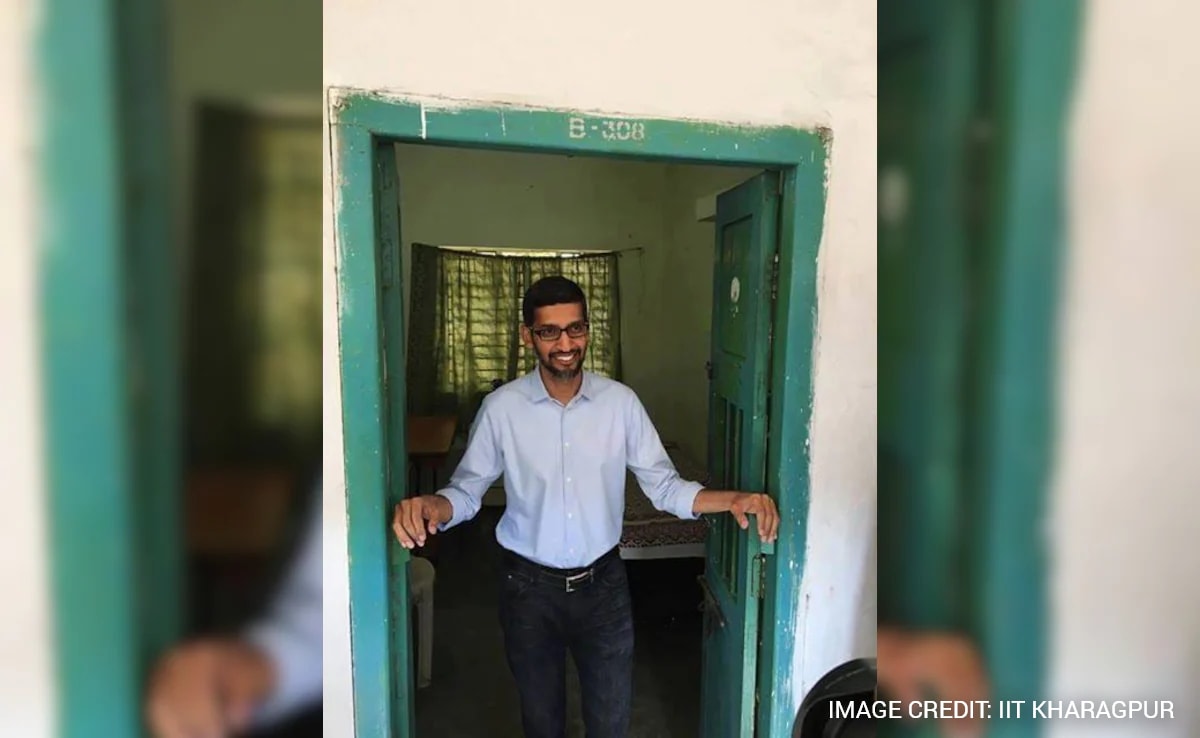
Google CEO Sundar Pichai once resided in Room B-308 at IIT Kharagpur during his undergraduate studies in metallurgical engineering.
Within the historic corridors of IIT Kharagpur's Nehru Hall of Residence stands Room B-308, a modest space that has become an emblem of extraordinary potential. This unassuming room once housed Sundar Pichai, who would later rise to become the CEO of Google and Alphabet, during his B.Tech studies in metallurgical and materials engineering.
When Pichai was a student, few could have predicted that someone from a branch considered less prestigious in the engineering hierarchy would eventually lead one of the world's most powerful technology corporations.
Photo Credit: IIT Kharagpur
Room B-308 epitomizes simplicity - a standard IIT hostel accommodation with basic furnishings including a bed, study desk, chair, and storage cabinet. Currently, Harshit Raj, a final-year Chemical Engineering student, occupies this historically significant space. Reflecting on his unique housing situation, Harshit notes: "It used to feel quite normal, but today, I think it might change a bit."
This seemingly ordinary room represents much more than physical space - it witnessed the formative years of a visionary who would later transform the global technology landscape.
In India's traditional engineering hierarchy, Computer Science typically commands the highest prestige, while fields like metallurgical engineering rank considerably lower in student preference. Yet Pichai's remarkable journey challenges this conventional wisdom. His success illuminates a profound truth: your ultimate achievement depends less on your academic specialization and more on the comprehensive skills you develop. During an interaction with IIT students, Pichai emphasized, "Getting real world rounded experience and soft skills are equally important."
Pichai's time at IIT Kharagpur transcended mere technical education in metallurgy. These years cultivated essential qualities like resilience, adaptability, and intellectual curiosity - attributes that later enabled him to excel in technology's dynamic environment. Pichai candidly admits his academic performance during his first year was "embarrassing," though he significantly improved in subsequent years.
Interestingly, Pichai has revealed that during the 1980s as an IIT student, he had considerable free time which he often spent programming in FORTRAN. He has also noted that his first encounter with a computer occurred at IIT, and coincidentally, his first airplane journey happened when he departed for further studies abroad after graduating.
After completing his education at IIT Kharagpur, Pichai pursued advanced degrees at Stanford and Wharton before joining Google in 2004. His career progression was remarkable - from developing the Google Toolbar to leading Chrome and Android initiatives. In 2015, he assumed the role of Google CEO, later extending his leadership to Alphabet, guiding the company through revolutionary developments in artificial intelligence and cloud computing.
The foundation for this extraordinary career was established in Nehru Hall, where he likely developed crucial skills in independent living, peer collaboration, and innovative thinking. During a town hall meeting with IIT Kharagpur students, Pichai advised: "Real life is so different, follow your dreams, do what you enjoy and not what you are pressured into, life will play out as one himself shapes it."
Room B-308 also harbors a personal chapter in Pichai's life story - it was during his IIT years that he met his future wife, Anjali Pichai, who was his classmate. Their relationship developed on campus, adding a romantic dimension to this room's legacy. In a conversation with IIT Kharagpur students, Pichai reminisced about waiting outside Sister Nivedita Hall for Anjali. This aspect of his story reminds current students that university experiences shape not only professional trajectories but also meaningful personal relationships.
Harshit Raj, the room's current occupant, nurtures his own aspirations. Though studying Chemical Engineering, he aspires to work in Artificial Intelligence - a field central to Google's strategic focus.
Photo Credit: Pallava Bagla
"When I first cleared JEE Advanced, I didn't know what my calling would be. But gradually, I thought AI would be the thing I am more inclined to," Harshit explains.
While Harshit hasn't yet contacted Sundar Pichai, he intends to do so eventually. "I suppose this is one thing that I would certainly do in future," he mentions.
Photo Credit: Pallava Bagla
The narrative of Room B-308 offers a powerful message for students everywhere. Success often emerges from exploring possibilities beyond one's immediate academic discipline. Pichai himself acknowledges that "getting into an elite institution does not guarantee success."
As demonstrated by Pichai's journey, a metallurgy graduate can indeed lead a global digital enterprise. The comprehensive IIT experience - encompassing dormitory life, friendships, and diverse exposure - plays a crucial role in developing visionary leaders.
Today, while Room B-308 remains physically unchanged, it emanates an inspirational aura. Pichai himself has observed that "the Nehru Hall looks exactly the same." For countless IIT aspirants and current students, this room stands as tangible evidence that extraordinary achievement can emerge from ordinary beginnings. As Harshit aptly expresses: "Of course, that's the feeling everyone would want to experience at least once."
Photo Credit: Pallava Bagla
From studying metallurgy to leading Google, from a simple hostel accommodation to Silicon Valley executive offices - Sundar Pichai's story exemplifies the transformative impact of Indian education combined with essential life skills.
Source: https://www.ndtv.com/india-news/how-iit-kharagpur-shaped-google-ceo-sundar-pichai-beyond-metallurgy-9729069