
"Why Did Osama Feel Safe In Pak?": S Jaishankar On Islamabad's Terror Links
Foreign Minister S Jaishankar, who is currently in Brussels to meet the European Union (EU) leaders, has called on the West to view New Delhi's action against Pakistan following the terror in Kashmir as an India vs terrorism issue.
- Date & Time:
- |
- Views: 62
- |
- From: India News Bull
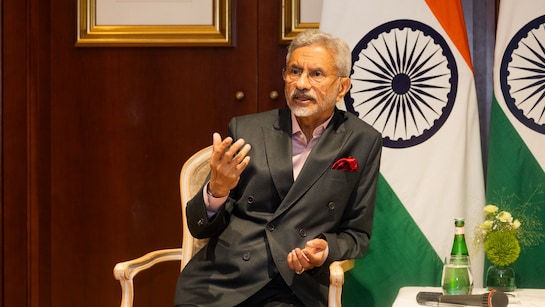
Indian Foreign Minister Addresses Pakistan's Terror Links During EU Visit
Brussels:
During his diplomatic visit to Brussels to engage with European Union (EU) leadership, Foreign Minister S Jaishankar has urged Western nations to recognize India's actions against Pakistan following Kashmir terror incidents as a fight against terrorism rather than merely a border dispute between neighboring countries. In his interview with Euractiv, the Minister also shared insights on Europe's evolving geopolitical landscape and expressed optimism for strengthened EU-India relations.
India is currently midway through negotiations on a comprehensive free trade agreement with the EU, seeking to expand its partnerships amid strengthening Russia-China relations.
Addressing Pakistan's Terror Connections
Jaishankar expressed concern about international media portraying India's Operation Sindoor following the Pahalgam terror attack as simply reciprocal actions between nuclear-armed neighbors.
"Consider this - Osama bin Laden. Why would someone like him choose to live securely for years in a Pakistani military town, adjacent to their military academy equivalent to West Point?... This isn't simply an India-Pakistan matter. It's about terrorism. The same terrorism that will eventually affect others globally," he emphasized.
On Russia-Ukraine Conflict
When questioned about India's decision not to join Western sanctions against Russia following its Ukraine invasion, the Foreign Minister reaffirmed India's position that military conflicts cannot yield lasting solutions.
"We maintain that differences cannot be resolved through warfare - solutions won't emerge from battlefields. We're not prescribing specific solutions, but we are certainly not uninvolved in seeking peace," he stated.
He highlighted India's strong relationships with both Ukraine and Russia, while noting that Western nations historically supported Pakistan during its post-independence invasion of India.
"Every nation naturally considers its own experiences, history and interests. India has endured longstanding grievances - our borders were violated shortly after independence when Pakistan sent infiltrators into Kashmir. And which countries most supported that action? Western nations," he pointed out.
"If these same countries, who were ambiguous or hesitant then, now advocate for discussions about international principles, I believe I'm justified in asking them to reflect on their past actions."
West's Changing Geopolitical Dynamics
Jaishankar observed the evolving geopolitical landscape in the West, noting that multipolarity is already a reality.
"Europe now faces the necessity of making more independent decisions - utilizing its own capabilities based on the global relationships it cultivates.... I notice terms like 'strategic autonomy' increasingly used in Europe - concepts that were once primarily in our vocabulary," he remarked.
He characterized the EU as a major and increasingly independent pole in the global order.
"This precisely explains my presence here: to strengthen our partnership in this multipolar world," he added.
Regarding EU's Climate Tax
Jaishankar expressed that India continues to have "significant reservations" about the EU's Carbon Border Adjustment Mechanism (CBAM) - a tax imposed on products from regions with less stringent climate policies.
"Let's be clear - we oppose certain aspects of it. We have profound concerns about CBAM, and we've been transparent about this. The concept that one region can establish standards for the entire world is something we fundamentally oppose," he stated.
On Trump and US Relations
The Foreign Minister also discussed India's expanding relationship with the United States across administrations, including under Donald Trump.
"I approach the world pragmatically. Our objective is to advance every relationship that serves our interests, and our relationship with the US holds immense importance. It transcends specific personalities or presidents," he explained.
On China
Jaishankar presented India to the EU as a nation of 1.4 billion people offering skilled workforce and a more reliable economic partnership than China.
"I recently met with several European companies in India that have established operations there specifically to diversify their supply chains. Many businesses are increasingly cautious about where they store their data - preferring security and trustworthiness over mere efficiency," he noted.
"Would you want critical assets in the hands of entities you're uncomfortable with?"