
Impossible To Ignore China In Confrontation With Pak: Shashi Tharoor
Congress leader Shashi Tharoor emphasised that a thaw in relations between Delhi and Beijing over the past few months was "seemingly making good progress" before the conflict.
- Date & Time:
- |
- Views: 69
- |
- From: India News Bull
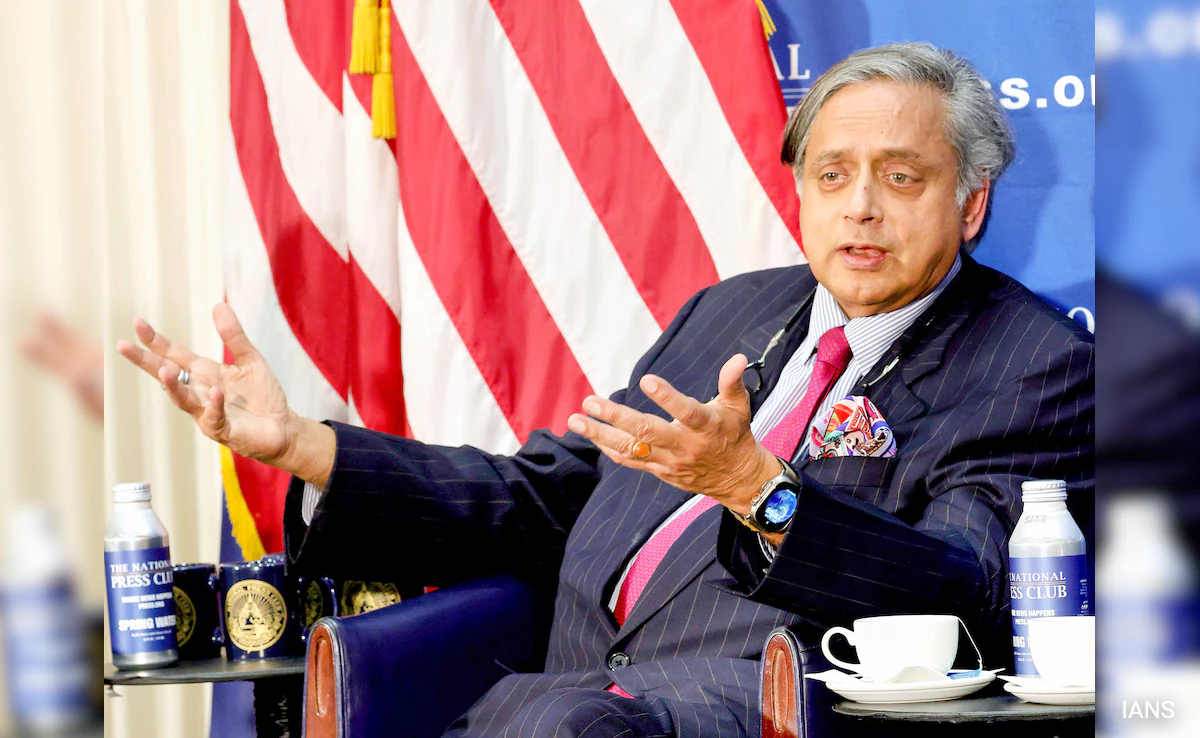
China Remains Unavoidable Factor in India-Pakistan Tensions, Says Tharoor
Washington:
During a think tank interaction at the Indian Embassy in Washington on Thursday, Congress leader Shashi Tharoor declared that China represents an "absolutely impossible factor to ignore" in India's ongoing confrontation with Pakistan. Tharoor, currently heading a multi-party parliamentary delegation to the United States, emphasized that a diplomatic warming between Delhi and Beijing had been "seemingly making good progress" in recent months before the latest conflict erupted.
"I'm not going to mince my words, but we are aware that China has immense stakes in Pakistan," Tharoor stated candidly. He highlighted that the China-Pakistan Economic Corridor stands as the largest individual project within China's Belt and Road Initiative, while noting that 81 percent of Pakistani defense equipment originates from China.
"Defense may be the wrong word here. Offense in many ways," he remarked pointedly.
"China is an absolutely impossible factor to ignore in what has been our confrontation with Pakistan," Tharoor reiterated.
The Congress leader observed that despite tensions between China and India following the June 2020 Galwan Valley incidents, "we had actually begun a thaw with China in September of last year, which was seemingly making good progress before this tragedy occurred."
Tharoor further noted that "then we saw a very different China" regarding its practical support for Pakistan, particularly at the Security Council.
"We have no illusions about what the challenges are in our neighbourhood, but I want to remind you all that India has consistently chosen a path of keeping open channels of communication, even with our adversaries," he emphasized.
"We have tried as much as possible to focus on development, on growth, on trade. Our trade with China is still at record levels. It's not that we are adopting a posture of hostility, but we would be naive" not to recognize these surrounding dynamics, Tharoor added.
Currently, Pakistan holds a non-permanent seat on the UN Security Council.
Following the April 22 Pahalgam attack, the UN Security Council issued a press statement on April 25 condemning the "terrorist attack in Jammu and Kashmir" in "the strongest terms".
"The members of the Security Council underlined the need to hold perpetrators, organisers, financiers and sponsors of this reprehensible act of terrorism accountable and bring them to justice," the statement declared.
However, the press release omitted mentioning The Resistance Front as the responsible organization after Pakistan, with Chinese support, successfully lobbied for the group's name to be removed.
In October last year, India and China established a disengagement agreement for Depsang and Demchok, the final two friction points in eastern Ladakh. Shortly after finalizing this agreement, Prime Minister Narendra Modi and Chinese President Xi Jinping held discussions in Kazan, Russia, making several decisions to enhance bilateral relations.
External Affairs Minister S. Jaishankar met with Chinese Foreign Minister Wang Yi in November last year on the G20 Summit sidelines in Rio de Janeiro, with the two ministers meeting again in Johannesburg in February this year.
During a conversation at the Council on Foreign Relations earlier in the day, when questioned about Pakistan's use of Chinese military equipment against India and potential reassessments, Tharoor responded: "Frankly, the reassessment took place while the fighting was going on."
He elaborated that when India observed Pakistan's tactics using Chinese technology, particularly the 'kill chain' system where radar, GPS, aircraft, and missiles are integrated for instant response, "we simply did things in a different way. Otherwise, we wouldn't have been able to hit" 11 Pakistani airfields and "we wouldn't have been able to breach the Chinese-supplied air defences.
"So it's clear that assessments were taking place while the fighting was happening, and we were recalibrating our strategies in order to end as effectively as we were able to end," Tharoor explained. "The fact is China has immense stakes in Pakistan, the largest single project on the Belt and Road Initiative is the one in Pakistan - the China-Pakistan Economic Corridor. So we have no illusions about the degree of commitment that China may well be feeling towards Pakistan."