
Opinion | Will Nepal Really See A Return Of The Monarchy?
In a striking reversal of roles, pro-royal forces in Nepal are out on the streets, demanding the reinstatement of the Hindu monarchy, nearly two decades after King Gyanendra was shunted out of his office.
- Date & Time:
- |
- Views: 55
- |
- From: India News Bull
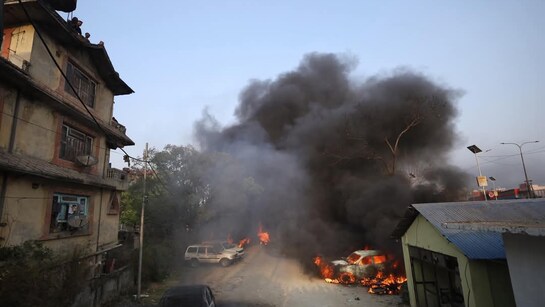
A massive crowd marched toward Prime Minister KP Sharma Oli's Baluwatar residence from downtown Kathmandu, chanting slogans supporting the restoration of Nepal's Hindu monarchy, which was abolished in 2008. The demonstrators, led by former Home Minister Kamal Thapa, attempted to breach the police security cordon.
This incident occurred on June 1. Police responded with batons as protesters persisted. Security forces eventually deployed tear gas to prevent the crowd from entering the Prime Minister's compound. As demonstrators dispersed, police apprehended Thapa, notably restraining him with bindings on his hands and legs before forcibly placing him in a police vehicle. Thapa and fellow detainees were released several hours later.
A Dramatic Role Reversal
Such confrontations have become increasingly common in contemporary Nepal. Thapa, who leads the Rastriya Prajatantra Party (RPP) Nepal, previously served as Home Minister during the 2006 nationwide uprising that ultimately ended the country's constitutional monarchy. During that period, discontented with King Gyanendra Shah's direct rule, countless thousands demonstrated for nearly a month demanding the abolition of the centuries-old Hindu monarchy. The government, comprised of the King's appointees, authorized police to fire upon protesters. Over two dozen demonstrators lost their lives, many others suffered injuries, and thousands faced detention.
Nevertheless, the protests continued unabated. This nationwide movement ultimately forced King Gyanendra to abandon the Royal Palace, concluding a 239-year tradition. Nepal was subsequently declared a Republic, with India, China, the United States and other influential nations endorsing this political transformation. The former royal residence, Narayanhiti Royal Palace, was later converted into a museum.
Now, almost twenty years later, monarchists like Thapa are leading street demonstrations with considerable support. The former rulers who suppressed the people's movement under King Gyanendra's direction have now become the protesters themselves—a complete reversal of roles in less than two decades.
Multiple Actors Enter the Political Arena
Currently, supported by a frustrated populace, pro-royalist forces are mobilizing, promising to restore the King to Narayanhiti Royal Palace. To strengthen their position, smaller political parties, academics, and sympathizers have joined this movement advocating for the reinstatement of constitutional monarchy. The royal family actively supports these protests, hosting lunches for movement leaders and issuing statements defending the campaign.
Public support for the previously dethroned monarchy has grown for various reasons. Nepal faces a worsening economic crisis, resulting in nearly double the number of citizens leaving the country for employment compared to previous decades. Alleged involvement of several ruling leaders in high-profile criminal activities—including smuggling, human trafficking, and fraudulent refugee and visa schemes—has intensified public dissatisfaction. To date, not one case has received proper investigation, with only junior officials being held responsible. Therefore, it was unsurprising when King Gyanendra's return from Pokhara—after visiting numerous Hindu shrines during his weeks-long stay in Kathmandu—drew thousands to the airport to escort him to his residence, Nirmal Niwas. Capitalizing on this popular discontent, Gyanendra has been meeting with fragmented pro-monarchy parties. Two such parties—one under Thapa's leadership and another led by Rajendra Lingden—have mobilized their supporters.
Consequently, confrontations have escalated as major republican parties mobilize their own adherents. On Monday evening, police intervened to prevent violence between the Young Communist League (YCL), the Maoist youth wing, and royal family supporters when former princess Himani Shah and her son Hridayendra attended a memorial procession for family members lost in the 2001 Royal Palace massacre.
Constitutional Challenges
Nepal's current constitution provides minimal accommodation for monarchist demands. Legal experts see no pathway within the existing constitutional framework. Amending the document to restore the Hindu monarchy would require securing a two-thirds parliamentary majority in the 2027 election. This seems improbable for monarchist groups, who hold very few parliamentary seats under the complex electoral system.
Given these constraints, pro-royalists are attempting to negotiate arrangements with political parties that might reinstate at least a ceremonial monarchy. However, most major parties maintain strict opposition to monarchist forces.
The monarchists have also begun openly lobbying neighboring countries, including India, for international support. The Indian establishment, which facilitated the 2006 agreement between Maoist rebels and parliamentary parties to abolish the monarchy, has shown little sympathy for the current protesters. China maintains a similar position. Generally, most major Nepalese political parties maintain stronger relationships with both India and China than monarchist groups do.
Another complication involves succession uncertainty within the royal family itself. Gyanendra has already served twice, while his son Paras remains unpopular. Only Gyanendra's grandson Hridayendra, currently studying in the United States, is viewed by some as a potential future monarch.
Given these complexities, constitutional reinstatement of monarchy appears impossible for now. Unable to secure the required majority, pro-monarchists would need to compel the government to enter negotiations. This would require mainstream parties—who currently maintain the advantage—to agree to dialogue. Nevertheless, it remains unlikely they will yield to pro-royalist demands.
(The author is a journalist based in Nepal)
Disclaimer: These are the personal opinions of the author